



Why Solar Installers Use Smaller Inverters (It's Not What You Think)
That "undersized" inverter on your solar quote isn't a cost-cutting trick—it's an engineering strategy that could save you thousands. Hook: Your installer just quoted you 28 solar panels (12.3kW) with inverters that max out at 9kW. Are you getting ripped off?
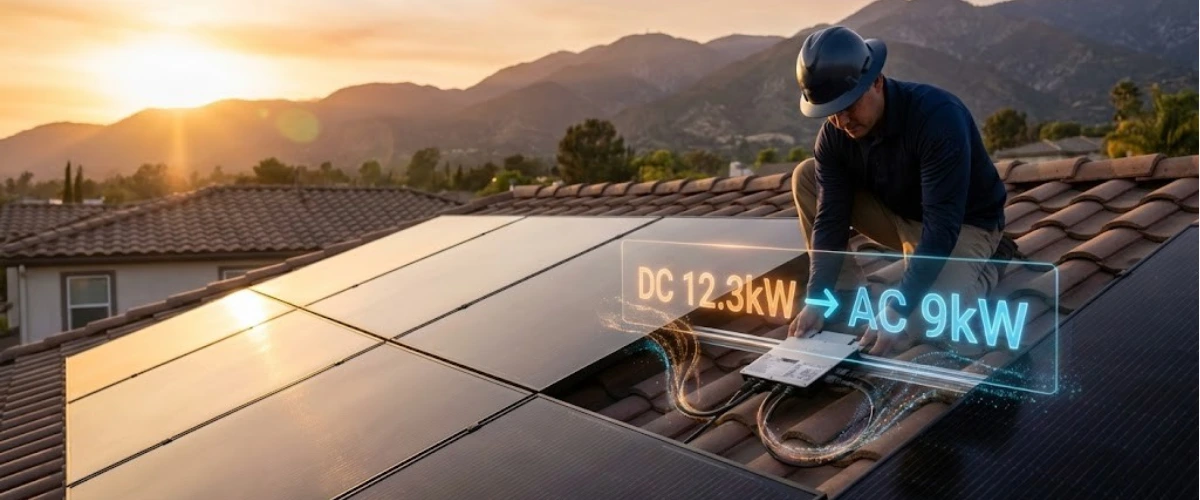
You're comparing solar quotes, and something doesn't add up. The proposal shows 28 panels rated at 440 watts each—that's 12.3 kilowatts of solar power. But the inverters? They're only rated for 9 kilowatts total.
Your first thought: "Am I losing power? Why would I pay for panels that can't even run at full capacity?"
You're not alone. This is one of the most common—and most misunderstood—aspects of solar system design. The truth? That "undersized" inverter isn't a mistake or a cost-cutting scheme. It's actually one of the smartest parts of your system. Here's why.
How DC/AC Ratios Actually Work (Without the Engineering Degree)
First, let's clear up what we're actually talking about. Your solar panels generate DC (direct current) electricity. But your home runs on AC (alternating current)—the same power the grid delivers. Inverters bridge that gap by converting DC to AC.
Here's the key: solar panels are rated under ideal laboratory conditions (77°F, perfect sun angle, zero haze). In the real world, they rarely hit that number.
Why panels underperform their rating:
- Heat reduces output: A 90°F roof can drop panel efficiency by 10-15%
- Angle matters: Unless the sun is directly overhead, you're losing production
- Atmospheric conditions: Haze, humidity, and even clean air quality affect output
- Seasonal variations: Winter sun is less intense than summer sun
According to solar engineers, panels typically produce about 75-80% of their rated capacity under normal operating conditions. So those 440-watt panels? They're realistically generating 330-350 watts most of the time.
If you're still wondering whether solar panels need an inverter at all, the short answer is yes—and choosing the right inverter size is just as critical as the panels themselves.
The 1.35 DC/AC Ratio: Industry Standard for a Reason
Solar engineers have landed on an optimal ratio: about 1.35 to 1.4 times more panel capacity (DC) than inverter capacity (AC).
Here's the math on your 28-panel system:
- Panel capacity (DC): 28 × 440W = 12,320 watts (12.3kW)
- Inverter capacity (AC): 28 × 320W = 8,960 watts (9kW)
- DC/AC ratio: 12.3 ÷ 9 = 1.37
That's right in the sweet spot.
What Happens at Different Ratios
Ratio too low (1.0 or less): You've matched your inverter to your panel rating. Sounds logical, right? But now your inverters are sitting idle most of the year, never reaching their full potential. You paid for capacity you're not using.
Ratio too high (1.6+): You're clipping significant amounts of power during peak production hours. While some clipping is fine, excessive clipping means you're genuinely losing potential production.
Ratio at 1.35-1.4: This is where the magic happens. Your panels feed the inverters at or near capacity for most of the day, and you only clip during the absolute peak sun hours—which is a tiny fraction of annual production.
Why "Clipping" Isn't the Villain You Think It Is
Let's address the elephant in the room: clipping.
Clipping happens when your panels produce more DC power than your inverter can convert to AC. That excess gets "clipped" off—essentially lost. It sounds wasteful, but here's the reality check.
Clipping Loss vs. Undersizing Loss
Scenario A: Oversized System (1.37 ratio like yours)
- Clipping occurs maybe 2-3 hours per day during summer
- Affects roughly 3-5% of your annual production
- The other 95%+ of the year, you're producing more than you would with smaller panels
Scenario B: "Perfectly Matched" System (1.0 ratio)
- Zero clipping, ever
- But your inverters are underutilized 80% of the time
- You produce 15-20% less energy annually
The math is clear: you'd rather clip a little bit during perfect conditions than underperform constantly.
Inverter Efficiency Sweet Spot
Here's another factor most homeowners don't know: inverters are most efficient when operating between 50-100% of their rated capacity.
Running an inverter at 30% capacity all the time is less efficient than running it at 90% most of the time, even if you clip occasionally at 100%. Modern inverters (like the ones US Power uses with QCells solar panels) maintain 95%+ efficiency across this range, so the losses are minimal.
When Oversizing Your System Matters Even More
In Southern California, there's an additional factor that makes proper DC/AC ratios even more critical: NEM 3.0.
Under California's current net metering policy, the value of exported solar energy is significantly lower than it was under NEM 2.0. This means storing your solar energy in battery storage systems has become essential for maximizing savings.
How Batteries Change the Clipping Equation
When you add battery storage to your system, clipping becomes even less of a concern. Here's why:
Without batteries: Clipped energy is lost. Your inverter hits its max, and any excess DC power has nowhere to go.
With batteries: Excess DC power can charge your battery directly, bypassing the inverter entirely for storage. You're not losing that peak production—you're banking it for evening use when SCE rates are highest.
This is why US Power recommends slightly higher DC/AC ratios (1.35-1.4) for NEM 3.0 systems. You're not just optimizing for grid export—you're optimizing for self-consumption and battery charging.
Microinverters vs. String Inverters: Does Clipping Work the Same?
Your Reddit research probably turned up debates about microinverters versus string inverters. The good news? The DC/AC ratio principle applies to both—but there are nuances.
Microinverter Systems (Like Your Quote)
Each panel gets its own small inverter. If you have 28 panels with 320W microinverters:
- Each panel's production is capped at 320W AC output
- Clipping happens at the panel level
- Shading on one panel doesn't affect the others
String Inverter Systems
Multiple panels connect in series to one larger inverter:
- Total system DC feeds into one inverter
- Clipping happens at the system level
- More flexibility when some panels produce less (they can "borrow" unused inverter capacity)
Both approaches work. The key difference is that string systems with optimizers can sometimes reduce clipping in scenarios where panels face different directions or experience partial shading. But for straightforward rooftop installs, microinverters offer better panel-level optimization and easier troubleshooting.
For a deeper dive into the technical differences, check out this guide on microinverter vs string inverter setups.
What US Power Does Differently with System Design
At US Power, we don't just slap panels on your roof and call it a day. Our CSLB-licensed consultants analyze your specific situation:
Your Custom DC/AC Analysis Includes:
Roof characteristics: Direction, pitch, shading, available space
Energy usage patterns: When you use power, not just how much
Local climate data: Southern California sun intensity, seasonal variations
Future needs: EV charging, home additions, lifestyle changes
We use American-made QCells panels manufactured in Dalton, Georgia—not imported panels with inflated specs. QCells provides real-world performance data, not just lab ratings, so we can design systems that actually deliver the promised production.
Our standard DC/AC ratios:
- Solar-only systems: 1.25-1.35 (conservative clipping)
- Solar + battery systems: 1.35-1.45 (optimized for self-consumption)
- EV charging systems: 1.4-1.5 (maximizing daytime production)
Every system comes with our 25-year comprehensive warranty covering panels, workmanship, and performance. If your system doesn't produce what we promised, we make it right.
What to Ask Your Installer About DC/AC Ratios
Don't take anyone's word for it—including ours. Here are the questions you should ask any solar company:
Critical Questions for Your Consultation
"What's the DC/AC ratio of this system, and why did you choose it?"
A good installer will explain the reasoning. A bad one will dodge the question or claim "it doesn't matter."
"How much annual clipping should I expect?"
Any answer above 5-7% is a red flag. You're oversized too aggressively.
"Can you show me production modeling for different scenarios?"
Reputable companies use software like Aurora or Helioscope that shows monthly production estimates, clipping losses, and system performance.
"What happens if my roof layout changes this ratio?"
Space constraints might force suboptimal ratios. Make sure your installer explains the tradeoffs.
"Will adding batteries change your inverter recommendation?"
If they say no, they're not thinking about NEM 3.0 optimization.
Before signing anything, make sure you understand the basics covered in this guide on things you must know before going solar in California.
Red Flags: When DC/AC Ratios Signal a Bad Deal
Not all solar companies have your best interests at heart. Here's when to walk away:
Warning Sign #1: Ratio Below 1.2
This screams "we're using cheap, oversized inverters to pad our margins." You'll have a system that underperforms for 25 years.
Warning Sign #2: Ratio Above 1.6
Unless you have a very specific reason (like massive battery arrays), this is aggressive clipping territory. You're paying for panels whose power you'll never use.
Warning Sign #3: They Can't Explain It
If your installer can't articulate why they chose a specific inverter size, they're either inexperienced or deliberately hiding something.
Warning Sign #4: "It's Industry Standard"
"Industry standard" without context is a cop-out. The right ratio depends on your location, roof, usage, and goals. One size does not fit all.
Want to make sure you're working with a reputable company? This guide on how to choose a solar company in Los Angeles will help you vet installers properly.
Why Getting This Right Matters Before December 31, 2025
Here's the urgency factor: the 30% federal solar tax credit expires at the end of this year. Starting January 1, 2026, it drops to 26%—and continues declining until it hits zero for residential systems.
On a $30,000 system:
- 30% tax credit in 2025: $9,000 back
- 26% tax credit in 2026: $7,800 back
- You lose $1,200 by waiting
But here's the critical part: a properly optimized DC/AC ratio can make a $30,000 system perform like a $35,000 system. That extra production translates to hundreds of dollars more in annual savings—which means you recover your investment faster and maximize the value of that 30% tax credit.
An undersized system with perfect inverter matching might cost $27,000, but if it produces 15% less energy over 25 years, you've lost far more than the $3,000 you "saved" upfront.
Learn more about maximizing the federal solar tax credit before time runs out.
The Southern California Advantage: Why Your Location Matters
You're in one of the best solar markets in the world. Southern California's consistent sunshine means you can push DC/AC ratios slightly higher than other regions without excessive clipping.
Why SoCal is different:
- 300+ sunny days per year: More opportunities for peak production
- Minimal seasonal variation: Your system produces well even in winter
- High electricity rates: SCE and other utilities make solar savings dramatic
- NEM 3.0 incentivizes batteries: Higher ratios work better with storage
This means that 1.37 ratio we discussed earlier? In Phoenix, it might cause more clipping. In Seattle, it might not produce enough. But in Los Angeles, Orange County, Ventura, San Bernardino, or Riverside? It's perfect.
US Power's exclusive partnership with QCells means we're using panels specifically tested for California conditions. We know exactly how they'll perform on your roof because we've installed thousands of them across Southern California.
Your Next Step: Get a System Designed for Real-World Performance
That 12.3kW system with 9kW of inverters? It's not undersized—it's optimized.
You're getting a system designed by engineers who understand California's solar landscape, NEM 3.0 realities, and real-world panel performance. Not by salespeople trying to hit quota with the cheapest components.
Here's what happens next:
- Free consultation: Our CSLB-licensed experts analyze your roof, usage, and goals
- Custom design: We create a system optimized for YOUR situation—not a cookie-cutter template
- Transparent pricing: Factory-direct QCells pricing, 15-20% below market rates
- Fast installation: 3-6 weeks from approval to producing power
- 25-year warranty: Comprehensive coverage on panels, workmanship, and performance
Don't let confusing specs keep you from making a smart decision. Understanding the 3-6 week installation timeline means you can still meet the December 31 tax credit deadline—if you act now.
Making the Right Choice for Your Home
Your solar installer isn't trying to rip you off with "smaller" inverters. They're using proven engineering principles to maximize your system's annual production, efficiency, and return on investment.
A 1.35-1.4 DC/AC ratio means:
- ✅ Your inverters run at peak efficiency most of the time
- ✅ You produce 15-20% more energy annually than "matched" systems
- ✅ Minimal clipping losses (3-5% vs. 15-20% underproduction)
- ✅ Better ROI and faster payback period
- ✅ Optimized for NEM 3.0 and battery storage
The question isn't whether your system is undersized—it's whether you're ready to start saving on electricity bills while there's still time to claim the maximum tax credit.
Ready to see what a properly engineered solar system looks like for your home?
US Power's team is standing by to design a system that actually delivers the production and savings you deserve. No games, no gimmicks—just honest engineering and factory-direct pricing on American-made QCells panels.
The 30% tax credit won't wait. Neither should you.
Frequently Asked Questions
Will I actually lose power from clipping?
Should I get bigger inverters to eliminate clipping?
Not unless you have unlimited budget and don't care about ROI. The cost of larger inverters rarely justifies the minimal additional production you'd gain.
Mostly, yes. Batteries can store excess DC power that would otherwise be clipped, making slightly higher DC/AC ratios even more beneficial.
What's the difference between microinverters and string inverters for clipping?



Bought a House with Solar? Here's How to Pick the Right PG&E Rate Plan
PG&E wants you to choose a rate plan, and you have no idea which one won't cost you.
Solar Production Winter vs Summer in California: What to Expect in 2025
Most homeowners are shocked to learn their solar panels shut off during outages.

Affordable Solar Financing Options in Southern California
Save more with affordable and smart solar financing or cash option with US Power.







Derechos de autor © 2025 US POWER | Energía solar y techosUS Power - Axia by QCells. All Rights Reserved.

¡Obtenga una estimación solar instantánea usando el satélite!