




Solar Production Winter vs Summer in California: What to Expect in 2025

Most California homeowners are shocked to discover their solar panels stop working during power outages. Here's why grid-tied systems shut down when you need them most—and what it actually takes to keep your lights on during blackouts.
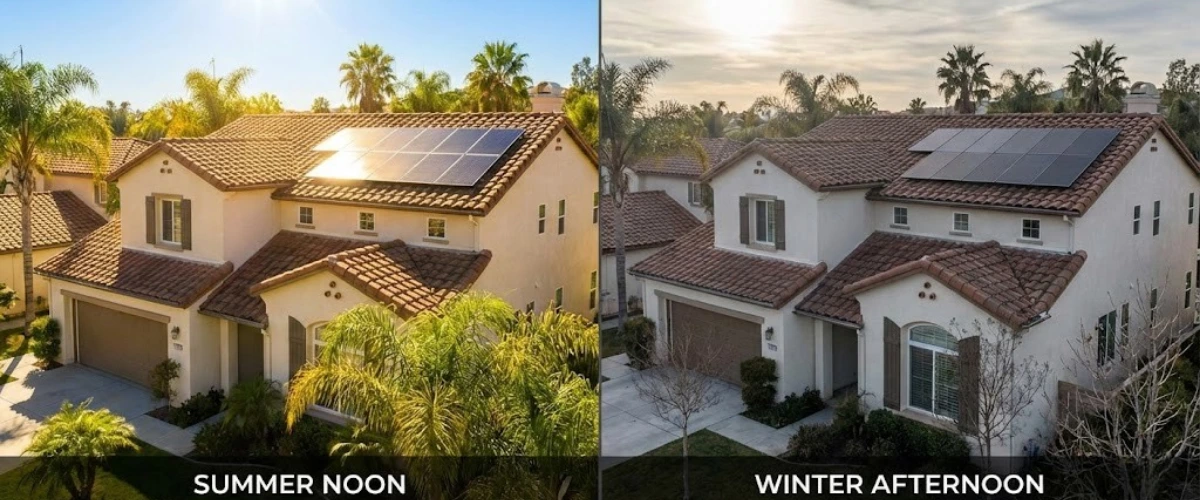
You just checked your solar monitoring app in mid-December, and your heart sank a little. Your panels that cranked out 45 kWh per day in July are now producing barely 25 kWh. Is something wrong? Should you be worried?
Take a breath. You're witnessing something completely normal: seasonal solar production variation. And here's the good news—it doesn't hurt your savings nearly as much as you think.
Let's break down exactly what happens to solar production during California winters, why it matters less than you'd expect, and how smart homeowners are using this knowledge to maximize their year-round savings.
Why Solar Production Drops in Winter (And By How Much)
Southern California enjoys some of the best solar conditions in the country, but physics is physics. Winter brings three unavoidable challenges that reduce your panels' output.
Shorter Days Mean Fewer Peak Hours
The winter solstice (December 21st) gives us roughly 9 hours and 53 minutes of daylight in Los Angeles, compared to 14 hours and 26 minutes during the summer solstice in June. That's nearly 4.5 fewer hours of potential production time.
Your panels might still hit their rated capacity during winter's peak midday hours, but those hours are dramatically compressed. Less time in the sun equals less total energy generated, even if efficiency remains strong.
Lower Sun Angle Reduces Panel Efficiency
In summer, the sun sits high in the sky—nearly perpendicular to your south-facing panels. In winter, it tracks a much lower arc across the southern horizon. This oblique angle means photons hit your panels at a less efficient trajectory.
Think of it like a basketball shot: a straight-on shot has better odds than one launched at a steep angle. Your panels experience the same geometry challenge during winter months.
Cloud Cover and Weather Patterns
December through February brings more cloud coverage and occasional rain to Southern California. Even high, thin clouds can reduce solar production by 10-25%, while overcast days might drop output by 40-90% depending on cloud density.
The good news? California's winter is still sunnier than most states' summer. We're not talking about Seattle-level gloom here.
Real Southern California Winter Production Data
Let's get specific. How much does production actually drop in winter for the average Southern California homeowner?
December vs July: The Reality
Based on 2024-2025 data from thousands of Southern California solar installations, here's what homeowners typically see:
Average Daily Production Comparison:
- July peak: 40-50 kWh per day (8 kW system)
- December low: 23-30 kWh per day (same system)
- Reduction: 35-43% less production in winter
That sounds dramatic until you consider your electricity consumption patterns. Most Southern California homes use significantly less electricity in winter because air conditioning loads disappear.
Monthly Production Patterns
Solar production doesn't just flip from high to low overnight. It follows a predictable curve throughout the year:
- December-January: Lowest production (bottom 10% of annual output)
- February-March: Production begins climbing (gain 20-30% versus December)
- April-September: Peak production months (70% of annual generation)
- October-November: Gradual decline (still 15-25% above winter lows)
This matters because all-year-round solar power in California is designed around annual net production, not daily snapshots.
Your Bills Still Drop (Here's Why)
Even with 35-43% less production, your winter solar savings remain strong. Why? Because your consumption drops even more dramatically than your production.
In summer, a typical Southern California home might consume 35-45 kWh per day thanks to air conditioning running constantly. In winter, that same home drops to 20-28 kWh per day—a reduction of 40-50%.
So while your panels produce less, your needs drop proportionally or even more. Many solar homeowners actually export excess power to the grid during winter months, banking credits for summer use under NEM 3.0.
Why Winter Electricity Bills Stay High (Even Without Solar)
If you're still on the fence about solar, understanding winter electricity patterns makes the investment case even stronger.
Heat Pumps Are Energy Hogs
The Reddit thread we analyzed revealed something important: homeowners with heat pumps face serious winter electricity challenges. One commenter noted their electric furnace uses "4x as much power for heating than cooling."
Heat pumps are incredibly efficient compared to traditional heating, but they still consume substantial electricity during cold snaps. In fact, top appliances that use the most electricity at home shows that heating systems rank among the biggest energy consumers.
For homeowners who rely on electric heating, winter bills can actually rival or exceed summer cooling costs—making solar's winter production valuable despite seasonal drops.
SCE and PG&E Rates Keep Rising
Here's the kicker: why electricity bills are so high in Southern California in 2025 isn't just about consumption—it's about relentless rate increases.
SCE raised rates by an average of 9.2% in 2024, with another increase approved for 2025. Even if you consume less electricity in winter, you're paying more per kilowatt-hour than ever before.
Solar production might drop 40% in winter, but it's still offsetting electricity that now costs $0.35-0.45 per kWh during peak evening hours. That's where your savings come from.
Why Battery Storage Changes Everything in Winter
This is where smart solar homeowners separate themselves from the pack. If you want to truly understand do solar panels work in winter in Southern California, you need to understand battery storage's winter advantage.
Store Midday Production for Evening Use
Winter's shorter days mean your panels generate power during a compressed midday window—say 9 AM to 3 PM. But your highest electricity consumption happens from 4 PM to 9 PM when you're home, cooking dinner, doing laundry, and running heaters.
Without batteries, you're forced to import expensive grid power during those evening peak hours, even though your panels were cranking out excess power at noon.
With batteries, you capture that midday surplus and deploy it exactly when SCE charges $0.40-0.50 per kWh. That's how solar batteries can maximize your savings during winter months.
NEM 3.0 Makes Batteries Essential
California's NEM 3.0 policy drastically reduced the credit you receive for exporting excess solar to the grid—dropping from $0.30+ per kWh under NEM 2.0 to just $0.05-0.08 per kWh under NEM 3.0.
This means exporting winter production to the grid during midday returns pennies on the dollar. But storing it in batteries for evening self-consumption saves you full retail rates ($0.35-0.50 per kWh).
Battery storage isn't optional anymore for California solar—it's the difference between good savings and exceptional savings.
Backup Power During Winter Storms
Southern California's winter occasionally brings strong storms, high winds, and power outages. In January 2024, atmospheric rivers caused widespread blackouts across the region.
Solar panels shut down during grid outages (safety requirement), but batteries with backup capability keep essential circuits running. Your refrigerator, internet, heating system, and lights stay on while neighbors scramble for candles.
That peace of mind alone justifies the battery investment for many homeowners.
What US Power Does Differently for Year-Round Performance
Not all solar installations are created equal. US Power's approach maximizes production during challenging winter months through three key advantages.
Factory-Direct QCells Panels with Superior Low-Light Performance
We're the exclusive QCells partner in Southern California, which means you get American-made panels from their Dalton, Georgia factory at prices 15-20% below market rates.
But beyond pricing, QCells panels with 25-year warranty deliver exceptional low-light performance. Their Q.ANTUM technology maintains higher efficiency during cloudy conditions and oblique sun angles—exactly what you need during winter.
While competitor panels might drop to 60-70% capacity on overcast days, QCells panels consistently maintain 75-85% output. Over a full winter, that difference translates to hundreds of dollars in additional savings.
Optimal System Sizing for Seasonal Variation
Many solar companies undersize systems to hit attractive price points, leaving homeowners short on production during summer peaks and barely scraping by in winter.
US Power's CSLB-licensed installers design systems accounting for your actual annual consumption patterns, including seasonal variation. We analyze your SCE bills from all 12 months, not just summer peaks, ensuring adequate winter production.
Our free consultations include detailed production modeling showing expected output for every month—no surprises when December rolls around.
3-6 Week Installation Timeline Beats the Deadline
Here's the urgency component many homeowners miss: the 30% federal tax credit expires December 31, 2025. After that, it drops to 26% in 2033, then 22% in 2034, before disappearing entirely.
On a typical $30,000 solar + battery system, that's $9,000 in tax credits you'll lose forever if you wait until 2026.
Most solar companies quote 12-16 week installation timelines from contract signing to PTO (permission to operate). US Power averages just 3-6 weeks thanks to streamlined permitting and dedicated installation crews.
If you start now, you can lock in the full 30% credit, get your system producing before 2026, and start offsetting those high winter bills immediately.
Beyond Winter: Your Annual Solar Savings Picture
Zooming out from seasonal anxiety reveals the bigger financial picture that makes solar one of the smartest investments California homeowners can make.
Annual Production Matters More Than Daily Numbers
Yes, your panels produce less in December. But they also produce substantially more in May, June, July, and August—the months when SCE rates hit their absolute peak.
A properly sized 8 kW system in Southern California generates approximately 12,000-14,000 kWh annually. Even with winter's 35-43% production drop, you're still generating enough energy over 12 months to offset 85-100% of your electricity consumption.
That's the metric that determines how much money solar panels save in 2025—annual offset, not daily production.
Net Metering Carries You Through Seasonal Dips
California's net metering policy (even under NEM 3.0's reduced export rates) still allows you to bank excess summer production as credits for winter use.
During those long July days when your panels generate 50 kWh but you only consume 35 kWh, the 15 kWh surplus gets credited to your account. When December rolls around and production drops to 25 kWh while consumption is 27 kWh, you draw from those banked credits.
This annual "true-up" approach smooths out seasonal variation, ensuring year-round savings despite winter's lower production.
System ROI Spans 25+ Years
Winter production anxiety often stems from short-term thinking. But solar is a 25-year investment (that's US Power's comprehensive warranty period covering panels, workmanship, and performance).
Over those 25 years, you'll experience roughly 25 winter seasons with reduced production—and 25 summer seasons with exceptional production. The average across all seasons determines your total lifetime savings, typically $60,000-$90,000 for Southern California homeowners.
Winter's temporary dip becomes a tiny blip in your overall financial picture.
Take Control of Your Energy Bills Before Year-End
Winter's shorter days and lower sun angle create temporary production dips, but they don't diminish solar's incredible financial value for Southern California homeowners.
The combination of reduced winter consumption, rising SCE rates, battery storage optimization, and 25-year system performance means your savings remain robust across all seasons. Annual net production—not December's daily output—determines your return on investment.
But here's what won't wait: the 30% federal tax credit expires in just days on December 31, 2025. After that, it drops to 26% in 2033, costing you thousands in lost savings.
US Power's exclusive QCells partnership, factory-direct pricing, and industry-leading 3-6 week installation timeline position you to capture the full tax credit before it vanishes—even with the year-end deadline looming.
Don't let winter production anxiety keep you from locking in decades of energy savings and rate protection.
Frequently Asked Questions
How much less solar do panels produce in winter in California?
Do solar panels still work on cloudy days?
Is solar worth it if production drops in winter?
Why do I need battery storage if I have solar panels?
When is the best time to install solar in California?


High Efficiency Solar Panels, Factory-Direct Pricing & Tax Credit
High-efficiency Qcells solar panels for maximum savings in Southern Califfornia.
AC vs DC Power in Solar: A California Homeowner’s Guide
Understand AC vs DC power and how it drives reliable solar energy in California.
Understanding PG&E PTO & Power Control Systems for SoCal
Get PTO approval faster and save with a PCS-certified system through US Power.








Derechos de autor © 2025 US POWER | Energía solar y techosUS Power - Axia by QCells. All Rights Reserved.

¡Obtenga una estimación solar instantánea usando el satélite!