




How to Size Your Solar System Correctly in California (2026 Guide)

Confused about solar system sizing? California homeowners are being sold 125-140% offset systems that cost more under NEM 3.0. Here's how to size correctly.
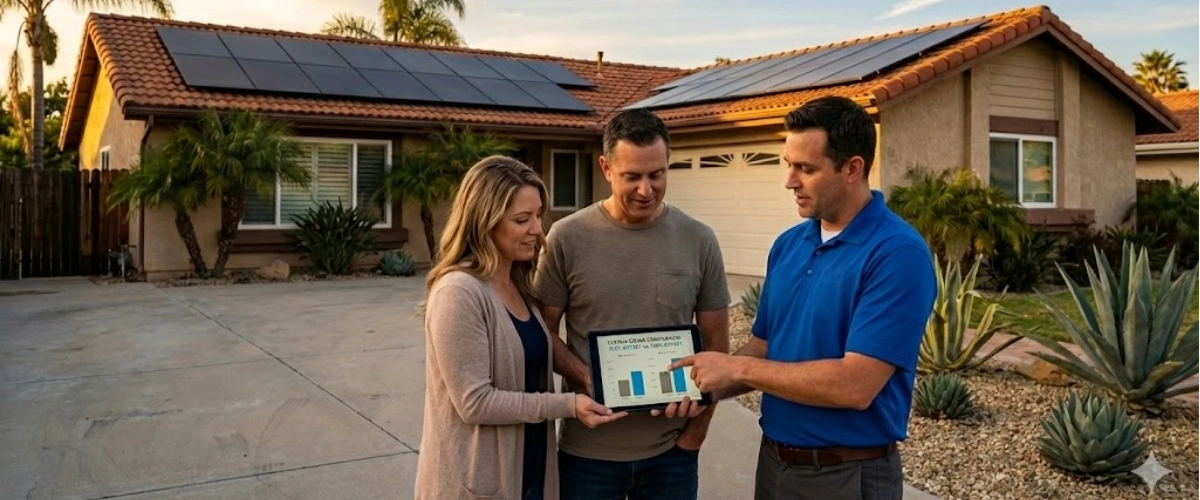
You're getting solar quotes that recommend 125-140% consumption offset. Your salesperson says it's "future-proofing." But under California's NEM 3.0 rules, you might be paying thousands extra for production you'll never use.
Here's what most homeowners don't realize: oversizing your solar system made sense under NEM 2.0, when excess power sold back to the grid at retail rates. Under NEM 3.0, that same excess power is worth 75% less. That 140% system you're considering? You're essentially buying panels that will never pay for themselves.
This guide shows you how to size your solar system correctly for your California home, avoid the oversizing trap, and make smart decisions about meter collars, inverters, and future upgrades.
Why 125-140% System Sizing May Cost You Money
Under NEM 2.0, oversizing made financial sense. Homeowners banked credits at full retail rates and drew them down when needed. Solar companies routinely recommended 125-140% offset to maximize these credits.
NEM 3.0 changed everything. Export rates dropped by approximately 75%, making excess production far less valuable. When you oversize now, you're paying upfront for panels that generate credits worth pennies on the dollar.
Here's the math: if you use 400 kWh monthly but install a system producing 560 kWh (140% offset), that extra 160 kWh exports to the grid. Under NEM 3.0, you might get $8-12 back instead of the $50-60 you'd have received under NEM 2.0. You paid an extra $2,000-3,000 for those panels, but you'll need 15-20 years just to break even on that portion of the system.
The solution isn't avoiding solar. It's understanding residential solar system sizes that match your actual consumption without wasteful overproduction.
How to Actually Size Your Solar System in 2025
Proper solar sizing starts with your electricity bills, not a salesperson's commission structure. Here's the methodology that works under NEM 3.0.
Calculate Your Average Monthly Usage
Pull 12 months of SCE or PG&E bills and calculate your average monthly kilowatt-hour (kWh) consumption. Don't just look at one summer bill or one winter bill—you need the full year to account for seasonal variation.
Most California homeowners use 350-500 kWh monthly, though this varies significantly by home size, occupancy, and climate zone. If your usage is 363-498 kWh like many Southern California homes, you're in the typical range.
Use how to calculate solar system size tools that factor in your roof orientation, shading, and local weather patterns to determine actual production needs.
Account for Future Increases (The Right Way)
You should plan for reasonable future consumption increases, but 125-140% oversizing isn't the answer. Here's what actually makes sense:
Electric vehicle charging: If you're planning to buy an EV within 2-3 years, add 300-400 kWh monthly to your baseline. That's roughly 3,000-4,000 kWh annually for typical commuting.
Heat pump installation: Air source heat pumps typically add 200-300 kWh monthly in California's climate, depending on your heating and cooling needs.
Home expansion: Adding square footage or an ADU? Plan for proportional increases based on conditioned space.
The key is being realistic. If you "might" get an EV "someday," don't pay for panels now. Modern systems with microinverters allow you to add panels later without replacing your entire system.
The 100-110% Sweet Spot
For most California homeowners under NEM 3.0, a system sized at 100-110% of annual consumption offers the best financial return. This provides a small buffer for usage variation without generating wasteful excess production.
If you have concrete plans for an EV or heat pump within 12 months, size for that known increase. If your plans are more than a year out, install what you need now and expand later when usage actually increases.
Meter Collar vs. Main Panel Connection: What You Need to Know
This is one of the most common questions from homeowners upgrading their electrical service, and it has a straightforward answer.
What Is a Meter Collar?
A meter collar is a device installed between your utility meter and your electrical panel that creates a connection point for solar equipment. It's essentially an interconnection point that doesn't require rewiring your main service panel.
When to Use a Meter Collar
Meter collars make sense in specific situations:
Meter-panel combo units: Some older homes have combined meter and service panel units where separating them would be expensive or impractical.
Space constraints: If your main panel is already full or doesn't have room for solar breakers, a meter collar provides an alternative connection point.
Backup power systems: If you're installing battery backup that functions during grid outages, you need a meter collar with microgrid interconnection device (MID) functionality. This allows your solar and battery to power your home when the grid is down while maintaining proper isolation from utility lines.
When to Connect Directly to the Panel
If you're already upgrading from 100-amp to 200-amp service like many homeowners doing solar, direct panel connection is usually the better choice. It's simpler, typically less expensive, and provides more flexibility for future expansions.
Your new 200-amp panel will have plenty of space for solar breakers, and direct connection avoids the additional equipment cost of a meter collar. For battery storage systems that remain grid-tied without backup functionality, direct panel connection works perfectly.
The bottom line: if you're getting a new panel anyway, skip the meter collar unless you specifically need backup power functionality.
Why Battery Storage Is Essential Under NEM 3.0
NEM 3.0 fundamentally changed the value proposition of battery storage. It went from "nice to have" to "essential for maximizing savings."
Under the new rules, daytime solar production is exported at rates 75% lower than what you pay to import power during evening peak hours. This creates a massive arbitrage opportunity: store your cheap daytime solar production and use it during expensive evening hours instead of exporting it for pennies.
The numbers are compelling. A homeowner using 400 kWh monthly might export 150 kWh during midday hours under NEM 3.0, receiving $8-12 in credits. That same 150 kWh consumed from the grid during evening peak hours costs $50-60. By storing that production in a battery and using it at night, you keep the full $50-60 in savings rather than settling for $8-12 in export credits.
Are batteries worth it for solar in California has a different answer in 2026 than it did in 2023. Under NEM 3.0, the payback period for battery storage is 6-8 years compared to 12-15 years under NEM 2.0.
Planning for Future Electric Vehicles and Heat Pumps
Future-proofing your solar system requires balancing known plans against uncertain possibilities.
If you're buying an EV within the next 12 months, sizing solar panels and batteries for EV owners should happen now. The average California EV driver uses 3,000-4,000 kWh annually for charging, which translates to 250-350 kWh monthly. Add this to your baseline consumption and size your system accordingly.
For heat pumps, the calculation depends on your current heating system and climate zone. Replacing natural gas heating with an electric heat pump in Southern California typically adds 200-300 kWh monthly, though this varies significantly based on home insulation, square footage, and thermostat settings.
The mistake most homeowners make is oversizing for vague "what if" scenarios. Don't add 40% capacity because you "might" get an EV in five years. Modern systems with microinverters or optimizers allow panel additions without replacing existing equipment.
Install what you need for known changes happening within 12-18 months. For anything beyond that timeframe, plan to expand when usage actually increases. You'll pay less per watt for those future panels due to ongoing solar technology improvements, and you won't carry debt on unused capacity in the meantime.
Microinverters vs. String Inverters: The Real Difference
The microinverter versus string inverter debate matters more than most homeowners realize, especially when battery storage is involved.
Microinverter Advantages
Microinverters convert DC power to AC at each individual panel. This provides panel-level monitoring, eliminates single-point-of-failure risks, and optimizes production when shading affects part of your array.
The main advantage is flexibility. If one microinverter fails, the rest of your system continues producing. Troubleshooting is simpler because monitoring shows exactly which panel has issues. Adding panels later is straightforward—just install additional microinverters without modifying existing equipment.
String Inverter Efficiency
Here's what many homeowners don't understand: solar inverters for California homes work differently when batteries are involved. With microinverters, solar production converts from DC to AC, then back to DC to charge your battery. That's two conversion steps, each with 3-5% efficiency loss.
String inverters with battery systems avoid this double conversion. DC power from panels charges the battery directly, converting to AC only when powering your home. This improved efficiency matters when you're storing 40-60% of your daily production.
For Southern California homes without significant shading, string inverters paired with battery storage typically deliver 4-6% better overall system efficiency. Over 25 years, that efficiency difference translates to thousands of dollars in additional savings.
The trade-off is risk concentration. String inverters fail more frequently than individual microinverters, and when they fail, your entire system goes down. Replacement can take weeks if your original installer has closed.
What to Ask Your Solar Consultant
Getting accurate system sizing requires asking the right questions. Many solar companies push oversized systems because larger installations mean higher commissions.
Start with these questions:
"What's my actual annual consumption, and how did you calculate it?" Legitimate companies analyze 12 months of utility bills. Red flag: if they're sizing based on a single bill or rough estimates.
"Why are you recommending this specific offset percentage?" If the answer involves vague "future-proofing" without specific usage increases, push back. Get concrete justification for any offset above 110%.
"How does NEM 3.0 affect the value of excess production?" If your consultant doesn't clearly explain export rates versus import rates, they either don't understand the rules or they're hoping you don't.
"Can I add panels later if my usage increases?" Systems with microinverters or optimizers make future expansion simple. If expansion isn't possible, you need to be absolutely certain about future usage when sizing.
"What happens if I install too large of a system?" The honest answer: you'll pay more upfront for production you'll never use. Any other answer is a red flag.
Comparing solar quotes in California requires understanding these sizing principles. The lowest price per watt doesn't matter if you're buying 40% more capacity than you need.
How US Power Sizes Systems Correctly
US Power takes a different approach to system sizing because we're CSLB-licensed consultants, not commission-based salespeople.
Our process starts with thorough analysis of your 12-month usage history, accounting for seasonal variations and usage patterns. We factor in your home's roof orientation, shading, and location-specific production data to determine actual panel output in your specific conditions.
When you tell us about planned EVs or heat pumps, we calculate the actual consumption impact based on vehicle models, charging habits, and HVAC specifications. No vague "add 40% for future-proofing"—just honest math based on real data.
As California's #1 QCells installer, we offer American-made panels at factory-direct pricing that's 15-20% below market rates. This means right-sized systems cost even less, maximizing your return on investment.
Our typical installation timeline is 3-6 weeks from approval to permission to operate. We handle permitting, utility interconnection, and all inspections. The 25-year comprehensive warranty covers panels, workmanship, and performance—no hidden exclusions or fine print.
Most importantly, we size systems based on what you need, not what maximizes our profit. That's why we maintain 175+ five-star Google reviews from homeowners who got exactly what they needed without oversized systems or high-pressure sales tactics.
Take Control of Your Solar Investment
Getting solar system sizing right under NEM 3.0 requires understanding how California's new rules changed the economics of solar production. Oversized systems that made sense under NEM 2.0 now waste money on production you'll never benefit from.
The right system size balances your actual consumption with reasonable future increases, avoids wasteful overproduction, and maximizes your return on investment. With proper sizing, most Southern California homeowners achieve payback in 5-7 years and save $30,000-50,000 over 25 years.
US Power's approach starts with honest analysis and ends with right-sized systems backed by factory-direct pricing and comprehensive warranties. Our CSLB-licensed consultants help you avoid the oversizing trap while capturing maximum value from California's solar incentives.
The federal solar tax credit is 26% in 2026 before dropping to 22% in 2027. With our 3-6 week installation timeline, now is still an excellent time to maximize your solar investment.
Frequently Asked Questions
Can I really add panels later, or is that just a sales tactic?
What if my usage increases more than expected?
Should I size for 100% or 110% offset?
How much does oversizing actually cost?
What's the difference between meter collar types?


What Qcells’ Expansion Means for Solar in California
QCells’ growth brings more options and efficiency for homeowners going solar.
How Long Does Solar Panel Installation Really Take? (2026 Guide)
57 panels in 72 hours? Here's the truth about solar installation timeline in CA.

Q.HOME CORE Might Be the Energy Storage Solution Your Home
Comparing Q.HOME CORE to other batteries to find the best for your CA home.








Derechos de autor © 2025 US POWER | Energía solar y techosUS Power - Axia by QCells. All Rights Reserved.

¡Obtenga una estimación solar instantánea usando el satélite!