




How to Size Solar Panels for Your Home | California 2026 Guide

Sizing your solar system correctly is the most critical decision you'll make when going solar. Too small and you'll keep paying high utility bills. Too large and you're wasting money upfront. This guide shows Southern California homeowners exactly how to calculate the right system size for maximum savings under NEM 3.0, avoid common mistakes, and future-proof your investment for EVs and growing energy needs.
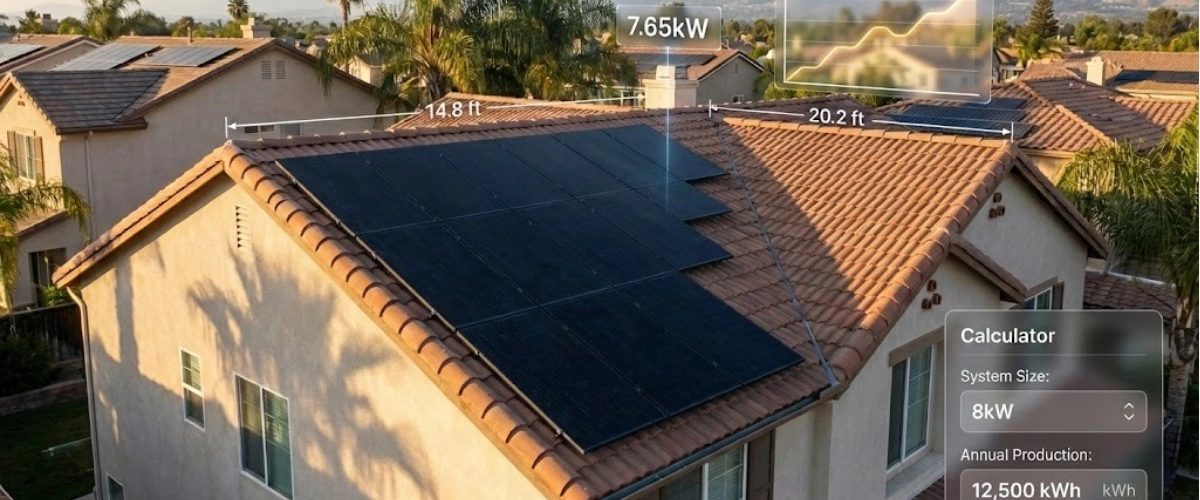
You're about to spend $20,000+ on solar panels. The size you choose will determine whether you save thousands per year or keep writing checks to SCE for the next two decades.
Here's the uncomfortable truth: most homeowners get this wrong. They either undersize their system to save money upfront (then watch their bills stay high), or they oversize based on pushy sales tactics (and waste money on panels they don't need).
A homeowner captures this perfectly. Solar contractors quoted them everything from 4.5kW to 11.5kW for the same house. That's a 150% difference. One commenter nailed it: "I wish we had installed a smaller solar array" — a phrase that has probably never been uttered.
For Southern California homeowners facing NEM 3.0 regulations, rising SCE rates, and the upcoming end of the 30% federal tax credit, getting your system size right isn't just important. It's everything.
Why Proper Solar Sizing Matters More in 2026 Than Ever Before
You can't just "add more panels later" like you could five years ago. NEM 3.0 changed the rules.
Under California's current net metering policy, the economics of solar have shifted dramatically. Export rates dropped by 75%, making battery storage nearly mandatory. If you undersize your system now, expanding later means navigating new permits, potentially different regulations, and significantly higher costs per watt.
The financial stakes are real. A homeowner with a 2,000 sq ft home using 900 kWh per month needs roughly 7-8kW of solar. Install a 5kW system to save $5,000 upfront, and you'll still pay SCE $80-120 per month. Over 25 years, that's $24,000-36,000 in utility bills you thought solar would eliminate.
Meanwhile, understanding your home's energy usage patterns becomes the foundation of accurate sizing. Without 12 months of usage data, you're guessing. And guessing costs money.
The other critical factor: California electricity rates increased 51% between 2014-2024. They're not slowing down. SCE's average rate hit $0.38/kWh in 2025, with peak rates exceeding $0.50/kWh. Undersizing your system means paying these inflated rates on whatever usage your panels don't cover.
The Three Sizing Mistakes That Cost Homeowners Thousands
Mistake #1: Using the previous owner's usage data. "Every family has different habits in the home and use electricity differently." The family that lived in your house before you might have kept the thermostat at 78°F. You prefer 72°F. That's 30-40% more cooling costs right there.
Mistake #2: Ignoring future needs. Planning to buy an EV? That's 300-500 kWh per month of additional usage. Getting a pool? Another 200-300 kWh. Working from home now? Add 150-200 kWh. Size for today's usage, and you'll outgrow your system in 2-3 years.
Mistake #3: Not accounting for NEM 3.0. Under the new rules, battery storage is essential under NEM 3.0. Your solar panels need to be sized not just for your usage, but for optimal battery charging during peak sun hours.
The Real Cost of Undersizing Your Solar System
Let's run the numbers with a real example. Meet the Johnson family in Pasadena.
Their situation:
- 2,400 sq ft home
- Monthly usage: 850 kWh (average SCE customer)
- SCE rate: $0.38/kWh average
- Monthly bill: $323
Option 1: Undersized System (5kW)
- Covers 60% of usage
- Remaining monthly bill: $129
- 25-year utility costs: $38,700
- System cost after tax credit: $12,250
- Total 25-year cost: $50,950
Option 2: Right-Sized System (8kW)
- Covers 95% of usage
- Remaining monthly bill: $16 (connection fees only)
- 25-year utility costs: $4,800
- System cost after tax credit: $19,600
- Total 25-year cost: $24,400
The "savings" from buying a smaller system? It costs you $26,550 over 25 years.
And here's what really hurts: expanding that 5kW system to 8kW three years later will cost you $12,000-15,000 (due to permitting, inspection fees, and higher per-watt costs for small additions). You'll spend more total money and still lose three years of full solar savings.
This is why experienced solar owners universally recommend: go as big as your roof and budget allow.
"Go as big as you can so you can charge an EV or use heat pumps for heating in the future."
How NEM 3.0 Makes Undersizing Even More Expensive
Before NEM 3.0, excess solar generation earned credits worth $0.30-0.35/kWh. You could undersize your system and still get decent value from summer overproduction.
Now? Export rates average $0.05-0.08/kWh. That's 75-85% less. The economics have flipped entirely.
This is why Southern California electricity rates continue climbing makes proper sizing critical. You need enough panels to cover your usage directly, because selling excess back to the utility is no longer profitable.
How to Calculate the Right Solar System Size for Your Home
Here's the step-by-step process we use with every US Power customer.
Step 1: Get 12 Months of Actual Usage Data
Log into your SCE or PG&E account and download your full year of usage. You need to see:
- Total annual kWh consumption
- Seasonal variations (summer AC usage vs. winter)
- Peak usage months
- Daily usage patterns (if available)
Pro tip: If you just moved in, request the previous owner's bills AND add 15-20% for your actual usage patterns. New homeowners almost always use more energy than they estimate.
Step 2: Calculate Your Daily Average
Take your annual kWh usage and divide by 365. For example:
- Annual usage: 10,200 kWh
- Daily average: 28 kWh/day
This is your baseline number.
Step 3: Add Future Usage Increases
Be honest about what's changing:
- EV charging: Add 10-15 kWh per day (300-450 kWh/month)
- Pool/hot tub: Add 7-10 kWh per day (200-300 kWh/month)
- Home addition: Add 5-8 kWh per day per 500 sq ft
- Working from home: Add 5-7 kWh per day
- New AC unit (upgrading): Add 3-5 kWh per day in summer
Taking advantage of the federal solar tax credit deadline makes sizing for these future needs affordable now, rather than expensive later.
Step 4: Account for System Degradation
Solar panels lose approximately 0.5% efficiency per year. A system producing 100% of your needs in Year 1 will produce about 87% by Year 25. Always size 10-15% above your current needs to maintain full offset over the system's lifetime.
Step 5: Calculate Required System Size
Southern California averages 5.5 peak sun hours per day. Use this formula:
System Size (kW) = Daily Usage (kWh) ÷ 5.5 ÷ 0.80
The 0.80 accounts for system losses (inverter efficiency, temperature, shading, etc.).
Example calculation:
- Daily usage: 28 kWh
- Future EV: +12 kWh
- Total: 40 kWh/day
- System size needed: 40 ÷ 5.5 ÷ 0.80 = 9.1 kW
Round up to a standard system size: 10 kW system with approximately 25-27 panels (depending on panel wattage).
Step 6: Consider Battery Sizing
Under NEM 3.0, how solar batteries maximize your savings requires matching your battery capacity to your system size and usage patterns. A 10kW solar system typically pairs with 13-20 kWh of battery storage for optimal results.
Future-Proofing Your Solar Investment
Here's what homeowners forget: your solar system lasts 25-30 years, but your life won't stay the same for three decades.
Common life changes that increase energy usage:
- Retiring (home all day instead of at work)
- Adult children moving back home
- Home office setup
- Medical equipment (CPAP, oxygen concentrators)
- Electric lawn equipment replacing gas
- Second EV purchase
- Aging in place (more heating/cooling for comfort)
A homeowner shared their approach: "I went with 50 percent first year and then added another 35 percent 2 years later." This works, but it's more expensive. They spent approximately $3,000-4,000 more than if they'd sized correctly from the start.
The smarter approach: Size 20-25% above your current usage. If you're using 30 kWh/day now, size for 36-38 kWh/day. This buffer costs about $2,000-3,000 more upfront but saves you from expensive expansions and ensures you have headroom for growth.
Should You Oversize for Maximum Roof Coverage?
Here's the nuanced answer: yes, if you have a good roof and no budget constraints.
"105% from what measurement? I would not install until I could pump that number as high as my roof supports." They're right—but only in jurisdictions without offset limits.
California allows systems up to 150% of historical usage under certain conditions. However, under NEM 3.0's economics, oversizing beyond 110-120% rarely makes financial sense unless you're certain about future usage increases (like adding 2-3 EVs).
The exception: If you have a nearly flat roof or one large, unobstructed south-facing section, maximizing panel coverage makes sense because:
- You're already paying for permits and installation
- The incremental cost per panel drops significantly (last 5 panels cost less per watt than first 15)
- Battery storage improves dramatically with more daytime generation
How US Power Gets Solar Sizing Right Every Time
We've sized over 2,000 systems across Southern California. Here's our process—and why it works better than guesswork or online calculators.
Our CSLB-Licensed Consultants Start with Your Bills, Not Sales Targets
Unlike solar companies that push maximum system sizes to boost commissions, our consultants earn the same whether you install 5kW or 15kW. Their only goal: accurate sizing for maximum long-term value.
We analyze:
- 12 months of utility data (we request it directly from SCE/PG&E with your permission)
- Your home's specific characteristics (square footage, insulation, HVAC age)
- Your actual lifestyle and future plans
- Detailed roof analysis using drone imagery and sun path modeling
Then we provide 2-3 system size options with honest pros/cons for each.
Factory-Direct QCells Pricing Makes Right-Sizing Affordable
This is where US Power's exclusive partnership with QCells changes everything. QCells panels with factory-direct pricing means you pay 15-20% less per watt than competitors.
Real example: A properly-sized 9kW system with battery storage:
- Typical market price: $38,000-42,000
- US Power price: $31,500-34,000
- After 30% tax credit: $22,050-23,800
That $8,000-10,000 savings eliminates the "I'll start small and expand later" temptation. You can afford the right size from day one.
We Use Premium Equipment That Justifies the Investment
When you're sizing a system for 25-30 years of service, panel quality matters enormously. American-made QCells solar panels come with:
- 25-year product warranty (not just performance)
- 25-year workmanship warranty from US Power
- 0.25% annual degradation (better than industry standard)
- Tier 1 bankability rating
Cheaper panels with 0.7% degradation will underperform your sized system by Year 10, essentially creating an undersized system through equipment failure.
Our 3-6 Week Installation Timeline Locks in 2025 Tax Credits
Time is working against you. The 30% federal tax credit drops to 26% on January 1, 2026. On a $32,000 system, that's $1,280 in lost savings.
US Power's streamlined process—design approval to Permission to Operate (PTO)—averages 3-6 weeks. We handle:
- Permitting (2-3 days)
- SCE interconnection application (same day as permit)
- Installation (1-2 days)
- Inspection (1 week)
- PTO (2-3 weeks)
This matters for sizing because you're not "betting" on future tax credits or incentives. Lock in the 30% now, size correctly, and stop paying SCE.
What Happens When You Get Solar Sizing Wrong
Let's be blunt about the consequences—because they're expensive and long-lasting.
Undersizing: The 25-Year Regret
Financial impact: You'll pay SCE $15,000-40,000 over your system's lifetime for the usage your panels don't cover. The solar payback calculator that showed a 6-year return? It's actually 12-15 years with an undersized system.
Practical impact: Summer bills of $150-200 instead of the $15-30 you expected. Constantly wondering if you should have "just gotten more panels."
Expansion reality: Adding panels later costs $4-6/watt versus $2.80-3.20/watt for a properly-sized initial installation. You'll spend $3,000-8,000 more for panels you should have installed originally.
Oversizing: The Waste Problem
Financial impact: Under NEM 3.0, excess generation earns $0.05-0.08/kWh. A system generating 30% more than you need creates $200-400/year in excess energy worth just $75-100/year in export credits. You paid $5,000-8,000 for panels that generate electricity you can't use profitably.
Exception: If you have a large battery bank (30+ kWh), moderate oversizing (110-115% of usage) improves battery cycling and extends battery life. But pure oversizing without storage is money wasted.
Getting It Right: The 25-Year Dividend
Financial impact: Monthly bills under $20 for 25 years. System pays for itself in 5-7 years, then generates $50,000-80,000 in net savings over its lifetime.
Practical impact: Energy independence. No anxiety about rate increases. Confidence that your EV, pool, or AC upgrade won't wreck your budget.
Avoiding common solar installation mistakes starts with proper sizing, but it extends to choosing the right installer, equipment, and financing structure.
Take Control of Your Energy Costs with the Right System Size
Here's your action plan for getting solar sizing right:
This week:
- Log into your SCE/PG&E account and download 12 months of usage history
- Make a list of planned changes (EV, pool, home addition, retirement)
- Request a free consultation with US Power's CSLB-licensed team
During your consultation:
- Share your actual bills and future plans honestly
- Ask to see 2-3 system size options with pros/cons for each
- Request a detailed production model showing seasonal performance
- Get sizing recommendations for both solar and battery storage
Before you sign:
- Verify your system covers 95-110% of projected annual usage
- Confirm equipment warranties (25 years on panels AND workmanship)
- Understand your payback timeline with accurate projections
- Lock in the 30% federal tax credit before December 31, 2025
The difference between a well-sized system and a poorly-sized one is $20,000-40,000 over 25 years. That's not a decision to make quickly or based on the cheapest quote.
Frequently Asked Questions
How do I know if I'm using more electricity than the previous homeowner?
Can I add more panels later if I need them?
What if I size for an EV but don't buy one for 5 years?
Should I size based on my current rate plan or peak rates?
What's the smallest system size that makes financial sense in California?


Should You Buy a House with Solar Panels? What First-Time Buyers Need to Know
Should You Buy a House with Solar Panels? What First-Time Buyers Need to Know

Homeowner Cuts Energy Use to Zero with Solar and Storage
Slash electricity costs and protect against the rising SCE bills with US Power.
Why Owning Your System Beats Leasing in SoCal
Learn more about why owning solar beats leasing in Southern California 2025.








Derechos de autor © 2025 US POWER | Energía solar y techosUS Power - Axia by QCells. All Rights Reserved.

¡Obtenga una estimación solar instantánea usando el satélite!