



A Southern California Homeowner's Guide to Avoiding Overpaying
Southern California homeowners share how they verified projections, spotted red flags, and chose installers they could trust—without overpaying.
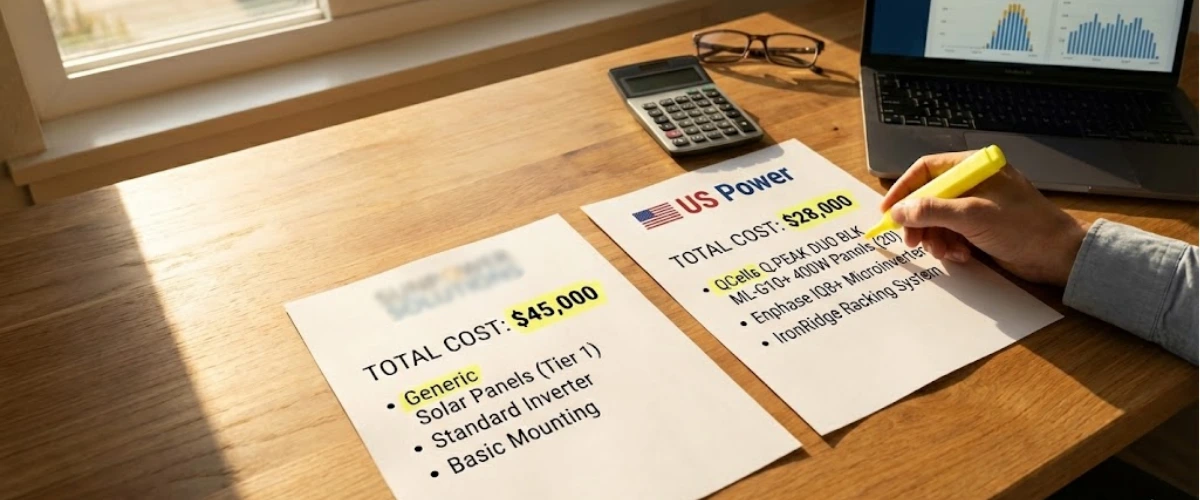
You've done your homework. You've requested quotes from multiple solar companies. But now you're staring at proposals that make no sense.
One installer promises your electric bill will drop to zero within three years. Another says five years is realistic. A third warns it could take eight. The system sizes are different. The prices vary by $15,000. And nobody can explain why.
Here's the uncomfortable truth: Most Southern California homeowners have no reliable way to verify if the numbers in their solar quotes are accurate or just aggressive marketing. That's why comparing solar quotes feels impossible—and why so many people either overpay or walk away from solar entirely.
This guide shows you exactly how to compare solar quotes like a pro, using the same verification tools and red-flag checklists that experienced homeowners rely on.
Why Solar Quotes Vary So Dramatically for the Same House
You'd think solar pricing would be straightforward. Same roof, same electric bill, same equipment—similar price, right?
Not even close.
The Hidden Variables That Change Everything
National solar companies with door-to-door sales teams often quote double the price of local installers for nearly identical systems. Why? Because their business model includes massive overhead costs: commissioned salespeople, nationwide advertising budgets, and multilevel approval processes.
Local installers with in-house crews can offer the same equipment at 15-20% less because they eliminate middleman markups. But even among local companies, quotes can differ based on panel efficiency, inverter technology, and whether batteries are included.
Sales Tactics That Inflate Your Quote
High-pressure sales representatives work on commission. The more you pay, the more they earn. Some tactics to watch for include inflating your electricity usage projections, oversizing your system beyond what you actually need, or bundling unnecessary add-ons to increase the total contract value.
Reddit users consistently report that companies using aggressive door-knockers tend to provide the highest quotes—sometimes 30-50% above fair market value.
Equipment Quality Makes a Massive Difference
A quote using premium Tier 1 panels with 25-year warranties should cost more than one using budget panels with shorter lifespans. But many homeowners can't tell the difference because installers don't clearly explain equipment specifications.
The problem? Some companies hide lower-quality equipment behind vague descriptions like "high-efficiency solar panels" without naming brands or providing datasheets.
What Should You Actually Look for in a Solar Quote?
A legitimate solar quote should give you enough information to make an informed decision—not just a monthly payment and a sales pitch.
The Five Non-Negotiables Every Quote Must Include
First, system specifications: exact panel brand and model, wattage per panel, total system size in kilowatts, and inverter type. If your quote says "premium solar panels" without naming QCells, REC, or another specific manufacturer, that's a red flag.
Second, production estimates: annual kilowatt-hour (kWh) output based on your roof's orientation, tilt, and shading. This number should come from software like Aurora or HelioScope—not pulled from thin air.
Third, warranty details: separate warranties for panels (usually 25 years), inverters (10-25 years), and workmanship (typically 10 years minimum). Companies that offer vague "lifetime warranties" often go out of business before honoring them.
Fourth, total cost breakdown: equipment costs, labor, permits, and any additional fees. The price should be transparent before and after the 30% federal tax credit.
Fifth, realistic payback timeline: based on your actual electricity bills, not inflated projections. Learn more about What Should Be Included in Every Solar Quote.
How to Decode the Fine Print
Pay close attention to escalator clauses in solar loans or leases. Some financing agreements increase your payment by 2-3% annually, which can eliminate your savings over time.
Also check for dealer fees, which can add $3,000-$5,000 to your loan without improving your system. These fees go directly to the sales company and provide zero value to you.
How to Verify Solar Savings Projections Yourself
You don't need a PhD in engineering to fact-check your solar quotes. Free online tools let you calculate expected production in under 10 minutes.
Using PVWatts to Cross-Check Output Claims
The National Renewable Energy Laboratory (NREL) offers PVWatts, a free calculator that estimates solar production for any address in the United States. Enter your location, system size, and roof details to see how many kilowatt-hours your panels should generate annually.
Compare this number to what installers are promising. If their estimate is 20-30% higher than PVWatts, they're probably inflating projections to make their quote look better. You can verify your solar savings with PVWatts and other free tools.
Calculating Your True Payback Period
Pull your last 12 months of electric bills from SCE or your utility provider. Calculate your annual electricity cost, including all fees and taxes. Divide your total solar system cost (after tax credit) by your annual electricity savings. That's your payback period.
If your installer claims a five-year payback but your math shows eight years, push back. Ask them to explain the discrepancy using your actual utility data.
Google Project Sunroof for Rough Estimates
Google's Project Sunroof analyzes satellite imagery to estimate your roof's solar potential. It's not as precise as professional software, but it gives you a ballpark number to compare against installer claims.
If Project Sunroof says your roof can fit 15 panels and an installer quotes you 30, question why they're oversizing your system.
Red Flags That Mean You're Getting a Bad Quote
Some warning signs are obvious. Others are subtle. Here's what to watch for when evaluating solar quotes.
High-Pressure Sales Tactics
If a sales representative tells you the deal expires today, walk away. Legitimate solar companies don't use artificial urgency to force decisions. The 30% federal tax credit expires December 31, 2025—that's the only real deadline.
Companies that require large upfront deposits before permits are approved are also suspect. California law limits solar deposits to $1,000 or 10% of the contract value, whichever is less.
Vague Equipment Descriptions
Quotes that don't specify panel brands, inverter models, or warranty terms are designed to confuse you. This allows companies to substitute lower-quality equipment after you sign without technically breaching the contract.
Watch for these Red Flags when Choosing a Solar Company.
Unrealistic Savings Claims
No solar system eliminates your electric bill completely unless you have battery storage and significantly overproduce. Under NEM 3.0, Southern California homeowners still pay grid connection fees and time-of-use charges.
If an installer promises "zero electric bills forever," they're either lying or they don't understand California's current net metering policy.
Pushy Financing with Hidden Fees
Some solar loans come with dealer fees that exceed $5,000. These fees increase your monthly payment without improving your system. Always ask for the total loan cost including interest, not just the monthly payment.
Leases and power purchase agreements (PPAs) can also include annual escalators that increase your cost by 2-3% per year—potentially costing you more than staying with your utility.
Why Southern California Homeowners Should Compare Local Installers
The Reddit thread that inspired this guide revealed a clear pattern: homeowners who got multiple quotes consistently found local companies 20-40% cheaper than national brands.
Local Companies Have Lower Overhead
National solar companies spend millions on advertising, maintain regional offices, and employ large sales teams. Those costs get passed to you. Local installers keep overhead low by relying on word-of-mouth referrals and in-house installation crews. Discover why local vs national solar companies makes such a difference in pricing.
In-House Installation Teams Matter
Companies that subcontract installations lose quality control. Your installer might be a roofing crew with minimal solar experience. Local companies with dedicated solar teams ensure consistent workmanship and faster problem resolution.
Better Post-Installation Support
When issues arise—and they sometimes do—local companies respond faster than national call centers. You'll work with the same team that installed your system, not a third-party warranty service.
Why Battery Storage Matters When Comparing Quotes
Under California's NEM 3.0 policy, solar panels alone provide significantly less value than they did under NEM 2.0. Battery storage changed from "nice to have" to "essential for maximum savings."
How NEM 3.0 Changed the Math
NEM 3.0 reduced the credit you receive for excess solar production by 75%. Without batteries, you're essentially giving away your surplus electricity for pennies. Batteries let you store that excess energy and use it during peak rate hours when electricity costs 50-60 cents per kilowatt-hour.
This is why quotes with batteries might look more expensive initially but provide much better long-term value. Learn how solar batteries can maximize your savings under California's current net metering policy.
Comparing Battery Options Across Quotes
Not all batteries are equal. Tesla Powerwalls, Enphase batteries, and QCells Q.HOME CORE systems have different capacities, lifespans, and warranty terms. Make sure you're comparing apples to apples when evaluating battery costs.
A cheaper battery with a 10-year warranty might need replacement twice as often as a premium system with a 25-year warranty.
Why US Power's Quotes Are Different (And Lower)
Most solar companies mark up equipment 40-60% above wholesale cost. US Power eliminates that markup entirely.
Factory-Direct Pricing from QCells
As an exclusive QCells partner, US Power buys panels directly from the Dalton, Georgia factory. No distributors. No middlemen. Those savings go straight to you—typically 15-20% below market rates for the same equipment. Discover how factory-direct QCells pricing eliminates unnecessary markups.
Transparent Breakdowns, No Hidden Fees
US Power quotes include every cost: panels, inverters, batteries, installation labor, permits, and inspections. What you see is what you pay. No surprise dealer fees. No last-minute upgrades. No financing gimmicks.
CSLB-Licensed, In-House Installers
Every US Power installation is performed by California State Licensing Board (CSLB) certified electricians. These aren't subcontractors—they're full-time employees trained specifically on QCells equipment and California building codes.
25-Year Comprehensive Warranty
While most companies offer separate warranties for panels (25 years), inverters (10-12 years), and workmanship (2-10 years), US Power provides a single 25-year comprehensive warranty covering everything. If something fails, you make one phone call—not three.
Beyond the Price: Hidden Costs to Compare
The lowest upfront quote isn't always the best deal. Several hidden costs can eliminate your savings over time.
Re-Roofing Complications
If your roof is older than 15 years, you'll likely need to replace it before installing solar. Some installers include roof replacement in their quotes; others don't mention it until after you've signed. Always ask about roof condition and factor replacement costs into your comparison. Be aware of hidden costs that can impact your California solar savings.
Panel Removal and Reinstallation
When you eventually re-roof, you'll pay $3,000-$8,000 to remove and reinstall your solar panels. This cost isn't included in initial quotes but impacts your long-term ROI.
Utility Interconnection Delays
SCE and other utilities can take 2-6 months to approve your interconnection application. During this time, you've paid for your system but can't use it yet. Ask installers how they handle permission-to-operate (PTO) delays.
Time-Sensitive Factors That Change Quote Values
Two factors make comparing quotes more urgent in late 2025 than ever before.
The 30% Federal Tax Credit Expires December 31, 2025
This is non-negotiable. Systems that receive permission to operate (PTO) by December 31, 2025 qualify for the full 30% federal tax credit. Systems installed in 2026 receive only 26%. By 2027, the credit drops to 22%. After 2034, it disappears entirely for residential installations.
On a $30,000 system, that's a $9,000 difference between installing now versus waiting until 2026. Don't miss your last chance for 30% solar savings before the tax credit deadline.
Rising SCE Rates Make Solar More Valuable
Southern California Edison rates have increased 32% since 2020 and show no signs of slowing. Every month you delay solar is another month paying peak rates of 50-60 cents per kilowatt-hour.
The longer you wait, the more you overpay—and the longer your payback period becomes.
Make Your Decision with Confidence
Comparing solar quotes doesn't have to feel overwhelming. The homeowners who succeed follow a simple process: get multiple quotes, verify the numbers independently using PVWatts, check for red flags, and choose companies with transparent pricing and strong local reputations.
The biggest mistake you can make is choosing the cheapest quote without verifying equipment quality or the most expensive assuming it's better. Price and value aren't the same thing.
US Power built its reputation on factory-direct pricing, transparent quotes, and CSLB-licensed installation teams that deliver exactly what they promise. With 165+ five-star Google reviews from Southern California homeowners, we've proven that you don't have to sacrifice quality to get fair pricing.
The 30% federal tax credit expires in just weeks. Systems must receive permission to operate by December 31, 2025 to qualify. That means you need to start the process now—not in January when you've already missed the deadline.
Frequently Asked Questions
How many solar quotes should I get before deciding?
Can I negotiate solar quotes like buying a car?
Should I trust online reviews when comparing companies?
What if all my quotes seem expensive?
How do I compare financing options across quotes?


Maximize Your Solar Savings During PG&E True-Up
QCells Solar Panels + Powerwall maximum solar savings. PG&E true-up explained.

Why 2025 Is the Year to Invest in a Solar Carport in SoCal
Save on energy and gain shade—here’s why solar carports are trending in SoCal.
How Much Does It Cost to Install Solar Panels for a 1600 Sq Ft Home?
See solar panel costs and savings with US Power for 1,600 sq ft homes in CA.








Derechos de autor © 2025 US POWER | Energía solar y techosUS Power - Axia by QCells. All Rights Reserved.

¡Obtenga una estimación solar instantánea usando el satélite!