




Does Solar Work When the Power Goes Out in California?

Most solar panels don't work during power outages—even on sunny days. Here's why your system shuts down and what you need for real backup power.
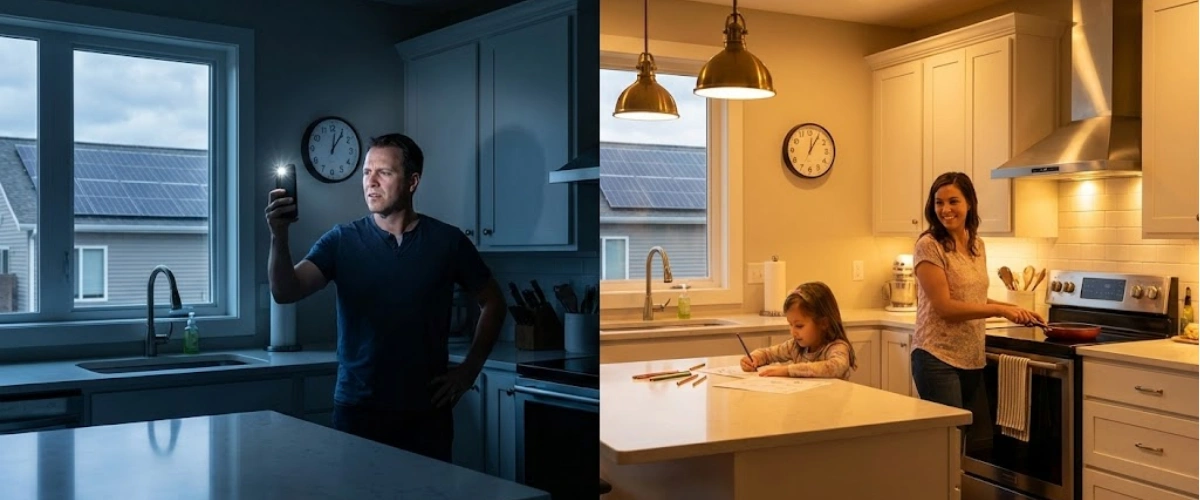
You installed solar panels. You generate more electricity than you use every month. So when the power goes out during the next wildfire, heatwave, or storm, your home will stay powered... right?
Not quite. Here's the reality that surprises thousands of California homeowners every year: standard solar panels shut off automatically when the grid goes down—even if the sun is shining directly on them.
This isn't a design flaw. It's a safety feature. But it means your solar investment alone won't protect you during California's increasingly frequent power outages.
Why Your Solar Panels Shut Off During Power Outages
When the grid loses power, your solar system immediately stops producing electricity. This happens because of anti-islanding protection—a safety feature required by law in all grid-tied solar systems.
Here's why this exists: when utility workers repair downed power lines, they need absolute certainty that no electricity is flowing through those lines. If your solar panels kept feeding power back to the grid during repairs, it could electrocute the workers trying to restore everyone's power.
Your inverter constantly monitors the grid. The moment it detects the grid is down, it shuts off your entire solar system within milliseconds. This happens automatically—you can't override it, and your installer can't disable it.
What Happens to Your Solar Power During an Outage
Even on a perfectly sunny day, your panels essentially become decorative roof ornaments during a blackout. The electricity they could be generating has nowhere to go. Without the grid to "push against," your inverter won't operate.
This surprises homeowners who see their utility bills showing they generate more than they use. That surplus power doesn't mean you have backup capability—it just means you're exporting to the grid during the day and importing at night.
California's Growing Grid Reliability Problem
Southern California's power grid faces mounting pressure from multiple directions. Rising SCE electricity rates continue climbing, but the reliability problems are getting worse too.
Wildfire Public Safety Power Shutoffs have become routine. SCE and other utilities now proactively shut off power to prevent their equipment from sparking fires during high wind events. These planned blackouts can last 2-5 days.
Extreme heat events strain the grid beyond capacity. California's grid operator has issued Flex Alerts asking residents to reduce usage during dozens of days each summer. Rolling blackouts remain a real possibility during the worst heat waves.
Aging infrastructure means unexpected outages happen more frequently. Transformers fail during heat spikes. Trees fall on lines during storms. Equipment malfunctions during peak demand.
The result? Solar and battery systems protect California homes during grid failures has become essential planning for Southern California homeowners, not paranoid preparation.
The Real Solution: Solar + Battery Storage
The only way to use your solar panels during a power outage is adding battery storage to your system. Batteries create a "microgrid" that allows your home to operate independently when the grid goes down.
Here's how it works: Your battery system includes a transfer switch that automatically disconnects your home from the grid during an outage. This isolation is what makes it safe for your solar panels to keep operating. Your panels charge the batteries, and the batteries power your home—no grid connection needed.
What Battery Backup Actually Powers
Most homeowners don't back up their entire home. Instead, they create a "critical loads panel" that includes:
- Refrigerator and freezer
- Internet router and devices
- A few lights and outlets
- Garage door opener
- Medical equipment if needed
A typical 13.5 kWh battery (like the Tesla Powerwall or QCells Q.HOME Core) can power these essentials for 1-2 days without sun, or indefinitely with solar recharging during the day.
For whole-home backup, you'll need 2-3 batteries depending on your home's size and energy usage. This ensures you can run air conditioning, electric appliances, and everything else even during multi-day outages.
How Modern Battery Systems Work
Today's solar battery backup systems are sophisticated. They don't just provide backup power—they optimize your entire energy usage.
During normal operation, your batteries charge from solar during the day and discharge during expensive evening hours. This maximizes your savings under California's time-of-use rates. When the grid fails, they automatically switch to backup mode.
The system monitors grid status constantly. When power returns, it seamlessly reconnects your home to the grid and resumes normal operation. You might not even notice the transitions.
Why Battery Storage Makes Sense in 2026
Beyond emergency backup, batteries deliver significant financial benefits under California's current solar policies. NEM 3.0 makes battery storage essential for any homeowner installing solar today.
NEM 3.0 Changes Everything
California's Net Energy Metering 3.0 policy dramatically reduced the value of excess solar sent back to the grid. Homeowners now receive only $0.05-0.08 per kWh for exports during the day, but still pay $0.45-0.60 per kWh when they import power during evening peak hours.
Batteries solve this problem. Instead of exporting your daytime solar production for pennies, you store it and use it during expensive evening hours. This "solar shifting" can triple your effective savings compared to solar-only systems.
The Financial Case for Batteries
Yes, batteries add $10,000-15,000 to your system cost. But they also:
- Increase your monthly savings by 40-60% compared to solar-only
- Qualify for the 30% federal tax credit (if installed in 2025)
- May qualify for additional SGIP rebates in California
- Eliminate anxiety about outages and food spoilage
- Increase your home's resale value
How solar batteries maximize your savings shows the math clearly: batteries typically add 2-3 years to your payback period while providing backup power worth thousands in peace of mind.
Comparing Your Backup Power Options
If you already have solar without batteries, or you're deciding what to install, you have several backup options. Which backup power option is right for you depends on your budget, backup needs, and existing equipment.
Battery Backup Systems
Best for: Homeowners who want automatic, silent, seamless backup power with solar integration.
Pros: Works with solar, requires no maintenance, provides financial benefits daily, automatic operation, clean and quiet
Cons: Higher upfront cost ($10,000-15,000)
Portable Generators
Best for: Budget-conscious homeowners who can tolerate noise and manual operation.
Pros: Lower cost ($500-2,000), easily portable, works anywhere
Cons: Requires gasoline storage and maintenance, loud operation, manual start-up, doesn't integrate with solar, produces emissions
Whole-Home Standby Generators
Best for: Homeowners who need guaranteed whole-home backup regardless of solar availability.
Pros: Powers everything automatically, proven technology, works during storms/cloudy weather
Cons: Expensive ($8,000-15,000 installed), requires natural gas line, ongoing maintenance, doesn't provide daily savings
Sunlight Backup Systems (No Battery)
Best for: Existing solar owners with Enphase IQ8 microinverters who want minimal backup capability.
Pros: Much lower cost than batteries ($2,000-3,000), works with existing equipment
Cons: Only provides power during sunny hours, limited capacity (typically one 15A circuit), doesn't help at night
The Cost Reality: Is Battery Backup Worth It?
The most common objection to battery backup is cost. One Reddit user shared they were quoted "$15,000+ for two 8kWh Enphase batteries" when their solar system cost $22,000. That ratio can feel shocking.
But context matters. Are batteries worth it for solar in California breaks down the true value proposition. You're not just buying backup power—you're buying:
Daily financial benefits: $50-100 per month in additional savings under NEM 3.0
Outage protection: Avoided food loss, comfort during heat waves, medical device operation
Home value increase: Homes with solar + storage sell faster and for more money
Energy independence: Protection against future rate increases and grid instability
US Power's Approach to Battery Costs
At US Power, we address battery costs through factory-direct QCells pricing. As California's #1 QCells installer, we eliminate distributor markups that other companies pass on to you.
Our typical solar + battery packages run 15-20% below market rates. A system that might cost $35,000 elsewhere costs $28,000-30,000 through US Power—making batteries far more accessible.
We also offer:
- Multiple battery sizing options to match your actual needs
- Transparent pricing with no hidden fees
- 25-year comprehensive warranties on everything
- In-house financing options with competitive rates
How US Power Makes Battery Backup Affordable
We've installed battery backup systems for hundreds of Southern California homeowners since NEM 3.0 took effect. Our approach focuses on right-sizing your system and maximizing available incentives.
The Right Battery Size for Your Home
Not everyone needs whole-home backup. We help you decide what's actually worth backing up:
Essential backup only: 13.5 kWh (1 battery) - Powers refrigeration, lights, internet, and essential outlets. Cost: $10,000-12,000 installed.
Partial home backup: 27 kWh (2 batteries) - Adds HVAC, washer/dryer, and most outlets. Cost: $18,000-22,000 installed.
Whole-home backup: 40+ kWh (3+ batteries) - Powers everything including pool equipment and major appliances. Cost: $26,000-32,000 installed.
Most homeowners choose essential or partial backup. You get the peace of mind you need without overspending on capacity you'll rarely use.
Our 3-6 Week Installation Timeline
Unlike national companies that take 4-6 months to complete installations, US Power's average timeline is 3-6 weeks from contract to Permission to Operate:
- Week 1: Site assessment and engineering
- Week 2: Permit submission and approval
- Week 3-4: Installation (typically 2-3 days of work)
- Week 5-6: Utility inspection and PTO
Our CSLB-licensed team handles everything. You don't chase permits or coordinate with the utility—we manage the entire process.
QCells Quality You Can Trust
Every US Power installation uses American-made QCells panels with industry-leading warranties:
- 25-year product warranty (panels won't fail)
- 25-year performance warranty (guaranteed output)
- 25-year workmanship warranty (our installation quality)
Our 180+ five-star Google reviews consistently mention our installation quality, communication, and post-installation support. When you invest in backup power, you need confidence it will work when you need it.
A free solar consultation takes 15 minutes and gives you a clear picture of your options, costs, and savings—with zero pressure to buy.
Take Control of Your Power Security Today
Standard solar panels shut off during outages—but they don't have to leave you in the dark. Battery storage transforms your solar investment from a money-saving tool into complete energy security.
California's grid isn't getting more reliable. Utility rates aren't getting lower. The longer you wait, the more you'll wish you'd acted sooner when the next PSPS hits your neighborhood or a heat wave triggers rolling blackouts.
US Power makes battery backup accessible through factory-direct pricing, expert guidance on right-sizing your system, and fast installation timelines that get you protected in weeks, not months. Our 180+ five-star reviews prove we deliver on that promise.
Schedule your free consultation today. We'll analyze your actual electricity usage, show you exactly what backup power will cost, and design a system that matches your needs and budget. No pressure, no games—just honest answers and fair pricing.
The next power outage is coming. Will you be ready?
Frequently Asked Questions
Can I add batteries to my existing solar system?
How long will my batteries last during an outage?
What happens if the outage lasts longer than my battery?
Do batteries require maintenance?
Will my batteries work during a wildfire evacuation?


Why Qcells Panels Are the Best Choice for California’s Climate
QCells panels deliver reliable performance even in California’s harsh conditions.
QCells vs Canadian Solar: Which Panels Are Worth It in 2026?
Both have great reviews, the other cost more. Which solar panel is actually worth it?
Do Solar Panels Work in Winter in Southern California?
Solar panels work in winter—maximize energy with batteries and proper placement.








Derechos de autor © 2025 US POWER | Energía solar y techosUS Power - Axia by QCells. All Rights Reserved.

¡Obtenga una estimación solar instantánea usando el satélite!