




QCells vs Canadian Solar: Which Panels Are Worth It in 2026?

Is paying $2,700 more for QCells panels worth it over Canadian Solar? We break down efficiency, warranties, and real Los Angeles installation costs.
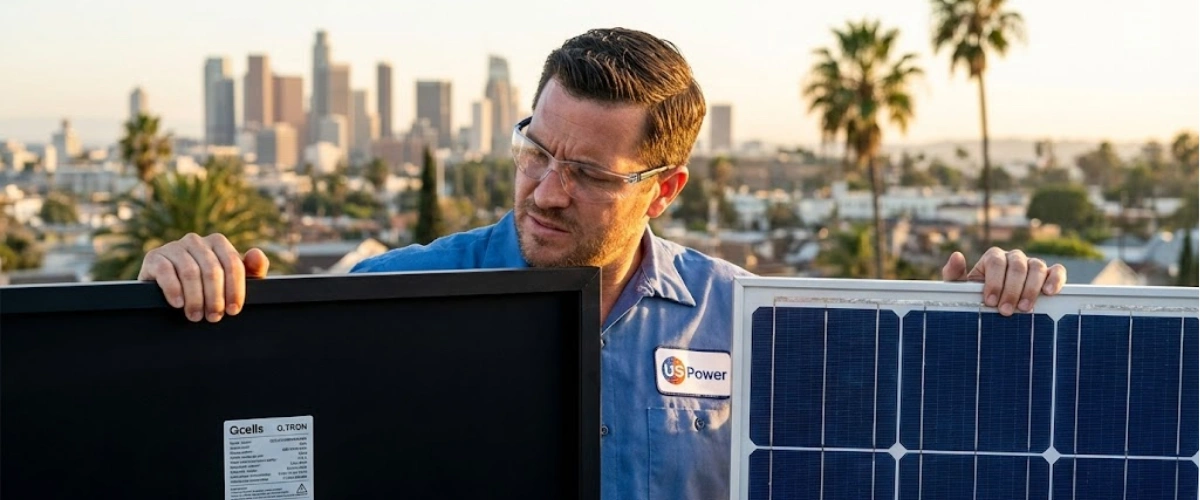
You're staring at two solar quotes on your kitchen table. Both companies seem legitimate. Both have good reviews. The systems are nearly identical in size. But one quote is $2,700 more expensive, and the only real difference is the panel brand: QCells versus Canadian Solar.
This isn't a hypothetical scenario. It's exactly what happened to a Los Angeles homeowner shopping for solar in 2024. He posted his dilemma on Reddit, and the responses were all over the map. Some said QCells are worth every penny. Others called it marketing hype.
So which is it? Are QCells solar panels actually better than Canadian Solar, or are you just paying for a label?
The Real Question Los Angeles Homeowners Are Asking
When you're comparing solar quotes, the price difference between panel brands can feel arbitrary. You're not buying a car where you can test drive both options. You're making a 25-year investment based on spec sheets and sales pitches.
The real question isn't "which panel is better" in some abstract sense. It's "which panel makes more financial sense for my specific situation?" That depends on your roof, your utility rates, your budget, and how long you plan to stay in your home.
For most Southern California homeowners, both QCells and Canadian Solar are solid choices. Neither will fail spectacularly. Both will generate electricity for decades. But there are meaningful differences worth understanding, especially when you're deciding whether that $2,700 premium is justified.
If you're shopping around and feeling overwhelmed by options, our guide on best solar panels in Los Angeles breaks down all the major brands available in 2026.
Why This Comparison Matters for Your Wallet
Let's use real numbers from that Reddit thread. The homeowner needed an 11-12 kW system to cover his usage plus a new EV charger.
Quote 1: Canadian Solar
- 25 panels × 455W = 11.375 kW
- Enphase IQ8A microinverters
- $23,318 cash price ($2.05/watt)
Quote 2: QCells
- 27 panels × 435W = 11.75 kW
- Enphase IQ8MC microinverters
- $26,073 cash price ($2.22/watt)
That's an 11.8% price difference for roughly the same system size. After the 30% federal tax credit, you're looking at $16,322 versus $18,251—still a $1,929 gap.
Over 25 years, will QCells panels generate $1,929 more electricity? Will they last longer? Will they increase your home value more? These are the questions that actually matter.
What $2,700 Extra Actually Buys You
The price premium for QCells isn't arbitrary. You're paying for three things:
- Assembly location: QCells panels are assembled in Georgia using some US-made components. Canadian Solar panels are manufactured entirely in China.
- Brand positioning: QCells markets itself as a premium brand with slightly higher efficiency ratings and better aesthetics (all-black design).
- Warranty structure: Both brands offer 25-year warranties, but the terms differ in ways most homeowners never read.
But here's what you're NOT necessarily buying: dramatically better performance. The efficiency difference between these specific models is marginal—around 0.5-1%. In real-world conditions on a Los Angeles roof, that translates to maybe 50-100 kWh per year in extra production.
At SCE's average rate of $0.35/kWh, that's $17.50 to $35 in extra annual savings. It would take 55-110 years to recoup the $1,929 price difference through efficiency gains alone.
So if efficiency isn't the justification, what is?
QCells Solar Panels: The American-Made Advantage
QCells is a South Korean company that manufactures panels in multiple locations worldwide, including a major facility in Dalton, Georgia. When solar companies say "American-made QCells," they're usually referring to the Q.PEAK DUO or Q.TRON series assembled in Georgia.
The Georgia facility opened in 2019 and has expanded multiple times. It's one of the largest solar panel manufacturing plants in the Western Hemisphere. But "assembled in America" doesn't mean every component is American-made. The silicon cells themselves are still primarily produced in Asia, then shipped to Georgia for assembly into full panels.
Does that matter? For some homeowners, yes. There's genuine value in supporting domestic manufacturing jobs. And some homeowners report feeling better about their purchase knowing it supports American workers, even if the price is higher.
For a deeper dive into what makes QCells unique, check out our comprehensive guide to QCells solar panels.
What "Assembled in Georgia" Really Means
The QCells Georgia facility handles several key manufacturing steps:
- Cell stringing: Connecting individual solar cells into strings
- Lamination: Sealing cells between glass and backsheet
- Framing: Adding aluminum frames and junction boxes
- Quality testing: Electrical performance verification
But the silicon wafers, solar cells, and most materials originate from QCells' facilities in South Korea, Malaysia, and China. The Georgia plant essentially performs final assembly and quality control.
This hybrid approach allows QCells to claim "Made in America" while keeping costs lower than fully domestic production would allow. It's similar to how many car manufacturers "assemble" vehicles in the US using globally sourced parts.
For buyers prioritizing domestic content, this is worth understanding. You're supporting some American jobs, but you're not buying a 100% American-made product.
Performance Specs That Matter: Efficiency and Degradation
Let's look at the actual specifications for the QCells Q.TRON BLK M-G2.H+ 435W panel from the Reddit quote:
- Efficiency: 21.5%
- Temperature coefficient: -0.33%/°C
- First-year degradation: 1%
- Annual degradation (years 2-25): 0.45%
- Estimated output at year 25: 89.4% of original capacity
Compare that to the Canadian Solar CS6.1-54TM-455H:
- Efficiency: 21.3%
- Temperature coefficient: -0.34%/°C
- First-year degradation: 2%
- Annual degradation (years 2-25): 0.45%
- Estimated output at year 25: 87.9% of original capacity
The difference is minimal. QCells has a 0.2% higher efficiency rating and slightly better first-year degradation. Over 25 years, you might see 1-2% more total energy production from QCells—meaningful, but not game-changing.
Both panels handle Southern California's heat reasonably well. The temperature coefficient tells you how much efficiency drops when panels get hot. At -0.33% for QCells, you lose about one-third of one percent of power for every degree Celsius above 25°C. On a 140°F roof in August, that's significant, but both brands lose power at nearly identical rates.
QCells Warranty: What's Actually Covered
QCells offers a 25-year product warranty and a 25-year performance warranty. Here's what that means:
Product warranty covers manufacturing defects—cracked cells, delamination, frame issues, junction box failures. If a panel fails due to defective materials or workmanship, QCells will replace it.
Performance warranty guarantees minimum power output over time. QCells warrants 89.4% of original capacity at year 25. If your panels degrade faster, they'll compensate you—though "compensate" usually means replacing underperforming panels, not cash.
The catch? You need to prove the degradation through professional testing, which costs money. And warranty claims require working through your installer first, then potentially dealing with QCells directly if the installer is unresponsive.
For a detailed breakdown of what solar warranties actually cover, see our guide on QCells warranty coverage.
Canadian Solar Panels: The Value Option
Canadian Solar is one of the world's largest solar manufacturers. Despite the name, the company is actually Chinese-owned (though it started in Canada). Their panels are manufactured primarily in China, Thailand, Vietnam, and Brazil.
The "made in China" label carries baggage in American marketing, but it's worth noting that China produces more solar panels than the rest of the world combined. Chinese manufacturers have decades of experience, massive scale advantages, and generally excellent quality control for established brands like Canadian Solar.
The CS6.1 series (HiKu) panels in the Reddit quote are Canadian Solar's mainstream residential product. They're widely available, competitively priced, and have a solid track record.
Why "Made in China" Isn't Automatically Bad
There's a perception that Chinese-made products are inferior. In solar, that's largely outdated.
Chinese solar manufacturers produce panels for virtually every major brand. Even "American" or "European" brands often source components from China. QCells, SunPower, REC—all have Chinese manufacturing in their supply chains.
Canadian Solar specifically has been manufacturing panels since 2001. They're a publicly traded company (NASDAQ: CSIQ) with significant quality control infrastructure. Their panels are IEC certified and meet the same international standards as any premium brand.
The real difference isn't quality—it's pricing power. Chinese manufacturers benefit from scale, vertical integration, and lower labor costs. They can sell high-quality panels at lower prices. That's why Canadian Solar consistently undercuts premium brands on cost.
For homeowners prioritizing value over brand cachet, this is the entire point. You're not buying inferior panels. You're buying competent panels without the marketing markup.
Performance Specs: How They Compare to QCells
We already covered the Canadian Solar CS6.1-54TM-455H specs above. Let's focus on what matters for Southern California:
Efficiency: At 21.3%, these panels convert sunlight to electricity slightly less efficiently than QCells. On a 400-square-foot roof section getting 5 peak sun hours daily, you'd generate about 2,200 kWh per year with Canadian Solar versus 2,240 kWh with QCells. That's a 40 kWh difference—worth about $14 annually at SCE rates.
Degradation: Canadian Solar's 2% first-year degradation is higher than QCells' 1%. After that, both degrade at 0.45% annually. Over 25 years, QCells panels retain about 1.5% more of their original capacity. On an 11 kW system, that's 165W more output at year 25—enough to power a refrigerator.
Temperature performance: Virtually identical. Both panels lose efficiency in heat at nearly the same rate.
The honest truth? In real-world Los Angeles conditions, you probably wouldn't notice the performance difference. Both systems will overproduce in summer and underproduce in winter. Both will offset your electric bill by similar amounts. The $14-$20 annual difference in production won't change your financial outcome meaningfully.
Canadian Solar Warranty Coverage
Canadian Solar offers a 25-year product warranty and a 25-year performance warranty—identical structure to QCells.
Product warranty: Covers manufacturing defects for 25 years. Same process as QCells—if a panel fails, they replace it.
Performance warranty: Guarantees 87.9% of original capacity at year 25. Slightly worse than QCells' 89.4%, but again, the real-world difference is marginal.
The catch with Canadian Solar? Warranty service reputation is mixed. Some installers report faster response times from QCells. Some homeowners report difficulty reaching Canadian Solar for claims. This varies by installer relationship and luck.
Here's the reality: panel failures are rare. If you choose a quality installer who stands behind their work, your installer warranty matters more than the manufacturer warranty. A local company that returns your calls beats a manufacturer warranty you'll struggle to activate.
Head-to-Head: Performance, Durability, and Real-World Results
Let's cut through the marketing and look at what actually matters over 25 years.
Efficiency Ratings in Southern California Sun
Both brands perform well in Los Angeles' intense sun. With 300+ sunny days per year and peak sun hours averaging 5-6 hours daily, even modest efficiency differences add up.
A properly sized 11 kW system (roughly 25-27 panels) should generate 15,000-17,000 kWh annually in Southern California. That assumes south-facing roof with minimal shading and optimal tilt.
QCells advantage: About 100-150 kWh more annual production due to higher efficiency and better first-year degradation. Worth $35-$50 per year at current SCE rates.
Canadian Solar advantage: Lower upfront cost by $2,700, which you can invest elsewhere (or put toward a battery).
If you ran the numbers purely on efficiency ROI, Canadian Solar wins. You'd need 54-77 years to recoup the QCells premium through efficiency gains alone—well beyond the system's useful life.
But efficiency isn't the whole story. For a broader look at how different brands compare, see our analysis of QCells vs the competition.
25-Year Degradation Rates Compared
Both brands degrade slowly, which is what you want. But QCells has a slight edge:
Year 1: QCells retains 99% of capacity; Canadian Solar retains 98%
Year 10: QCells at 95%; Canadian Solar at 94%
Year 25: QCells at 89.4%; Canadian Solar at 87.9%
On an 11 kW system:
- QCells at year 25: 9,834W of capacity remaining
- Canadian Solar at year 25: 9,669W remaining
That's a 165W difference—meaningful but not transformative. You'll still be generating plenty of power with either brand.
The bigger question: Will either company still be around in 25 years to honor the warranty? QCells and Canadian Solar are both large, financially stable companies. But the solar industry is volatile. Suntech, SunEdison, and other once-dominant brands have collapsed.
Your best protection isn't the manufacturer warranty—it's choosing an installer with a strong workmanship warranty and a track record of staying in business.
Real Los Angeles Installation Data
Here's what actually happened to the Reddit homeowner who posted the original question: He chose Canadian Solar with Future Energy and signed the contract in July 2024.
His timeline:
- July 16: Contract signed
- July 23: Site visit completed
- July 30: Installation completed (ahead of schedule due to cancellation)
- August 5: Passed inspection
- August 12: LADWP meter installed, PTO granted
Total time from contract to power-on: 27 days.
His feedback? He was happy with his choice. Not because Canadian Solar panels are objectively better, but because the installer communicated well, the price was competitive, and the project moved quickly.
That's the real lesson here. Panel brand matters less than you think. Installer quality matters more.
The Price Difference: When Is It Worth Paying More?
Let's be blunt: Most of the time, paying extra for QCells isn't financially justified based on performance alone.
If you're purely optimizing for ROI, Canadian Solar makes more sense. The efficiency difference is marginal, the warranty is similar, and you save $2,700 upfront. Over 25 years, you'll generate 2-3% less electricity—a difference you'll never notice on your electric bill.
But personal finance isn't purely rational. Here are legitimate reasons to pay more for QCells:
1. You value domestic manufacturing: Supporting American jobs matters to you, even if it costs more. Fair enough.
2. Aesthetics matter: QCells all-black panels look sleeker than Canadian Solar's silver-framed panels. If your roof is highly visible and curb appeal matters, this could influence resale value.
3. You're staying in the home 20+ years: The efficiency advantage compounds. If you're never selling, the extra few hundred watts at year 25 might matter.
4. You want the "best" regardless of ROI: Some people just prefer premium products. That's fine, as long as you understand you're paying for preference, not dramatically better performance.
Breaking Down the Cost Per Watt
The Reddit homeowner paid:
- Canadian Solar: $2.05/watt
- QCells: $2.22/watt
In 2026, competitive pricing for residential solar in Southern California ranges from $2.00 to $2.80 per watt depending on:
- Panel brand
- Installer overhead
- System size
- Roof complexity
- Permit and interconnection fees
Both quotes were reasonable. Neither was overpriced for Los Angeles.
The sweet spot for most homeowners? $2.10-$2.30/watt for a quality system with premium panels, microinverters, and a strong workmanship warranty.
If you're quoted above $2.50/watt, you're likely paying for marketing overhead, aggressive commissions, or unnecessary add-ons. If you're quoted below $2.00/watt, scrutinize the installer's experience and warranty terms—low prices sometimes signal corner-cutting.
Calculating Your 25-Year ROI
Let's run real numbers on an 11 kW system paying SCE rates:
Canadian Solar scenario:
- Upfront cost (after 30% tax credit): $16,322
- Annual production: 15,500 kWh
- Year 1 savings: $5,425
- 25-year savings: $120,000+ (assuming 3% annual rate increases)
- Net profit: $103,678
QCells scenario:
- Upfront cost (after 30% tax credit): $18,251
- Annual production: 15,650 kWh (100 kWh more per year)
- Year 1 savings: $5,478
- 25-year savings: $121,200+ (assuming 3% annual rate increases)
- Net profit: $102,949
Wait—Canadian Solar has a higher net profit? Yes. The extra $1,929 upfront cost for QCells exceeds the additional electricity savings over 25 years.
This is why panel brand shouldn't be your primary decision factor. Both options generate massive returns. The $729 difference in net profit over 25 years is noise compared to the $100K+ you'll save compared to staying with the utility.
For detailed ROI calculations specific to your situation, see our guide on calculating your 25-year ROI.
Resale Value Considerations
Some real estate agents claim QCells panels increase home values more than Canadian Solar. The data on this is mixed.
Studies show solar panels generally increase home value by $15,000-$20,000 in Southern California, but there's little evidence that panel brand significantly affects this premium. Buyers care that you have solar. They rarely ask about brand.
The exceptions:
- Leased systems: These can actually hurt resale value if the lease terms aren't favorable
- Unknown brands: Cheap panels from obscure manufacturers raise questions about quality
- Aesthetics: All-black panels may appeal more to design-conscious buyers
Between QCells and Canadian Solar, you're splitting hairs. Both are recognizable, reputable brands that won't scare off buyers.
Why US Power Only Installs QCells (And Passes Savings to You)
Here's where things get interesting. US Power is an exclusive QCells partner, which means we get factory-direct QCells pricing that most installers can't match.
Remember that $2.22/watt QCells quote from the Reddit thread? We consistently beat that—typically by 15-20%—because we eliminate the distributor middleman.
Our typical QCells pricing: $2.00-$2.15/watt for systems with premium panels, Enphase microinverters, and our 25-year comprehensive warranty.
That changes the math entirely. If you can get QCells at Canadian Solar prices, the decision becomes obvious.
Factory-Direct Partnership Eliminates Middleman Markup
Most solar installers buy panels through distributors, who mark up the wholesale price by 15-25%. That markup gets passed directly to you.
As a QCells exclusive partner, we:
- Buy directly from the factory at wholesale rates
- Stock inventory in California for faster installations
- Get priority allocation during supply shortages
- Receive direct technical support from QCells engineers
The result? We can offer QCells panels at prices that compete with value brands, without sacrificing quality or warranty coverage.
This isn't a bait-and-switch where we upsell you later. Our quotes include everything: panels, microinverters, racking, labor, permits, interconnection, monitoring, and our 25-year workmanship warranty. No hidden fees. No surprise charges during installation.
Quality Control with In-House Installation Teams
Here's something the Reddit thread touched on: installation quality matters more than panel brand.
Large solar companies often subcontract installations to the lowest bidder. That's how you get cracked tiles, roof leaks, and "oops, we need to charge you extra for additional racking" surprises mid-project.
US Power uses in-house installation crews. Every installer is a W-2 employee, not a subcontractor. They're CSLB-licensed, trained specifically on QCells products, and accountable to our quality standards.
This matters when things go wrong. If you have an issue five years after installation, you're calling us—not trying to track down a subcontractor who's moved on to other projects.
For guidance on what to look for when vetting installers, see our article on how to choose a solar company.
25-Year Comprehensive Warranty on Everything
Most installers offer a 10-year workmanship warranty and point you to the manufacturer for panel issues. That's fine until you realize coordinating between installer and manufacturer is a nightmare.
Our warranty is simpler: 25 years on everything—panels, inverters, racking, labor, and performance.
If something fails, you call us. We handle it. No finger-pointing between installer and manufacturer. No "that's not covered under our warranty" runarounds.
This is especially valuable in years 10-25, when many installers have gone out of business. We've been in business for over a decade specifically because we stand behind our work.
What Really Matters: Panels Are Only Part of the System
Here's the uncomfortable truth: homeowners obsess over panel brands and mostly ignore the components that cause 80% of solar system failures.
Your inverter is far more likely to fail than your panels. Microinverters like Enphase have a 25-year warranty, but they're electronic components exposed to heat and weather. Failures happen. When they do, your system stops generating power.
Your racking matters more for roof integrity than panel brand. Cheap racking with improper flashing causes leaks. Poor installation voids your roof warranty. This is where inexperienced installers cut corners.
Your installer's business stability matters more than manufacturer warranties. If your installer closes in year 8 and you have a problem in year 12, you're stuck navigating manufacturer warranty claims alone—a process that's often frustrating and slow.
Why Your Inverter Choice Matters More Than You Think
Both Reddit quotes used Enphase microinverters—the right choice.
Microinverters (one per panel) outperform string inverters (one for the whole system) in several ways:
- Shade tolerance: One shaded panel doesn't drag down the whole system
- Panel-level monitoring: You can see exactly which panels are underperforming
- Redundancy: If one microinverter fails, the rest keep working
- Future expandability: Easy to add more panels later
The difference between Enphase IQ8A and IQ8MC models? Mostly power handling capacity. The IQ8MC in the QCells quote can handle higher-wattage panels more efficiently. It's a minor difference in real-world performance.
If an installer tries to sell you a string inverter to save money, run. The $500-$1,000 you save upfront isn't worth the performance loss and single point of failure.
Installation Quality Trumps Panel Brand Every Time
The Reddit poster made a smart observation: he chose Future Energy partly because the salesperson's communication style was straightforward. No pressure. No mandatory in-person pitches. Just text and email with transparent pricing.
That's the right instinct. An installer who respects your time and communicates clearly is more likely to respect your home and do quality work.
Red flags to watch for:
- Pressure to sign immediately ("This price is only good today")
- Vague quotes (no itemized breakdown of equipment and costs)
- Upcharges mid-project ("Your roof needs extra racking; that'll be $2,000 more")
- Subcontractor disclaimers ("We can't control what the installation crew does")
- Lowball quotes (significantly cheaper than competitors without explanation)
Green flags:
- Detailed quotes with specific equipment models and pricing
- Site visit before final quote (not relying on satellite imagery alone)
- Clear warranty terms (who covers what, for how long)
- References you can check (real customers, not cherry-picked testimonials)
- CSLB license verification (California State License Board)
Making Your Decision: Price vs Performance vs Peace of Mind
If you've read this far, you already know the answer: there is no universal "best" panel brand.
Canadian Solar makes sense if you want proven performance at the lowest price. QCells makes sense if you value premium features and domestic assembly—especially if you can find factory-direct pricing.
But here's what matters more than the brand name on your panels:
- Installer quality: Choose a company that communicates well, does quality work, and will still be in business in 10 years
- System design: Proper sizing, optimal roof placement, and quality inverters matter more than panel brand
- Warranty coverage: Make sure you understand what's covered and who handles claims
- Price transparency: Avoid installers who use panel brand as an excuse for hidden upcharges
The Reddit homeowner made a good choice. Not because Canadian Solar panels are objectively superior, but because he found an installer he trusted, got transparent pricing, and didn't overthink the decision.
You should do the same. Compare quotes. Check references. Read the warranty terms. Then choose the option that makes you feel confident—whether that's QCells, Canadian Solar, or another quality brand entirely.
At US Power, we only install QCells because our factory-direct partnership lets us offer premium panels at value-brand prices. That eliminates the trade-off. But if another installer you trust is offering Canadian Solar at a great price? That's a perfectly fine choice too.
The goal is solar panels on your roof, offsetting your SCE or LADWP bill, not analysis paralysis over spec sheets.
Ready to move forward? Get a transparent quote with detailed equipment specs, itemized costs, and no pressure sales tactics. See exactly what you'll pay and save before you commit.
Frequently Asked Questions
Are QCells panels worth the extra cost?
How long do QCells vs Canadian Solar panels last?
Which brand has better efficiency?
Does "Made in America" actually matter?
What if I'm on a tight budget?


Choosing Between AC vs DC Solar Batteries for Energy Savings
Explore AC vs. DC solar systems and maximize your home’s backup and savings.
Solar Installation Timeline Explained for California Homeowners
Understand the steps and timing for a smooth home solar installation process.

Is There a “Best” Residential Solar Brand in 2025?
Before choosing your solar system, compare the leading brands head-to-head.








Derechos de autor © 2025 US POWER | Energía solar y techosUS Power - Axia by QCells. All Rights Reserved.

¡Obtenga una estimación solar instantánea usando el satélite!