




Will Solar Prices Drop in 2026? The Truth About Post-Tax Credit Pricing

Will solar get cheaper in 2026? Here's what the data in Southern California actually shows.
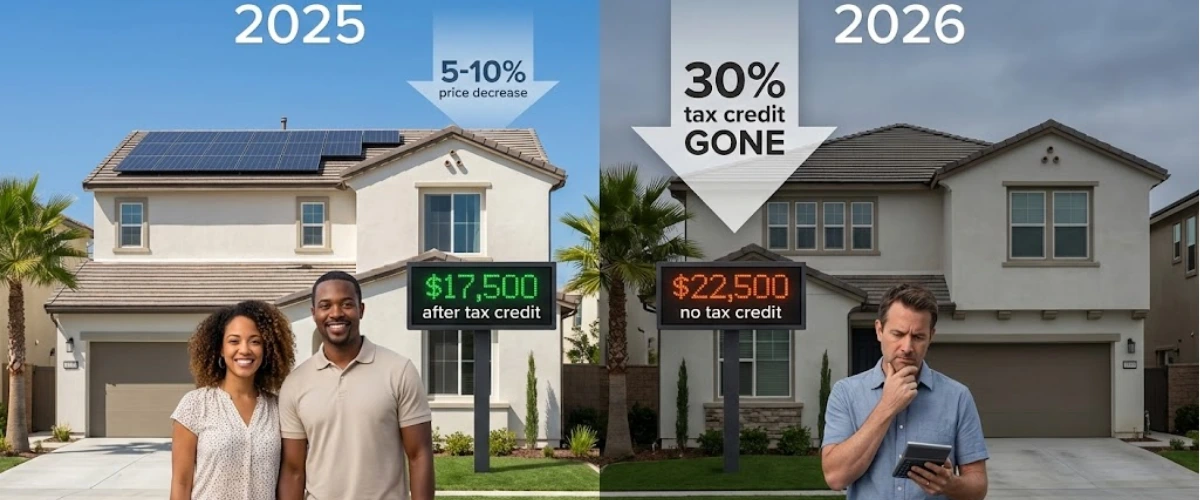
If you're reading this, you probably got a solar quote that made your eyes water. Maybe you're thinking: "I'll just wait until 2026 when the 30% tax credit goes away and prices drop."
You're not alone. Thousands of Southern California homeowners are asking the same question right now. And there's a lot of conflicting information out there—from installers who say prices will stay the same, to people on Reddit claiming everything will be 30% cheaper by February.
Here's what's actually going to happen, based on industry data, installer economics, and what's already playing out in states where incentives disappeared.
Why Everyone Thinks Solar Prices Are Inflated Right Now
Let's address the elephant in the room. A lot of homeowners suspect that solar companies jacked up their prices when the 30% federal solar tax credit became available. The logic makes sense: if the government is giving customers 30% back, why not just charge 30% more?
Here's the reality. Some companies did exactly that. But not in the way you think.
The real price inflation didn't come from greed—it came from dealer fees. Many solar companies offer 0% or 1.99% financing with zero down. Sounds great, right? Except those loans come with hidden costs. The lender charges the installer a 20-30% dealer fee to buy down the interest rate. And guess who pays that fee? You do. It's baked into the system price.
So when you see a quote for $35,000 on a system that should cost $25,000, that extra $10,000 isn't pure profit for the installer. Most of it goes to the financing company. After the tax credit, you're roughly breaking even—or paying slightly more than you should.
This practice became standard across the industry. And yes, it made solar feel more expensive than it needed to be.
What the Data Actually Shows About 2026 Pricing
California's current average solar installation cost sits at $3.14 per watt as of December 2025. For a typical 7.2 kW system, that's about $22,600 before incentives.
Industry analysts predict installations will drop 25% in 2026 compared to 2025. That's significant, but it's not the 55% collapse some expected. Why? Because solar still makes financial sense—even without the tax credit.
Here's what's likely to happen with pricing:
Q1 2026 (January-March): Prices will probably stay flat or even increase slightly. Supply chains are still squeezed from the year-end rush. Tariffs on imported components remain in place. Installers with healthy backlogs won't discount aggressively.
Q2-Q3 2026 (April-September): This is when you might see modest price drops of 5-10%. Installations slow down. Competition increases for fewer customers. Some marginal installers go out of business, creating brief opportunities for deals.
Q4 2026 and Beyond: Prices stabilize at a new normal—probably 10-15% lower than peak 2025 pricing, but nowhere near the 30% some people expect.
The key word here is modest. Don't expect a fire sale.
The Real Driver: Rising Electricity Rates, Not Tax Credits
Here's what most people miss when they focus on the tax credit ending. The value of solar isn't the upfront discount—it's what you save over 25 years.
Southern California Edison (SCE) rates have increased 32% since 2014. And they're not slowing down. Between AI data centers, wildfire mitigation costs, and infrastructure upgrades, experts project electricity costs will rise $83-152 per year for the average household.
Let's do the math on a real scenario:
Scenario A: Install solar in December 2025 with tax credit
- System cost: $25,000
- After 30% tax credit: $17,500
- Monthly payment (20-year loan at 6%): $125
- Current SCE bill: $220/month
- Net monthly savings: $95
Scenario B: Wait until mid-2026, prices drop 10%
- System cost: $22,500 (10% lower)
- No tax credit
- Monthly payment (20-year loan at 6%): $161
- Current SCE bill: $220/month
- Net monthly savings: $59
Over 20 years, Scenario A saves you an additional $8,640. Even with a 10% price drop, waiting costs you more.
And that's assuming rates don't increase. If SCE raises rates by just 3% annually (conservative estimate), the 2025 system saves you even more.
The tax credit isn't a discount. It's acceleration of payback. You hit break-even faster. But the long-term savings come from locking in protection against rising Southern California electricity rates and securing your energy costs today.
Why Installer Margins Aren't What You Think They Are
Let's talk about the claim that installers are price-gouging because of the tax credit. You see comments online saying equipment costs $11,000 but installers charge $33,000. That must be pure profit, right?
Wrong. Here's what actually goes into that price gap:
Equipment costs (about $11,000 for a 9 kW system):
- Solar panels: $4,500
- Inverters/optimizers: $2,500
- Racking and mounting: $1,500
- Electrical components: $1,500
- Battery (if included): $6,000-12,000 additional
Labor and overhead (the other $14,000-22,000):
- CSLB-licensed installers: $8,000-12,000
- Engineering and design: $1,500-2,500
- Permitting and utility fees: $800-1,500
- Insurance and licensing: $1,200-2,000
- Project management: $1,500-2,500
- Warranty administration: $800-1,200
- Dealer fees (if financed): $5,000-7,500
After all expenses, most quality installers operate on 8-15% net margins. That's not price-gouging. That's a normal business margin for a skilled trade.
The companies that will drop prices dramatically in 2026? They're the ones who were overcharging to begin with. They're also the ones most likely to cut corners, use lower-quality components, or go out of business when their volume collapses.
You don't want to buy solar from a company that won't be around to honor your 25-year warranty.
What About Leases and PPAs in 2026?
Here's where things get interesting. While the consumer tax credit (Section 25D) ends December 31, 2025, the commercial tax credit (Section 48E) continues through 2027 for leased systems.
This has created a new product: prepaid leases.
Here's how they work. You pay a lump sum upfront (similar to buying). The leasing company takes the tax credit. You get a discount—typically 15-20% off the purchase price. After 5-6 years, ownership transfers to you.
Sounds good, right? Maybe. The devil is in the details.
Prepaid lease pros:
- Lower upfront cost than purchasing outright in 2026
- Access to tax credit benefits (indirectly)
- Less cash out of pocket
Prepaid lease cons:
- You don't own the system for 5-6 years
- Murky terms around early buyout or home sale
- Can't claim property tax exclusions immediately
- Potential issues if leasing company goes bankrupt
- Harder to refinance or sell your home
For most Southern California homeowners, the decision of whether to buy or lease solar panels comes down to one question: Do you plan to stay in your home for more than 10 years? If yes, ownership almost always wins.
If you're only going to be in your home for 3-5 years, a prepaid lease might make sense. But get everything in writing, especially the transfer process.
NEM 3.0 Makes Batteries Essential, Not Optional
One factor that's changing the solar equation completely: California's Net Energy Metering 3.0 (NEM 3.0) policy.
Under the old NEM 2.0 rules, you got paid full retail rates for excess solar you sent to the grid. Under NEM 3.0, you get paid about 25% of retail—roughly 8-10 cents per kWh.
This makes batteries crucial. Without storage, you're giving away 75% of the value of your solar production. With battery storage paired with solar, you store that excess energy and use it during expensive peak hours (4-9 PM).
Here's the problem: batteries add $10,000-15,000 to your system cost. That's on top of the solar panels. And while batteries are eligible for the 30% tax credit in 2025, they're also eligible through 2027 under commercial programs.
So if you're planning to add battery storage anyway, the question becomes: Do you want to maximize your savings by getting the full system (solar + battery) installed before year-end? Or do you want to piece it together over multiple years?
Most homeowners find that getting everything done at once—panels, battery, and installation—saves money in the long run. You avoid multiple permitting fees, inspection fees, and site visits.
How US Power Keeps Pricing Honest
This is where US Power's model is fundamentally different from most solar companies.
We're the exclusive QCells partner in Southern California. That means we don't shop around for the cheapest panels from wherever. We source directly from the QCells factory in Dalton, Georgia. American-made. No middlemen.
This factory-direct QCells pricing model gives us 15-20% lower costs than companies buying through distributors. We pass those savings to you.
Here's what that looks like in practice:
Traditional installer:
- Buys panels from distributor: $0.85/watt
- Distributor markup: 25-35%
- Final panel cost: $1.10-1.15/watt
US Power (factory-direct):
- Buys panels from QCells factory: $0.70/watt
- No distributor markup
- Final panel cost: $0.70/watt
That difference adds up. On a typical 7.2 kW system (about 18 panels at 400W each), you save $2,880-3,240 just on the panels. That's before we talk about competitive labor rates and transparent pricing.
We also don't play financing games. If you want 0% financing, we show you what it costs—usually a 10-15% dealer fee. If you want to pay cash or get your own loan, we quote the cash price. No bait and switch.
And our installation timeline? 3-6 weeks after approval. Most companies are quoting 8-12 weeks because they're overwhelmed. We maintain capacity specifically to avoid those delays.
Will Some Installers Lower Prices? Yes. Should You Wait? Probably Not.
Here's the straight answer: Yes, some installers will lower prices in 2026. But not the ones you want to work with.
The installers who drop prices 20-30% in early 2026 are the ones who were overcharging to begin with. They're also the ones most likely to cut corners, use lower-quality components, or go out of business when their volume collapses.
Quality installers with fair pricing, proven track records, and strong financial backing? They'll drop prices 5-10% at most. Because they can't afford to operate at a loss, and they won't compromise on quality.
You might save $2,000-3,000 by waiting. But you'll lose $9,000 in tax credits. You'll also lose 6-12 months of electricity savings (another $1,500-3,000 depending on your usage). And you'll take on the risk that the installer you choose won't be around in 5 years to honor your warranty.
The math doesn't work.
What Happens to Equipment Costs in 2026?
One area where you might see savings: equipment costs. Panel prices have already dropped significantly. In 2014, the average cost was $3.80/watt. In late 2024, it hit a record low of $2.50/watt.
Tariffs complicate this. The current administration has imposed tariffs on Chinese solar components, and there's talk of expanding them to Vietnam, Thailand, and other manufacturing hubs. If those tariffs stick, equipment costs could actually increase 10-20% in 2026.
On the flip side, if tariffs are rolled back or manufacturers build more U.S. capacity (like QCells is doing), equipment costs could drop another 5-10%.
Battery costs are following a similar trajectory. Lithium-ion battery prices have dropped 89% since 2010. They're expected to drop another 15-20% by 2027 as manufacturing scales up.
But here's the thing: Even if equipment costs drop 15%, labor costs won't. Insurance costs won't. Permitting fees won't. Those costs are actually increasing due to inflation and rising wages.
So while you might save a few thousand dollars on equipment in late 2026 or 2027, you're unlikely to see total system costs drop more than 10-15% from today's fair market pricing.
The Bottom Line: Is Solar Still Worth It in 2026?
Let's cut through the noise. Solar will still be worth it in 2026 for most Southern California homeowners. Here's why:
Rising utility rates: SCE and PG&E aren't getting cheaper. Every year you wait, you pay more to the utility. Over 25 years, that adds up to tens of thousands of dollars.
Long-term ROI: Even without the tax credit, solar still delivers strong ROI, calculating to a 15-20% return on investment for most homes. That's better than most stock market returns, with zero volatility.
Energy independence: Pairing solar with batteries means you're protected during blackouts and grid failures. That peace of mind has value beyond dollars.
Home value increase: Solar systems add 4-6% to your home's resale value, and homes with solar sell 13% faster in Southern California.
But—and this is important—you should act before December 31, 2025 if possible.
Why? Because even with modest 2026 price drops, you can't make up for losing $7,000-12,000 in tax credits. The break-even timeline difference is 3-4 years. And those are years where you could be saving money instead of paying SCE.
Your Next Steps: Don't Wait for Prices That Might Never Come
If you've been sitting on the fence waiting for a better deal in 2026, here's what you need to know:
The "better deal" probably isn't coming. At least not in a way that offsets losing the 30% tax credit.
What you should do right now:
- Get multiple quotes from reputable installers. Don't just grab the cheapest price. Look at warranties, component quality, installation timelines, and company stability.
- Run the actual numbers. Don't trust vague promises. Get a site-specific analysis that shows your current usage, projected savings, and break-even timeline.
- Understand your financing options. Cash purchase gives you the best long-term ROI. Solar loans are next best if you can avoid high dealer fees. Leases and PPAs make sense in very specific scenarios.
- Act before December 31, 2025. This isn't a sales pitch. It's math. The tax credit ends, and it's not coming back.
US Power's consultants can walk you through all of this in a free, no-pressure consultation—virtual or on-site. We'll show you exactly what your system would cost, what you'd save, and whether 2025 or 2026 makes more financial sense for your situation.
No games. No pressure. Just honest information so you can make the best decision for your family..
Don't Leave Money on the Table
The question isn't whether solar prices will drop in 2026. They probably will—a little.
The question is whether that small drop is worth giving up $7,000-12,000 in guaranteed tax credits, plus a year of electricity savings, plus the risk of working with desperate installers.
For 95% of Southern California homeowners, the answer is no.
Get your honest quote from US Power before the deadline. We'll show you exactly what you'd save with 2025 pricing versus waiting for 2026. No pressure, no games—just real numbers so you can decide.
Frequently Asked Questions
Will solar installers really lower their prices in 2026?
Should I wait until 2026 to go solar and get lower prices?
Are solar companies inflating prices because of the tax credit?
How do I know if an installer is giving me a fair price?
Will battery prices drop significantly in 2026?


How US Power Delivers Solar Faster Than the Competition
Learn how US Power installs solar efficiently without compromising quality.

The US Power Installation Experience: Quality Backed by Qcells
Experience faster, high-quality solar installations backed by QCells reliability.
Do Solar Panels Work in Cold Weather? What California Homeowners Need to Know
Cold weather boosts solar efficiency. CA homeowners: maximize year-round savings.








Derechos de autor © 2025 US POWER | Energía solar y techosUS Power - Axia by QCells. All Rights Reserved.

¡Obtenga una estimación solar instantánea usando el satélite!