




Why 60% of Your Solar Power Goes to Waste Without Batteries

Discover why most Southern California solar systems waste over half their production without battery storage, and how US Power's solutions capture every dollar of savings.
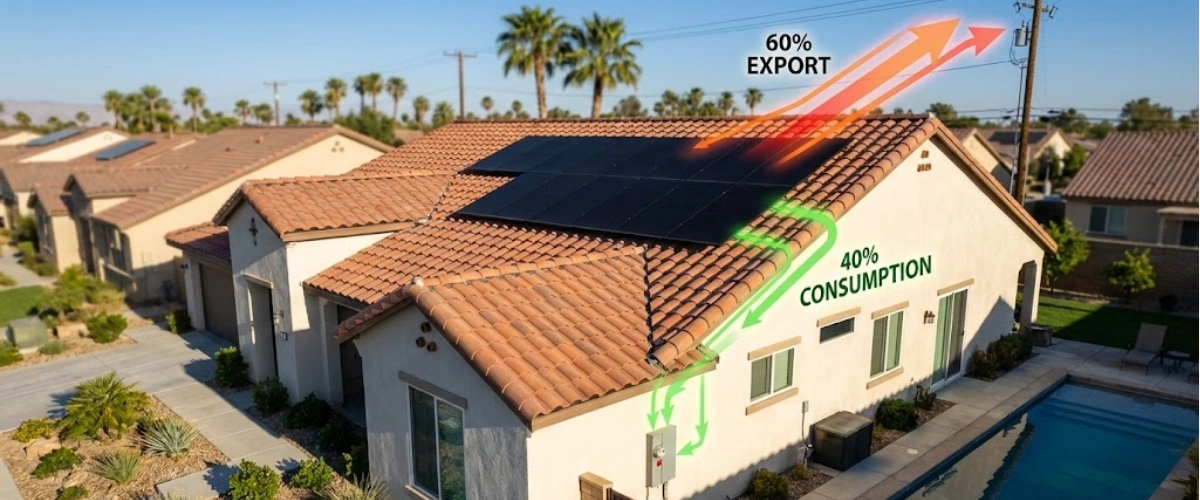
You installed solar panels to slash your electricity bills. But here's what most Southern California homeowners don't realize until it's too late: without battery storage, you're likely giving away 60% or more of the clean energy your panels produce—for pennies on the dollar.
A recent analysis of real-world solar performance data revealed a shocking truth. One homeowner with a 6.7kW solar system discovered that only 36% of his annual solar generation actually powered his home. The remaining 64% was exported to the utility grid at rates that were 70% lower than what he paid to buy electricity back.
And if you think that's just one extreme case, think again. Under California's NEM 3.0 policy and SCE's current rate structure, this utilization crisis affects nearly every solar-only homeowner in Southern California.
The Hidden Problem: Most Solar Systems Waste More Than Half Their Production
When you picture solar panels on your roof, you probably imagine them powering your refrigerator, air conditioner, and every light in your home. The reality? Most of that solar energy flows straight past your home and onto the grid—where you're compensated at a fraction of its actual value.
Here's why this happens. Solar panels generate the most electricity between 9 AM and 3 PM when the California sun is strongest. But most Southern California households use the majority of their electricity during different hours—early morning routines, evening cooking and entertainment, late-night air conditioning in summer, and overnight EV charging.
The Timing Mismatch That's Costing You Thousands
The case study that opened this article isn't an outlier. That Arizona homeowner with 36% self-consumption was actually being strategic about his energy use. In Southern California, where NEM 3.0 policies are even less favorable, the situation is worse.
Consider a typical weekday for a working family in Los Angeles. By 7 AM, everyone's left for work and school. Your solar panels kick into high gear around 9 AM, flooding your empty home with clean energy that has nowhere to go except the grid. By 5 PM when your family returns and energy consumption spikes, the sun is setting and your panels are producing minimal power.
The result? You export cheap midday solar power to SCE at 5-8 cents per kWh, then buy expensive evening electricity back at 34-58 cents per kWh depending on your rate plan. It's like selling dollar bills for quarters, then buying them back for five dollars each.
Real Numbers: What You Actually Get Paid for Exported Solar
Under California's NEM 3.0 solar export rates, the compensation structure has fundamentally changed. Gone are the days of 1:1 net metering where exported solar earned the same credit as retail electricity rates.
Today's reality for Southern California Edison customers looks like this:
What You Pay SCE to Import Electricity:
- Off-peak (overnight): 24-31¢ per kWh
- Mid-peak: 42-48¢ per kWh
- On-peak (4-9 PM): 58-74¢ per kWh
- Average residential rate: 34.5¢ per kWh
What SCE Pays You to Export Solar:
- Midday hours (highest production): 5-8¢ per kWh
- Early morning/evening: 8-12¢ per kWh
- Summer late afternoon (only): up to 15-20¢ per kWh
The math is brutal. You're exporting at rates that are 75-85% lower than what you pay to import electricity. For every 100 kWh your panels produce during peak sunshine hours, you might earn $5-8 in export credits—but buying that same 100 kWh back during evening hours costs $34-58.
Why California's NEM 3.0 Makes Battery Storage Essential
California's net metering policy didn't just change—it fundamentally transformed the economics of residential solar. What used to be a simple calculation (solar panels = lower bills) now requires strategic energy management to maximize your investment.
How NEM 3.0 Changed the Solar Game
Before April 2023, California operated under NEM 2.0, which credited solar exports at or near retail electricity rates. If SCE charged you 30¢ per kWh, you received approximately 30¢ per kWh for your solar exports. The system essentially used the grid as a free battery—storing your excess solar during the day and withdrawing it at night.
NEM 3.0 eliminated that arrangement. Now, exports are valued using an "Avoided Cost Calculator" that pays you based on what the utility would otherwise spend to generate or purchase that electricity at that specific moment. Since California's grid is already saturated with solar during midday hours, the value of your noon-time solar exports plummets.
The policy was designed to encourage exactly what homeowners should be doing anyway: using their own solar power instead of relying on the grid. And the only practical way to do that when your production and consumption don't align? Battery storage.
The SCE Rate Structure Makes It Worse
If NEM 3.0's reduced export rates weren't enough, Southern California Edison rates in 2026 have created an even wider gap between what you pay and what you earn.
SCE's time-of-use rate structure means electricity costs the most exactly when your solar panels produce the least. The dreaded 4-9 PM on-peak window—when rates spike to 58¢ per kWh or higher—coincides with declining solar production as the sun sets.
Meanwhile, your panels are cranking out maximum power during the 9 AM-2 PM window when:
- Most people are at work
- Grid demand is moderate
- Export compensation is at its lowest
- Your home needs minimal electricity
Understanding SCE time-of-use rate plans is critical because the rate differential between peak and off-peak hours can be 3:1 or higher. That spread is where battery storage delivers its enormous value.
The Real Math: Solar-Only vs. Solar + Battery Systems
Let's break down what this utilization crisis actually costs Southern California homeowners using real-world scenarios.
Scenario 1: Solar Panels Only (The Waste Scenario)
System size: 8kW solar array
Annual production: 12,000 kWh
Household consumption: 10,000 kWh/year
Self-consumption rate: 35% (industry average without batteries)
Export rate: 65%
Annual breakdown:
- Solar used directly: 4,200 kWh × $0.345 (avg SCE rate) = $1,449 saved
- Solar exported: 7,800 kWh × $0.07 (avg export rate) = $546 credit
- Electricity purchased from grid: 5,800 kWh × $0.345 = $2,001 cost
- Net annual savings: $1,449 + $546 - $2,001 = -$6 (minimal benefit)
Even with a substantial 8kW system producing 20% more power than the home uses annually, the homeowner sees almost no net savings because of the utilization mismatch.
Scenario 2: Solar + Battery Storage (The Optimized Scenario)
System size: Same 8kW solar array
Battery: 13.5 kWh storage
Annual production: 12,000 kWh
Self-consumption rate: 85% (with battery optimization)
Export rate: 15%
Annual breakdown:
- Solar used directly (via battery storage): 10,200 kWh × $0.345 = $3,519 saved
- Solar exported: 1,800 kWh × $0.07 = $126 credit
- Electricity purchased from grid: minimal (battery fills gaps)
- Net annual savings: $3,519 + $126 = $3,645
The battery system transforms the same solar panels from generating essentially $0 in net savings to delivering $3,645 annually. Over a 25-year system lifespan, that's over $91,000 in additional savings—all from the same solar panels you already installed.
For detailed analysis of return on investment, check out solar and battery payback period calculations specific to 2026 conditions.
The Battery Solution: Capturing Your Wasted Solar Power
Battery storage isn't just an add-on to your solar system—it's the technology that actually makes solar work the way you thought it would. Instead of watching your valuable midday solar production flow to the grid for pennies, a battery captures and stores that energy for use when you actually need it.
How Batteries Transform Solar Utilization
A properly sized battery system acts as a time-shift device for your solar energy. Here's what happens with how solar batteries maximize your savings:
Morning (6-9 AM): Your battery supplies power for your morning routine—showers, coffee, breakfast prep—using solar energy it stored the previous afternoon.
Midday (9 AM-3 PM): Your panels generate maximum power. Your home uses what it needs immediately, and the battery charges with the excess instead of exporting it at low rates.
Evening Peak (4-9 PM): This is when SCE rates hit 58-74¢ per kWh. Your battery discharges to power your home during these expensive hours, avoiding grid electricity entirely.
Overnight: If you charge an EV, your battery can supplement charging, or you can program your EV to charge during super off-peak hours (midnight-6 AM) when rates drop to 24¢ per kWh.
The result? Your self-consumption rate jumps from 35-40% to 80-90%, and nearly all your solar production directly reduces your electric bill instead of generating minimal export credits.
Sizing Battery Storage for Maximum Impact
Not all battery systems deliver equal value. The key is matching your storage capacity to your actual consumption patterns and solar production. For most Southern California homes, the sweet spot is:
- Small homes (under 1,500 sq ft): 10-13 kWh battery capacity
- Medium homes (1,500-2,500 sq ft): 13-18 kWh battery capacity
- Large homes or EV owners: 18-27 kWh (dual battery system)
The calculation should factor in your peak evening consumption, overnight baseline usage, and any specific needs like medical equipment or EV charging. A CSLB-licensed consultant can run a detailed load analysis to prevent over-sizing (wasted upfront cost) or under-sizing (missed savings opportunities).
How US Power Solves the Utilization Problem
At US Power, we've installed hundreds of solar-plus-storage systems across Southern California, and we've seen firsthand how batteries transform solar economics. Our approach is built on transparency, quality American-made equipment, and realistic expectations about what your system will actually deliver.
QCells Battery Storage: American-Made Quality
As California's exclusive QCells partner, we offer QCells battery storage systems that are manufactured in Georgia with the same precision and quality standards as our solar panels.
QCells Q.HOME CORE specifications:
- 12.9 kWh usable capacity per unit
- Modular design (add up to 3 batteries)
- 10-year product warranty, 25-year performance warranty
- 97% round-trip efficiency
- Smart energy management with app control
- Seamless integration with QCells solar panels
Because we go factory-direct, our battery pricing is typically 15-20% below what you'd pay through other installers. No dealer markups, no hidden fees—just straightforward pricing backed by transparent contracts.
Real Installation Timeline: 3-6 Weeks to Full Operation
One of the biggest frustrations homeowners express is being kept in the dark about installation timelines. Here's our actual process:
Week 1-2: Site assessment, system design, and permitting. Our CSLB-licensed team handles all paperwork with your local jurisdiction and SCE.
Week 3-4: Installation of battery system (typically 1-2 days of onsite work). If you're adding batteries to existing solar, minimal disruption.
Week 5-6: SCE inspection and Permission to Operate (PTO). This is often the longest wait as it depends on utility scheduling.
From contract signing to your battery actively managing your energy, most customers are fully operational within 6-8 weeks. That's significantly faster than the 3-4 month timelines common with larger national installers.
Financing Battery Storage in 2026
Let's address the elephant in the room: the 30% federal solar tax credit expired for cash and loan purchases on December 31, 2025. But battery storage is still financially viable through several paths:
Option 1: Third-party ownership (Lease/PPA) - The 48E business tax credit remains available through 2027 for leased systems. Monthly payments are typically structured to be lower than your pre-solar electric bill.
Option 2: Cash purchase with state incentives - California's SGIP (Self-Generation Incentive Program) still offers rebates of $200-$250 per kWh for battery storage, which can cover 15-25% of battery costs.
Option 3: Solar + battery financing - Low-interest solar loans through our partner network, with payments structured around your projected savings.
Our consultations include detailed financial modeling showing your specific payback period under each financing scenario, so you can make an informed decision based on real numbers—not industry averages.
What If You Already Have Solar Panels?
If you installed solar in the last few years and you're frustrated by smaller-than-expected savings, you're not alone. The good news? Adding battery storage to existing solar panels is straightforward and immediately impactful.
Retrofitting Batteries to Existing Systems
Most modern solar inverters are battery-compatible, which means adding storage is often as simple as:
- Installing the battery unit (usually near your main electrical panel)
- Connecting it to your existing solar inverter or adding a battery inverter
- Configuring the energy management system
- SCE approval and PTO
The process typically takes 1-2 days of installation work, with another 2-4 weeks for utility approval. You'll notice the savings impact immediately—your export volumes will drop dramatically as your battery captures that power instead.
Grandfathered NEM 2.0 Systems Should Still Consider Batteries
Even if you're on NEM 2.0 with 1:1 net metering through 2043, batteries offer value beyond just financial optimization:
- Backup power during outages - California wildfire season and grid instability make resilience valuable
- Rate structure protection - If NEM 2.0 gets challenged or modified, you're already optimized
- Peak demand management - Avoid SCE's highest time-of-use rates
- EV charging optimization - Power your electric vehicle with stored solar
For comprehensive details on adding storage to existing installations, see everything you need to know about solar and battery storage.
Take Control of Your Solar Investment Today
If you've already invested in solar panels, you've taken the first step toward energy independence. But without battery storage, you're only capturing a fraction of the value your system can deliver.
The math is clear: under NEM 3.0 and SCE's current rate structure, solar panels alone deliver minimal savings. Add battery storage, and those same panels generate thousands of dollars in annual value—money that compounds over the 25-year lifespan of your system.
At US Power, we specialize in honest consultations that show you exactly what to expect. No inflated savings projections, no hidden fees, no predatory financing. Just American-made QCells equipment, transparent pricing, and realistic timelines.
Our CSLB-licensed consultants will analyze your specific situation—current solar production, household consumption patterns, SCE rate plan, and budget—to design a battery solution that maximizes your ROI. The consultation is free, the quote is transparent, and the decision is entirely yours.
Ready to stop wasting your solar power? Get started with a free battery assessment from US Power. See exactly how much money you're leaving on the table—and how quickly battery storage pays for itself through captured savings.
Southern California's electricity rates aren't getting cheaper. The grid isn't getting more stable. And NEM 3.0 isn't changing back to favorable export rates. But with the right battery storage system, none of that matters—because you'll be using your own power, on your own terms, at a fraction of what SCE charges.
The only question is: how much longer will you keep paying SCE for the solar power you're already generating?
Frequently Asked Questions
Do I really need a battery if my solar system is small?
Can I add a battery later, or should I install it with my solar panels?
How long do solar batteries last before needing replacement?
What happens during a power outage—will my battery keep working?
Will batteries work with time-of-use rate plans?


Find the Perfect Solar Tilt Angle for California Homes Homes
The perfect solar tilt angle can make your California system more efficient.

SCE Solar PTO Delays? Here's What to Do While Waiting (2026)
SCE rejecting your solar application again? You're not alone—here's what to do.

California’s Solar Property Tax Exclusion
Understand how solar property tax exclusions help California homeowners save.








Derechos de autor © 2025 US POWER | Energía solar y techosUS Power - Axia by QCells. All Rights Reserved.

¡Obtenga una estimación solar instantánea usando el satélite!