




What California Homeowners Must Know Before December 31

Confused about the solar tax credit deadline? You're not alone. Thousands of California homeowners are asking the same question: do I need my system operational by year-end, or just installed?
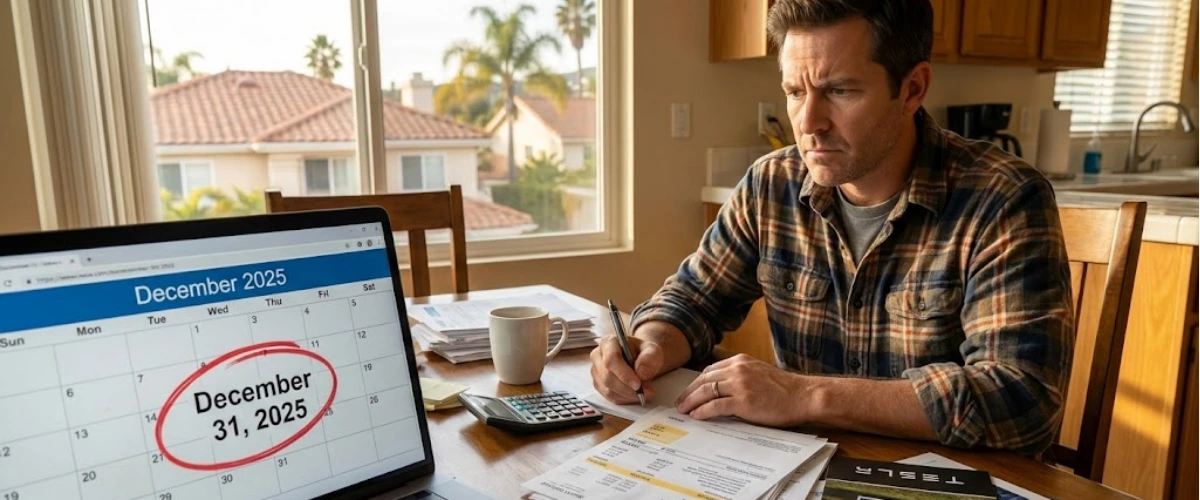
The Reddit forums are exploding with panicked homeowners asking the same question: "Do I need to pull the trigger on solar before the tax credit disappears?" If you've been saving up for solar and just heard about the deadline, you're probably feeling the pressure. Here's what's actually happening—and why the timeline might be more forgiving than you think.
What the Tax Credit Deadline Actually Means
The federal solar tax credit is ending on December 31, 2025. After that date, the 30% credit drops to zero. For a typical $30,000 solar system in Southern California, that's $9,000 in savings completely gone.
But here's where it gets confusing: you don't need permission to operate (PTO) from your utility by year-end. You just need your system installed.
This distinction is causing massive confusion across California. Utility companies like SCE and PG&E can take 4-8 weeks just to approve your interconnection after installation. If you needed PTO by December 31, most homeowners would already be out of luck.
The Legal Language That Changes Everything
According to 26 USC Section 25D(e)(8)(A), the tax credit is based on "when the original installation of the item is completed"—not when you flip the switch. This means once your installer finishes mounting panels, connecting inverters, and completing their work, you qualify. The utility's approval process happens after that.
Think of it like buying a car. You own it the moment you sign the papers and drive off the lot. You don't need to wait for the DMV to mail your registration to call it yours.
The Real Deadline: Installation vs Permission to Operate
Here's what actually needs to happen by December 31, 2025 for you to claim the full 30% credit:
Required: Your solar panels must be physically installed on your roof, inverters connected, and the installation work completed.
Not Required: Utility approval (PTO), final inspection sign-off, or your system actively producing power.
The law specifically separates "installation completion" from "placed in service" (which is when you get PTO). Since the deadline language says "installation must be completed by December 31, 2025"—not "placed in service"—you're covered as long as the physical installation is done.
Why This Matters for Southern California Homeowners
SCE has been notoriously slow with interconnection approvals lately. Some homeowners are waiting 6-10 weeks post-installation. If the deadline required PTO, thousands of systems installed in November and December wouldn't qualify, even though the installation was finished on time.
The IRS clarified this specifically to avoid punishing homeowners for utility company delays beyond their control.
How Long Does Solar Installation Actually Take?
Most California homeowners worry about one thing: "Can I even get installed by year-end if I start now?"
The answer depends entirely on your installer. Here's the realistic timeline:
Week 1-2: Site assessment, system design, contract signing
Week 2-4: Permit approval from your city/county
Week 5-6: Physical installation (usually 1-3 days of actual work)
Week 7-8: Utility interconnection approval (after installation)
With US Power's 3-6 week installation timeline, you could theoretically start in mid-December and still finish installation before year-end—though we don't recommend cutting it that close.
The September Myth
You've probably heard "you need to start by September to finish by December." That was true for national solar companies with 12-16 week timelines. But local installers who handle their own permitting and installation move much faster.
US Power's average timeline from contract signing to installation completion is 4-5 weeks. That's because we:
- Handle permitting in-house (no third-party delays)
- CSLB-licensed Consultants (no subcontractor coordination issues)
- Stock QCells inventory locally (no shipping delays)
- Prioritize year-end deadline projects
Why Most California Homeowners Need Battery Storage
Here's something the Reddit threads got right: solar batteries are essential under NEM 3.0.
California's new net metering rules (NEM 3.0) slashed the credit you get for sending excess solar back to the grid. What used to be worth $0.30/kWh is now worth $0.05/kWh during most hours. That means solar-only systems take 12-15 years to pay off instead of 6-8 years.
Battery Storage Changes the Economics
When you add battery storage, you can:
- Store excess solar production during the day
- Use that stored energy during expensive evening hours
- Avoid buying power from SCE at $0.50-0.65/kWh
- Keep backup power during outages
The good news? Battery storage also qualifies for the 30% tax credit if installed by December 31, 2025. A $15,000 battery system becomes $10,500 after the credit.
Under NEM 3.0, most Southern California homes need both solar and batteries to see real savings. US Power can show you exactly how much you'd save with how solar batteries can maximize your savings based on your actual SCE bills.
Understanding Tax Credit Eligibility
One Reddit commenter mentioned something crucial: the tax credit only works if you owe enough in federal taxes. This confuses many homeowners.
Here's how it actually works:
Tax Liability vs Tax Owed at Filing
Your tax liability is the total federal income tax you owe for the year—not what you owe when you file. If $12,000 was withheld from your paychecks and you usually get a $500 refund, your tax liability is $11,500.
If your solar system's 30% credit is $9,000, you'd get back all $9,000—either by reducing what you owe or increasing your refund.
What If You Don't Owe Enough Tax This Year?
The tax credit can be carried forward to future years. If you only owe $6,000 in federal taxes this year but your credit is $9,000, you use $6,000 now and carry $3,000 forward to next year.
Important: You must own your solar system to claim the credit. If you lease solar panels or sign a PPA (power purchase agreement), the leasing company claims the credit—not you. This is why we strongly recommend buy vs lease solar panels for any homeowner who wants to maximize their investment.
Avoiding Solar Companies That Go Bankrupt
Several Reddit commenters warned about solar companies going out of business after the tax credit expires. This is a legitimate concern.
National solar companies rely heavily on aggressive sales teams and the tax credit to close deals. When the credit disappears, their business model collapses. We've already seen major players like SunRun and Sungevity lay off thousands of workers.
Why Local Matters
When choosing a local, licensed solar company, you're not just getting faster installation—you're getting stability. Companies that survive market changes have:
- Diverse revenue streams (roofing, electrical, HVAC—not just solar)
- Local presence (can't disappear overnight)
- CSLB licensing (state-regulated, bonded, insured)
- Real service infrastructure (not just sales offices)
US Power is California's exclusive QCells partner with factory-direct pricing. We're not a sales company—we're installers. Our business model works whether the tax credit exists or not because we control costs and deliver value.
When you sign a 25-year warranty, you need confidence that company will still exist in year 15 when you need warranty service.
Why Now Is Still the Right Time to Go Solar
Even without the tax credit, solar makes financial sense in Southern California—but the savings are significantly better with it.
Consider this scenario:
With 30% Tax Credit (installed by Dec 31, 2025):
- System cost: $30,000
- Tax credit: -$9,000
- Net cost: $21,000
- SCE savings: ~$2,800/year
- Payback: 7.5 years
Without Tax Credit (installed Jan 1, 2026):
- System cost: $30,000
- Tax credit: $0
- Net cost: $30,000
- SCE savings: ~$2,800/year
- Payback: 10.7 years
That's a 3+ year difference in payback time. And with rising SCE electricity rates projected to increase another 8-12% in 2026, waiting means paying more to your utility while missing out on thousands in tax savings.
What Happens After the Tax Credit Expires?
Solar won't disappear. Equipment costs may drop slightly as manufacturers adjust to lower demand. But the real driver of solar adoption in California isn't the tax credit—it's electricity rates.
When you're paying $0.55/kWh during peak hours and solar brings that to near-zero, the math works. The tax credit just makes the math work faster.
Your Next Steps: Getting Started with US Power
If you've been on the fence about solar, the math is simple: every day you wait costs you money twice—once in lost tax credits, and again in continued high SCE payments.
Here's what happens when you schedule a free consultation with US Power:
1. Virtual or On-Site Assessment (30 minutes)
We review your SCE bills, roof layout, and energy goals. No sales pressure—just honest analysis of whether solar makes sense for your situation.
2. Custom System Design (24-48 hours)
Our engineers create a detailed proposal showing exactly how much you'd save with solar, battery options, and accurate timeline to completion.
3. Transparent Pricing (immediately)
Factory-direct QCells pricing means 15-20% below market rates. You see every cost—no hidden fees, no surprises.
4. Fast Installation (3-6 weeks)
CSLB-licensed installers handle permitting, installation, and inspection coordination. You get photos and updates throughout the process.
5. 25-Year Comprehensive Warranty
Panels, workmanship, and performance guaranteed. We're here for the long haul.
Frequently Asked Questions
Can I still get the tax credit if my utility delays my PTO approval?
What documentation do I need to prove my installation date?
Can I add batteries later and still get the credit?
What if I signed a contract but installation hasn't started?
Do I need to file my taxes by a certain date to claim the credit?


QCells vs REC Solar Panels: Best Choice for Homeowners
Compare QCells and REC panels to pick the right solar option for your home.

Why Qcells Panels Are the Best Choice for California’s Climate
QCells panels deliver reliable performance even in California’s harsh conditions.
5 Smart Rules for Powering Your Home and EV with Qcells Solar
Qcells solar systems make home charging cleaner, faster, and more affordable.








Derechos de autor © 2025 US POWER | Energía solar y techosUS Power - Axia by QCells. All Rights Reserved.

¡Obtenga una estimación solar instantánea usando el satélite!