




Is Solar Pricing Transparent in California? | 2026 Quote Analysis

Solar quotes in California can differ by $15,000+ for identical systems. A homeowner analyzing multiple quotes reveals the pricing opacity crisis—and how to protect yourself.
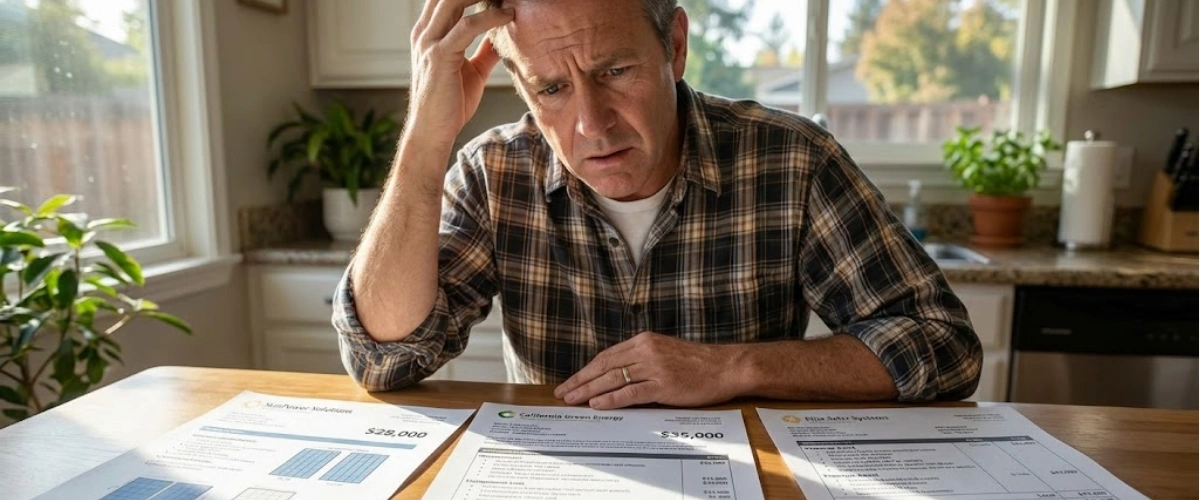
You request three solar quotes for your Southern California home. One comes in at $28,000. Another at $35,000. The third? $43,000—for nearly identical equipment.
When you ask why, each installer gives a different answer. "Premium installation." "Better service." "We include things others don't." But nobody shows you the actual breakdown. Nobody explains what you're really paying for.
This isn't unique to you. A recent analysis of over 300,000 solar quotes from government databases and public sources revealed something disturbing: California homeowners routinely receive quotes that vary by 30-50% for the same system. The solar industry has a transparency problem—and it's costing homeowners thousands.
Why Southern California Homeowners Are Desperate for Price Transparency
The Reddit solar community is filled with frustrated homeowners. One recent thread asked: "If I publish hundreds of thousands of solar quotes, will installers hate it?"
The overwhelming response? "Do it. The solar industry desperately needs price visibility."
The truth is, most California homeowners have no benchmark for what's fair. Unlike buying a car—where you can look up invoice pricing and compare dealer fees—solar pricing remains deliberately opaque. And there's a reason for that.
According to industry insiders commenting on the thread, "Most money in the industry is made by solar reps because of price opacity." When homeowners can't compare apples-to-apples, sales teams can justify almost any markup.
This is especially frustrating in Southern California, where electricity bills are climbing to record highs. SCE customers now pay $0.30-$0.33 per kilowatt-hour during peak times—among the highest rates in the nation. Homeowners are motivated to go solar, which makes them vulnerable to aggressive pricing tactics.
The Bait-and-Switch Problem
One Reddit user shared their experience: They received a quote for a 20kW system with batteries. On the day they were supposed to sign, the installer showed up with bad news. "They stopped making those panels six months ago," the installer claimed. "And we can't get the batteries either."
The panels had been discontinued six months prior—before the quote was even written. This wasn't an unfortunate surprise. It was a planned bait-and-switch.
Quotes That Vary by Thousands With No Explanation
Another homeowner described getting "wildly different quotes for the same system" with no clear reason why. Equipment list? Nearly identical. Installation complexity? Same roof, same electrical panel. Yet the quotes ranged from $2.85 per watt to $4.20 per watt—a difference of nearly $15,000 on a typical 10kW system.
What Makes Solar Quotes So Wildly Different?
To understand why California solar quotes lack transparency, you need to understand what actually goes into pricing. There are four main components:
1. Equipment Costs (Should Be Consistent)
In 2026, wholesale solar equipment costs are relatively standardized:
- Tier 1 solar panels: $0.40-$0.60 per watt
- Inverters: $0.30-$0.50 per watt
- Mounting/racking: $0.15-$0.25 per watt
- Battery storage (if included): $700-$1,000 per kWh capacity
For a 10kW system, equipment costs should land around $10,000-$13,000. Yet quotes regularly come in at $28,000, $35,000, or more. Where does the extra money go?
2. Labor & Installation (The Variable Part)
Installation labor varies based on:
- Roof complexity (multiple planes, steep pitch, tile vs. composition)
- Electrical upgrades needed (panel replacement, trenching)
- Permit requirements by city
- Crew efficiency and experience
Fair labor costs for a standard installation: $4,000-$7,000. But some installers quote $15,000+ for labor without itemizing what justifies the premium.
3. Sales & Marketing Markup (The Hidden Cost)
Here's what most installers won't tell you: 20-40% of your quote goes to sales commissions and marketing costs. Door-to-door solar companies often pay sales reps $3,000-$7,000 per closed deal. That comes directly out of your pocket.
One industry professional noted: "You typically get what you pay for. The lowest price isn't always the best deal." That's true—but only when you know what you're paying for. The problem isn't that companies charge for quality. It's that they don't disclose where your money goes.
4. Financing Costs (Often Buried)
Many installers offer "$0 down solar." What they don't emphasize: the 20-year loan at 6.99% APR inflates your total cost by 60-80%. A $30,000 system becomes $48,000 in total payments—but the quote only shows the monthly payment, not the true cost.
If you want to understand how to evaluate your solar quote properly, you need every line item disclosed, including financing terms.
What You Should Actually Pay for Solar in 2026
Based on analysis of government ITC tax credit filings—where installers must report exact costs—here's what fair pricing looks like in Southern California:
Solar-Only Systems (Not Recommended Under NEM 3.0):
- $2.43-$2.85 per watt installed
- 10kW system: $24,300-$28,500 before incentives
- After 30% federal tax credit: $17,010-$19,950
Solar + Battery Systems (Recommended):
- $3.10-$3.50 per watt for solar
- $10,000-$14,000 for 13.5kWh battery
- Total 10kW system with battery: $41,000-$49,000 before incentives
- After incentives (30% federal credit + SGIP rebate): $26,650-$31,850
If you're receiving quotes significantly above these ranges, you should ask for itemized breakdowns. If the installer refuses or gives vague answers about "premium service," that's a red flag.
For detailed regional benchmarks, see how much solar panels actually cost in California with up-to-date 2026 pricing data.
The Hidden Cost Truth: Why Cheap Solar-Only Quotes Cost More Long-Term
Here's where pricing opacity gets especially predatory: the "low-ball solar-only quote."
An installer quotes you $24,000 for a 10kW solar system. Sounds great—it's at the lower end of the fair range. But there's a critical detail buried in fine print: no battery included.
Under California's NEM 3.0 policy (implemented April 2023), solar-only systems have drastically reduced economics. Without a battery, you export excess solar production to the grid for just $0.05-$0.08 per kWh—yet buy power back at $0.30-$0.33 per kWh during evening peak hours.
The result? Your "cheap" solar system saves 40-50% less than the installer projected. Your actual payback period: 14-16 years instead of the promised 7-8 years.
Meanwhile, the installer who quoted you $42,000 for solar + battery looked "expensive"—but delivers the real savings under NEM 3.0. Here's why solar batteries are essential under NEM 3.0 for achieving ROI.
This is pricing opacity at its worst: using a low quote to win the contract, while hiding the fact that the system won't deliver promised savings. Homeowners don't realize the problem until 12-18 months later when their utility bills remain high.
How US Power Brings Transparency to California Solar Pricing
US Power takes a fundamentally different approach: complete pricing transparency through factory-direct access to QCells.
What "Factory-Direct" Actually Means
Most solar installers buy panels through 2-3 layers of distributors. Each layer adds 10-15% markup. By the time panels reach your roof, you're paying 30-50% above wholesale cost.
US Power is California's exclusive QCells factory-direct partner. We eliminate distributor markups entirely. The result: 15-20% lower equipment costs, which we pass directly to homeowners. Learn more about our factory-direct pricing model and how it saves California homeowners thousands.
What's Included in Every US Power Quote
Our quotes include complete line-item breakdowns:
Equipment:
- QCells Q.PEAK DUO BLK-G10+ panels (American-made, 400W)
- String inverter or microinverters (specified by model)
- IronRidge racking system
- Q.HOME CORE battery (if applicable, with capacity specified)
Labor & Services:
- Installation labor (crew size and timeline disclosed)
- Electrical work (panel upgrade if needed—specified separately)
- Permits and inspections (by jurisdiction)
- Monitoring system setup
Warranty (All Included, No Upsells):
- 25-year panel performance warranty
- 25-year workmanship warranty
- 25-year system performance guarantee
We also disclose financing terms upfront if applicable—including total cost over loan term, not just monthly payments.
Most importantly: if you need an electrical panel upgrade, we tell you before you sign. No surprise $3,000 "required upgrades" discovered during installation.
The QCells comprehensive warranty we provide is one of the most robust in the industry—and it's included in our transparent pricing, not sold as an add-on.
Red Flags That Mean "Run Away From This Quote"
Based on the Reddit thread analysis and industry patterns, here are warning signs of pricing opacity:
1. Refusal to Provide Written Equipment List
If the installer won't specify exact panel models, wattages, and inverter types in writing, they're leaving room to substitute inferior equipment after you sign.
2. "Trust Us" on Savings Projections
Any installer who won't show you their calculation method—how they determined your electricity usage, solar production estimates, and rate escalation assumptions—is hiding something.
3. Pressure to "Sign Today" for Special Pricing
Legitimate pricing doesn't expire in 24 hours. This is a classic high-pressure sales tactic designed to prevent you from comparing quotes or doing research.
4. Vague Warranty Language
"25-year warranty" without specifying what's covered (panels only? Workmanship? Performance guarantee?) is meaningless. Get it in writing, in detail.
5. Monthly Payment Shown Without Total Cost
If the quote emphasizes "$139/month" but doesn't clearly state the total system cost and total payments over the loan term, they're hiding the true price.
For a complete guide on what to watch for, see these five red flags when choosing a solar company in California.
Why Ownership Matters More Than Ever
Another transparency issue: lease vs. own.
Some installers push 20-year solar leases or Power Purchase Agreements (PPAs) with "no money down." It sounds appealing—until you read the contract.
Hidden costs in solar leases:
- Annual escalator clauses (3-5% rate increases built into the lease)
- Transfer complications when selling your home (many buyers refuse homes with solar leases)
- No access to federal tax credits (the leasing company claims them, not you)
- Total payments over 20 years often exceed the cost of buying outright by 40-60%
Under NEM 3.0, where battery storage is essential, lease agreements become even more problematic. Most leases don't include batteries—meaning you're locked into a solar-only system that under-performs for 20 years.
Ownership gives you control, full incentive access, and the ability to add batteries or expand capacity later. See why owning beats leasing in 2026 and beyond.
The Path Forward: Demand Better From California Solar Companies
The solar industry won't fix its transparency problem voluntarily. Change happens when homeowners demand better.
What you can do:
Get multiple quotes—but evaluate them based on completeness and clarity, not just bottom-line price. A detailed $42,000 quote is more trustworthy than a vague $28,000 quote.
Ask direct questions—and expect direct answers. "What's your sales commission on this deal?" "Where does each dollar of my payment go?" "Why does your quote differ from the benchmark pricing I researched?"
Walk away from pressure tactics—any installer who won't let you take 48 hours to review the contract is hiding something.
Share your experience—whether good or bad. Online reviews, Reddit threads, and community forums help other homeowners make informed decisions.
The data is clear: California solar pricing lacks transparency. But as one Reddit commenter put it, "Good installers should welcome transparency since it proves their pricing is competitive." Companies with nothing to hide have nothing to fear from informed homeowners.
US Power built our business on transparency because we believe Southern California homeowners deserve better. When you eliminate distributor markups and disclose every cost upfront, the numbers speak for themselves.
Frequently Asked Questions
Why do solar quotes vary so much in California?
What's a fair price per watt for solar in Southern California?
Should I get multiple solar quotes before deciding?
How can I tell if a solar quote is transparent?
Is factory-direct solar pricing really cheaper?


How to Measure Sun Exposure for Solar Panels
Learn methods to accurately measure sunlight for optimal solar panel placement.
How to Wire Solar Panels in Series vs. Parallel
Maximize solar efficiency by choosing the right panel wiring for California homes.
Top Solar Installation Mistakes Los Angeles Homeowners Make
Before signing a solar contract, make sure you know the risks. Read to learn more.







Derechos de autor © 2025 US POWER | Energía solar y techosUS Power - Axia by QCells. All Rights Reserved.

¡Obtenga una estimación solar instantánea usando el satélite!