




Can You Add Batteries to Existing Solar? AC Coupling Explained

AC coupling lets Southern California homeowners add battery storage to existing solar systems without replacing inverters or rewiring panels—saving time and thousands of dollars.
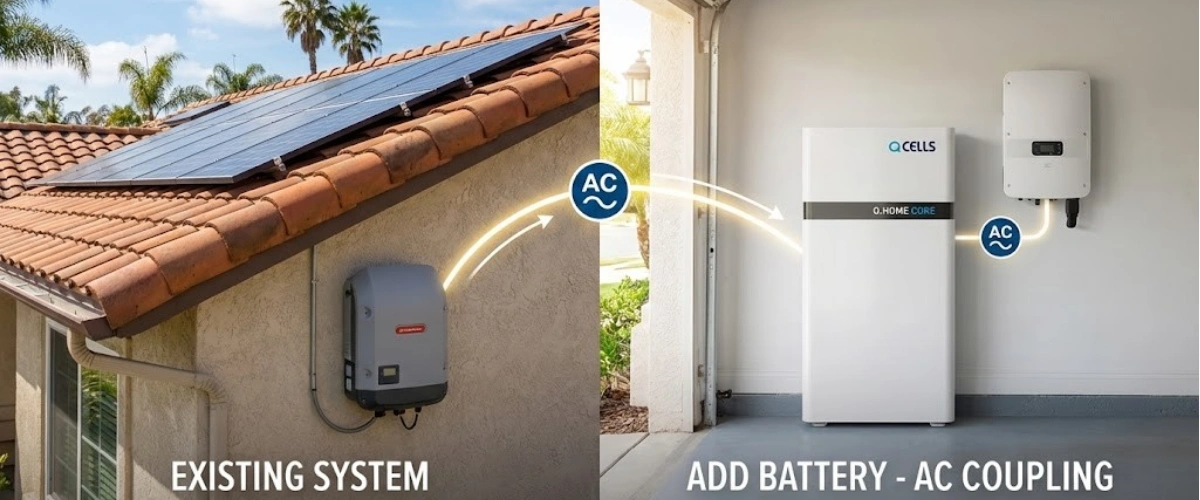
You've had solar panels on your roof for a few years now. They've been great, cutting your electricity bills and doing their part for the environment. But now, with California's NEM 3.0 slashing what utilities pay for excess solar by 75%, you're wondering if you need batteries.
Here's the good news: you probably don't need to rip everything out and start over. AC coupling technology lets you add battery storage to your existing solar system without touching your current inverter or panels. No expensive equipment replacement. No complex rewiring. Just a straightforward battery addition that works with what you already have.
Why Southern California Homeowners Are Racing to Add Batteries
SCE and PG&E rates have climbed relentlessly over the past decade. What used to be a $150 monthly bill has ballooned to $300 or more for many Southern California families. If you installed solar before April 2023, you're still on NEM 2.0—the good rates that credit you fairly for excess power. But everyone else? They're getting paid pennies for midday solar exports while peak evening rates hit $0.50 per kWh or higher.
That's where batteries change everything. Instead of sending your excess solar to the grid for $0.08 per kWh at noon, you store it and use it at 7 PM when electricity costs $0.48. The math isn't complicated—it's just smart.
The Rising Cost Problem Nobody Talks About
Between 2014 and 2025, electricity rates in Southern California jumped 32%. SCE recently announced another rate increase for 2026. Without storage, your solar panels generate power when it's worth the least and you buy from the grid when it costs the most.
NEM 3.0 Changed the Solar Game Completely
Under NEM 3.0, which took effect in April 2023, California homeowners saw their solar export credits drop by approximately 75%. A kilowatt-hour that used to earn you $0.30 now brings in $0.08. Meanwhile, buying that same kilowatt-hour during peak hours costs you $0.45 to $0.52.
The solution isn't giving up on solar—it's understanding that solar panels alone aren't enough in 2025 and embracing battery storage to shift when you use your solar power.
Why AC Coupling Makes Adding Batteries Simple
When homeowners ask "can I add batteries to my solar panels," they're usually worried about cost and complexity. AC coupling answers both concerns beautifully.
Think of your current solar setup as a well-oiled machine. Your panels generate DC power, your inverter converts it to AC for your home, and everything works perfectly. AC coupling doesn't mess with any of that. Instead, it adds a battery inverter that connects on the AC side—after your existing solar inverter has already done its job.
How AC Coupling Actually Works
Your solar panels produce DC electricity during the day. Your existing solar inverter converts that to AC power. Here's where AC coupling comes in: a separate battery inverter takes some of that AC power, converts it back to DC for storage in your battery, then inverts it again to AC when you need it.
Yes, there's an extra conversion step. But the trade-off is worth it—you keep your existing equipment, avoid rewiring your panels, and can add storage in days instead of weeks.
The Retrofit Advantage Nobody Mentions
With adding batteries to existing solar systems, you're looking at 3-5 days of work instead of 2-3 weeks. Your installer doesn't need roof access to reconfigure panels. Your existing inverter stays put. The battery system connects to your home's electrical panel alongside your current solar—completely independent.
This matters when you're trying to get your system operational before peak summer rates hit or before the end of the year for tax credit purposes.
AC Coupling vs DC Coupling: Which One's Right for You?
The internet loves debating AC versus DC coupling. Here's the truth: if you already have solar, AC coupling is almost always your best option.
When AC Coupling Makes Perfect Sense
You have existing solar panels with a working inverter. You want to add batteries without replacing equipment. You need the project done quickly. Your current inverter is relatively new and working well.
If any of these describe your situation, AC coupling is your path forward. The 2-4% efficiency loss from extra conversions? You'll make that back in saved installation costs and keeping your existing equipment running.
When DC Coupling Might Be Better
DC coupling shines when you're installing everything from scratch. If you're building new solar plus storage, a hybrid inverter that handles both panels and batteries on the DC side eliminates conversion losses. You get slightly better efficiency and potentially lower equipment costs.
But for retrofits? DC coupling means replacing your existing solar inverter with a hybrid unit, which adds thousands in costs and extends installation time.
For a detailed breakdown of the technical differences and financial implications, check out choosing between AC vs DC solar batteries for energy savings.
How NEM 3.0 Makes Battery Storage Essential
Let's talk real numbers. Under NEM 2.0, a typical solar-only system offset 90% of electricity costs. That same system under NEM 3.0? Only 55% offset.
Add an AC-coupled battery, and you jump back up to 70-90% offset. That's the difference between a $180 monthly bill and a $30 monthly bill.
The Peak Hour Problem
Your solar panels produce the most electricity between 10 AM and 2 PM. Great timing for solar production, terrible timing for making money. NEM 3.0 export rates during those hours hover around $0.08-0.12 per kWh.
Your home uses the most electricity between 5 PM and 9 PM. Dinner prep, air conditioning, TV time, device charging. Grid electricity during these peak hours costs $0.45-0.52 per kWh.
Without batteries, you export cheap power at noon and buy expensive power at dinner. With batteries, you store that noon solar and use it during peak hours—keeping $0.40+ per kWh in your pocket.
Real Savings Example from Southern California
A Northridge homeowner with a 7 kW solar system was exporting about 15 kWh daily under NEM 3.0. At $0.10 per kWh, that's $1.50 per day or $45 monthly. They were buying 12 kWh during peak hours at $0.48 per kWh—costing $5.76 daily or $173 monthly.
After adding a 13.5 kWh AC-coupled battery, they now store that midday excess instead of exporting it. Their peak grid purchases dropped to nearly zero. Monthly savings? About $128. Their battery paid for itself in under six years, and that's before factoring in continued rate increases.
Learn more about how solar batteries can maximize your savings under California's current rate structure.
The Real Cost vs. Savings Analysis
Adding AC-coupled batteries to your existing solar isn't cheap, but it's far less expensive than replacing everything with a new DC-coupled system.
What You'll Actually Pay
A quality AC-coupled battery system (13-15 kWh) typically runs $12,000-$16,000 installed in Southern California. That includes the battery inverter, the battery itself, installation labor, permits, and electrical work.
Compare that to a full DC-coupled retrofit where you replace your solar inverter: $18,000-$24,000. The savings are significant.
California SGIP Rebates
Some Southern California homeowners still qualify for California's Self-Generation Incentive Program (SGIP), which can provide $200-$250 per kWh in rebates. On a 13.5 kWh battery, that's potentially $3,375 in additional savings.
Combined with the federal tax credit, you could see total incentives of $7,500+ on a battery installation.
For current rates and eligibility, see our guide on are batteries worth it for solar in California.
US Power's AC Coupling Solution: QCells Integration
US Power specializes in retrofitting battery storage to existing solar systems—regardless of which company installed your original panels.
Why QCells Batteries Work with Any Solar System
QCells' Q.HOME CORE battery storage solution uses AC coupling technology, meaning it integrates seamlessly with your existing solar setup. Got SolarEdge panels? No problem. Enphase microinverters? Works perfectly. SunPower system? Compatible.
The beauty of AC coupling is its flexibility. Your current solar equipment keeps operating exactly as it has been. The QCells battery system simply adds another layer of energy management.
American-Made Quality, Factory-Direct Pricing
QCells manufactures panels in the United States, and their battery systems meet the same quality standards. US Power's exclusive partnership means you get factory-direct pricing—typically 15-20% below what larger solar companies charge for the same equipment.
That's real money saved on an already cost-effective upgrade.
Installation Timeline: 3-6 Weeks Start to Finish
Once your system is approved, US Power typically completes AC-coupled battery installations within 3-6 weeks. Compare that to 8-12 weeks (or longer) with larger national installers dealing with backlog.
Fast installation means you start saving money sooner and lock in federal tax credits before they decrease.
What to Consider Before Adding AC-Coupled Batteries
Not every home needs the same battery solution. Before pulling the trigger, think through these key factors.
Your Current Energy Usage Patterns
Look at your last 12 months of electricity bills. When are you using the most power? If your peak usage aligns with peak rates (5-9 PM), batteries make tremendous sense. If you're somehow home during midday and using solar as it's generated, your battery ROI will be longer.
Your Existing Solar System's Age and Condition
If your solar inverter is 10+ years old and showing signs of wear, you might want to consider replacing it with a hybrid DC-coupled system instead. But if your equipment is relatively new and working well, AC coupling is the clear winner.
Your Backup Power Needs
Do you lose power frequently? Are you in a high-fire-risk area with Public Safety Power Shutoffs? If backup power is a priority, make sure you size your battery appropriately and configure it for backup mode. Not all AC-coupled batteries automatically provide backup—you need to specify this during installation.
For essential information before making your decision, read through things you must know before going solar in California.
Finding the Right Installer for Your AC Coupling Project
Not all solar companies have experience with battery retrofits. Some will push you toward replacing everything because they lack AC coupling expertise.
Red Flags to Watch For
An installer who insists you need to replace your working solar inverter. Quotes that seem excessively high (20%+ above market rates). Companies that can't explain how AC coupling works. Pressure tactics to sign immediately without giving you time to review.
What Good Installers Provide
A thorough assessment of your existing system. Clear explanation of how AC coupling integrates with your current setup. Transparent pricing with no hidden fees. Multiple battery size options based on your actual needs. References from similar retrofit projects.
US Power's CSLB-licensed consultants provide all of this, plus transparent factory-direct pricing and a 25-year comprehensive warranty covering panels, workmanship, and performance.
For guidance on selecting the right company for your project, see our article on how to choose a solar company in Los Angeles.
Upgrading to Solar Plus Storage
AC coupling technology makes adding batteries to your existing solar system straightforward and affordable. You keep your current equipment, avoid expensive inverter replacements, and start maximizing your solar investment under NEM 3.0's challenging rate structure.
The combination of rising electricity rates, reduced export credits, and expiring tax incentives creates a narrow window for optimal battery ROI. Southern California homeowners who add storage now lock in maximum savings before incentives decrease in 2026.
US Power's factory-direct QCells pricing, CSLB-licensed consultants, and 3-6 week installation timeline make battery retrofits accessible and stress-free. With 180+ five-star Google reviews and a 25-year comprehensive warranty, you're working with California's most trusted solar partner.
The question isn't whether AC-coupled batteries make sense for your existing solar—it's how soon you can get them installed to start keeping more of your money instead of sending it to the utility company.
Frequently Asked Questions
Can I add any battery to my existing solar panels?
How much does it cost to add AC-coupled batteries in Southern California?
Will AC coupling void my solar warranty?
How long do AC-coupled batteries last?
Can I install AC-coupled batteries myself to save money?



How Does Solar Billing Work? A Clear Guide for California Homeowners
Solar was supposed to mean you have $0 bills. So why are you still getting charged?

Are Rising Electric Bills Caused by AI Data Centers in 2026?
You're paying for Big Tech's AI ambitions through your electric bill. Need to Know
How Long Does Solar Panel Installation Really Take? (2026 Guide)
57 panels in 72 hours? Here's the truth about solar installation timeline in CA.








Derechos de autor © 2025 US POWER | Energía solar y techosUS Power - Axia by QCells. All Rights Reserved.

¡Obtenga una estimación solar instantánea usando el satélite!