



Are Rising Electric Bills Caused by AI Data Centers in 2026?
Your SCE bill keeps climbing, but it's not just you. Big Tech's AI data centers are consuming massive amounts of electricity, and Southern California homeowners are footing the bill. Discover why your rates are rising and how solar + battery storage can protect you from paying for infrastructure you never wanted.
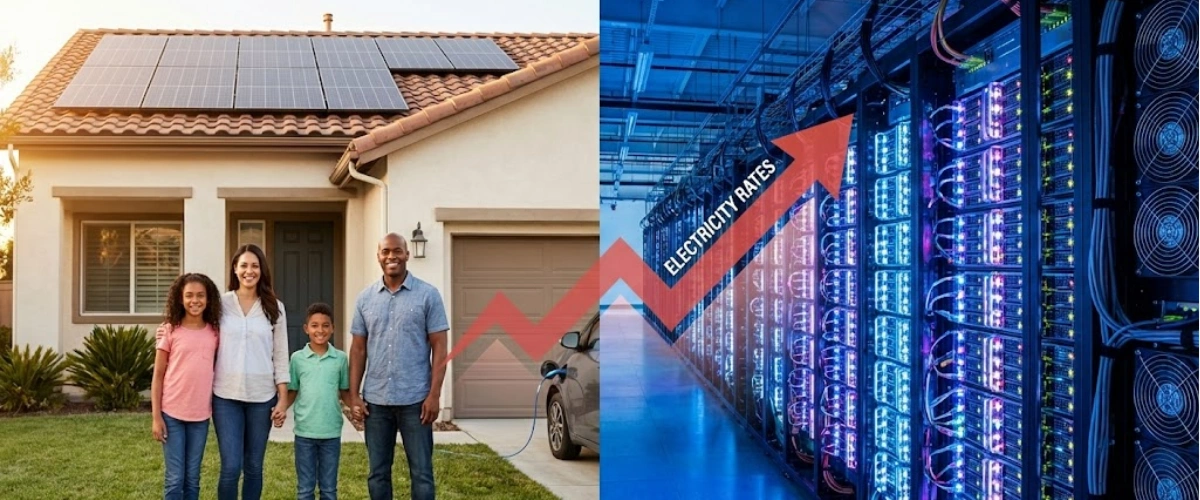
You just opened your SCE bill and nearly choked on your coffee. Again. It's not your imagination—your electricity costs are climbing faster than ever. But here's what Southern California utility companies aren't telling you: a significant chunk of those rate increases is funding the massive energy appetite of AI data centers that benefit tech giants, not your family.
The Reddit thread that sparked nationwide outrage put it bluntly: "We're all subsidizing Big Tech's AI ambitions by paying higher electric bills." And for Southern California homeowners stuck with SCE or PG&E, this reality hits especially hard.
Why Southern California Electric Bills Hit Record Highs in 2026
Your rising electric bill isn't just about increased usage or seasonal changes. SCE rates have jumped significantly to accommodate massive infrastructure upgrades—primarily to support the explosion of AI data centers across California and neighboring states.
The Hidden Cost of AI's Energy Appetite
Artificial intelligence isn't just changing how we work—it's fundamentally reshaping our power grid. Every ChatGPT query, every AI-generated image, every machine learning model requires enormous computational power. Data centers housing these AI systems consume electricity at unprecedented rates, and utilities are passing those infrastructure costs directly to residential customers.
One Reddit user with off-grid solar captured the frustration perfectly: "Glad I have off-grid solar, a natural spring on my property, and a forest for heat." While most Southern California homeowners can't go completely off-grid, solar + battery systems offer similar protection from utility rate manipulation.
Learn more about Why Electricity Bills Are so High in Southern California.
SCE Rate Increases You're Already Paying For
Southern California Edison has implemented several rate increases in 2025-2026, citing grid modernization and infrastructure expansion. Translation: they're building the capacity to serve massive commercial data centers while residential customers shoulder the financial burden.
The base service charge alone has increased, meaning you're paying more even before you flip a single light switch. Add time-of-use rates that penalize evening usage (when families actually need power), and you have a system designed to extract maximum revenue from homeowners.
The infrastructure demands are staggering—and as many energy analysts have noted, AI is powering an energy crisis that residential customers are funding involuntarily.
Water, Jobs, and Privacy Concerns
It's not just electricity. As one commenter noted, "It's not just electricity, it's also water and in big picture jobs and privacy." AI data centers consume millions of gallons of water for cooling systems—water that Southern California desperately needs. Meanwhile, these facilities create relatively few local jobs compared to their environmental impact.
How Solar + Battery Storage Protects You from Rate Increases
While you can't control what SCE charges per kilowatt-hour, you can control where your electricity comes from. Solar panels generate power from sunlight hitting your roof—no utility company involvement required.
Why NEM 3.0 Makes Batteries Essential
California's Net Energy Metering 3.0 policy changed the solar game. Under NEM 3.0, excess solar energy sent back to the grid receives far less credit than before (roughly 75% less). This means the financial benefit shifts dramatically toward self-consumption: using your solar power as you generate it, or storing it in batteries for evening use.
For Southern California homeowners facing data center-driven rate hikes, this actually works in your favor. Instead of depending on grid credits, you're becoming truly energy independent. Discover how solar batteries can maximize your savings under the new system.
The Math That Utility Companies Don't Want You to See
Here's what utilities won't tell you: once you install solar panels, your cost per kilowatt-hour is essentially locked in for 25+ years. While SCE continues raising rates to fund data center infrastructure, your solar panels keep producing at the same predictable cost.
A typical Southern California home using 900 kWh monthly could pay $250-350 to SCE today. With projected rate increases, that same usage could cost $400-500 monthly within five years. Solar systems typically pay for themselves in 5-8 years, then provide decades of savings.
Protection Against Future Infrastructure Costs
One Reddit commenter warned: "When the costs rise too high, the data centers can bail when they can deploy new and cheaper generation on premise and then leave the abandoned infrastructure and their costs to be paid exclusively by the other rate payers, mainly residential."
This scenario is entirely plausible. Data centers are mobile—they can relocate to regions with cheaper power. But residential homeowners are stuck paying for the infrastructure left behind. Solar panels protect you from this exact vulnerability.
What US Power Does Differently from Big Solar Companies
Not all solar installations are created equal. While Big Tech exploits the power grid at your expense, US Power offers a genuinely different approach to residential solar.
Factory-Direct QCells Partnership
US Power is the exclusive QCells partner in Southern California, which means we bypass the typical solar supply chain markup. You're not paying for multiple middlemen—you're getting American-made panels at factory-direct pricing, typically 15-20% below market rates. If you're researching solar, here's our guide on how to choose a solar company and why our factory-direct pricing advantage matters for your bottom line.
CSLB-Licensed Consultants, Not Commissioned Salespeople
Unlike companies that send commissioned sales reps to pressure you into oversized systems, US Power employs CSLB-licensed consultants. We're required by California law to provide accurate, honest assessments of your solar potential.
Our consultants earn salaries, not commissions, so there's zero incentive to sell you more panels than you need or lock you into predatory financing.
3-6 Week Installation Timeline
While typical solar companies take 3-6 months from contract signing to system activation, US Power averages 3-6 weeks to Permission to Operate (PTO). That's months of utility bill savings other homeowners miss out on.
We've streamlined permitting, installation, and utility coordination to get your system producing as quickly as possible—critical when you're watching electric bills climb monthly.
25-Year Comprehensive Warranty
US Power's warranty covers panels, workmanship, and performance for 25 years. If anything goes wrong—from panel defects to installation issues—we handle it. No runaround, no surprise charges.
This matters because solar systems require virtually zero maintenance but can face issues from installation errors. Our 175+ five-star Google reviews reflect our commitment to quality that lasts decades.
The Real Math: Will Solar Actually Save You Money?
Let's cut through the noise with real numbers based on typical Southern California usage.
Average Southern California Home Energy Profile
A 2,000 square-foot home in Los Angeles typically uses 850-1,000 kWh monthly. At current SCE rates (averaging $0.32-0.38 per kWh depending on time-of-use), that's $272-380 monthly, or $3,264-4,560 annually.
With data center-driven rate increases projected to continue, conservative estimates put that same usage at $400-500 monthly within three years—an additional $1,500-2,500 annually. See detailed calculations of how much money solar panels save based on actual Southern California usage patterns.
Solar System Cost vs. Savings
A properly sized solar system (7-9 kW) for that home costs roughly $18,000-24,000 after the 30% federal tax credit (available through December 2025). With factory-direct pricing from US Power, many homeowners pay 15-20% less than quotes from traditional solar companies.
That system eliminates or dramatically reduces your electric bill immediately. With SCE rates rising, your payback period shrinks annually. Most US Power customers see full payback in 5-7 years, followed by 20+ years of essentially free electricity. Learn more about the federal solar tax credit and how to maximize your savings before it decreases.
Battery Storage ROI Under NEM 3.0
Adding battery storage (typically $10,000-15,000 after incentives) extends your energy independence. You're no longer limited to using solar power only when the sun shines—you're storing excess daytime generation for evening use when rates peak.
Under NEM 3.0, batteries often pay for themselves in 7-10 years through avoided time-of-use charges and backup power during outages. For Southern California homeowners facing increasing outage risks from wildfire-related Public Safety Power Shutoffs, that backup protection has real value.
Your Next Steps: Taking Control of Your Energy Costs
You can't stop data centers from consuming massive amounts of electricity. You can't prevent SCE from raising rates to fund infrastructure you never asked for. But you absolutely can take control of your own energy costs.
What to Expect from a US Power Consultation
Our free consultations are genuinely educational. A CSLB-licensed consultant will:
- Analyze your actual usage from recent SCE bills
- Assess your roof's solar potential
- Calculate expected system production
- Show you real payback timelines with conservative estimates
- Explain financing options with transparent pricing
- Answer every question without pressure or sales tactics
Before your consultation, review our guide on things you must know before going solar in California to make the most of your meeting.
Timeline from Consultation to Activation
Once you decide to move forward, US Power handles everything:
Week 1-2: System design, permit submission, utility applications
Week 3-4: Installation (typically 1-2 days)
Week 5-6: Final inspection and Permission to Operate from SCE
Most homeowners are producing solar power within 6 weeks of signing a contract—far faster than the industry average of 3-6 months.
Financing Options That Actually Work
US Power offers multiple payment options:
- Cash purchase (best long-term savings)
- Solar loans with competitive rates
- Property Assessed Clean Energy (PACE) financing
- No predatory leases or power purchase agreements
Every option comes with full transparency. You'll know exactly what you're paying, with no hidden fees or surprise charges down the road.
What Homeowners Can Do
You didn't ask to subsidize Big Tech's AI ambitions through your electric bill. You didn't vote to fund data center infrastructure while your family struggles with rising energy costs. But that's exactly what's happening across Southern California.
Solar panels offer the most effective way to protect yourself from this rigged system. By generating your own power at a locked-in cost, you're no longer at the mercy of utility rate increases designed to fund infrastructure that doesn't benefit you.
US Power makes this transition straightforward with factory-direct pricing, fast installation, and honest consultation. While SCE continues raising rates, you could be producing your own clean energy within weeks.
Frequently Asked Questions
Can solar panels really protect me from future rate increases?
How much of my bill comes from data center infrastructure costs?
Will data centers cause more power outages in Southern California?
Is solar worth it if I plan to move in 5-7 years?
What happens if battery technology improves dramatically in a few years?


How California Homeowners Can Control Energy Costs with Solar
Get Smart, start controlling your energy costs before utility rates rise further!
Why You Still Pay a Connection Fee with Solar Panels in California
My bill is $17—why am my solar not efficient enough? Learn more from US Power.
SCE Time-of-Use Rates Explained: Cheapest Hours to Use Power
High SCE rates with solar + battery solutions. Avoid SCE peak charges with US Power.







Derechos de autor © 2025 US POWER | Energía solar y techosUS Power - Axia by QCells. All Rights Reserved.

¡Obtenga una estimación solar instantánea usando el satélite!