




Can Solar Panels Really Charge Your Electric Car for Free?

Your 60 kWh EV doesn't need a massive solar system to charge daily. Most Southern California drivers only use 16-30 miles per day—that's just 4.5-8.6 kWh. Here's the truth about solar EV charging.
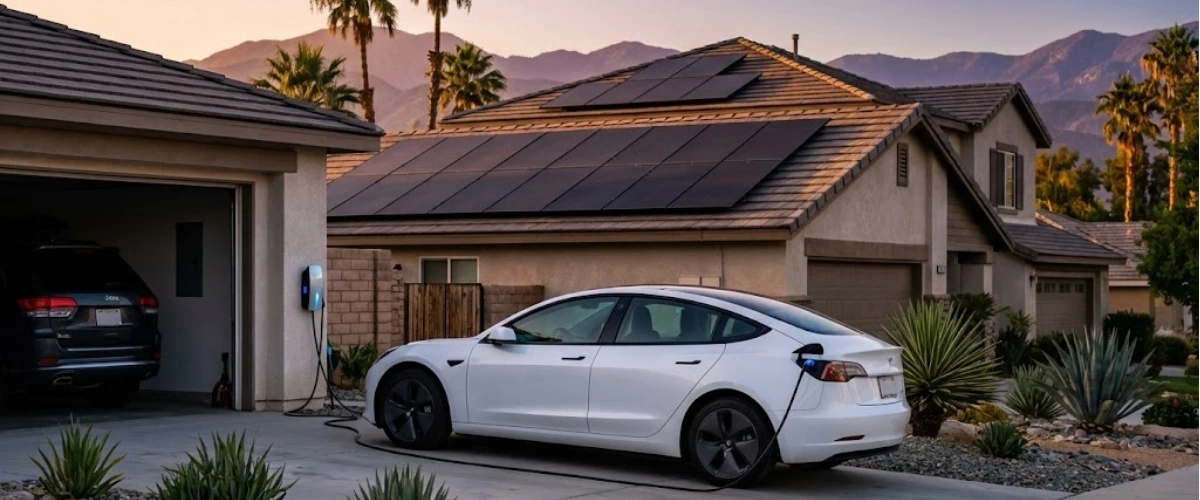
If you've ever wondered whether your solar panels can actually charge your electric car "for free," you're not alone. It's one of the most common questions Southern California homeowners ask—and the answer isn't what most people expect.
The short version? Yes, but not in the way you think. And understanding the difference could save you thousands of dollars on both your electric bill and EV charging costs.
How Southern California EV Owners Are Getting Gouged
Let's start with the uncomfortable truth: if you're charging your EV from the grid in Southern California, you're paying some of the highest electricity rates in the country.
SCE's Time-of-Use rates hit $0.52 per kWh during peak hours (4-9 PM). For most EV owners, that's exactly when you plug in after work. A typical Tesla Model 3 with a 60 kWh battery would cost you $31.20 to charge from empty to full. Do that twice a week, and you're spending over $3,200 per year just on charging.
But here's where it gets interesting. Most people don't actually charge from empty to full. According to real-world data, the average Southern California driver uses their car for 16-30 miles per day. That's only 4.5-8.6 kWh of electricity—not the full 60 kWh battery capacity.
This is the first big misconception about EV charging. You don't need to fill up like a gas tank. You're just topping off what you used. And that changes everything about how you think about solar.
Want to know exactly what you're paying? Check out the actual cost to charge an electric vehicle in California based on current utility rates.
The Real Math: What "Free" Actually Means
So can solar panels charge your EV for free? Yes—but with important caveats.
Let's use a real example from a Southern California homeowner. You have a modest 2 kW solar system producing power during the day. Your home typically uses about 500 watts, leaving 1.5 kW available to charge your car.
The math:
- Daily driving: 20 miles = 5.7 kWh needed
- Available solar: 1.5 kW surplus
- Charging time needed: 3.8 hours of sunlight
On paper, this works perfectly. Your solar panels can replace what you drove yesterday in about 4 hours of good sun. Southern California gets 6-8 hours of productive solar time per day, so you have plenty of margin.
But here's the problem: when is your car actually home?
Most people leave for work at 8 AM and return around 6 PM. That's exactly when your solar panels are producing the most power—and exactly when your car isn't plugged in. By the time you get home and plug in after dinner (8 PM), the sun is gone. Now you're pulling from the grid at $0.52/kWh.
This is where the word "free" starts to fall apart. Unless you work from home or have a very flexible schedule, direct solar-to-EV charging during the day isn't realistic for most people.
The good news? There's a solution that actually works. And it's probably already sitting on your neighbor's roof.
Wondering about total savings beyond just EV charging? Here's how much solar panels save in 2025 when you factor in your entire energy usage.
Why Battery Storage Makes EV Charging Actually Free
Here's the real secret to "free" EV charging with solar: you need battery storage systems.
A home battery acts like a reservoir. During the day, your solar panels fill up the battery with excess power. At night, when you plug in your EV, you're drawing from your battery—not the grid. Now you're truly charging with solar power, even though the sun went down hours ago.
How NEM 3.0 Makes Batteries Essential
If you're in Southern California, you've probably heard about NEM 3.0 changes everything. Under the old rules (NEM 2.0), you could sell excess solar back to the utility for almost the same price you paid. It was essentially like using the grid as a free battery.
NEM 3.0 killed that deal. Now utilities pay you $0.05-$0.08 per kWh for excess solar during the day, but charge you $0.30-$0.52 per kWh when you need power at night. That 6-10X price difference makes batteries absolutely critical.
Without a battery:
- Your daytime solar goes to the grid for $0.06/kWh
- Your nighttime EV charging pulls from the grid at $0.48/kWh
- Net cost: You're still paying $0.42/kWh difference
With a battery:
- Your daytime solar fills your battery
- Your nighttime EV charging drains your battery
- Net cost: $0.00/kWh (actually free)
This isn't theory. Southern California homeowners with solar + battery systems are reporting $150-$250 monthly savings on combined electric and EV charging costs. Over 25 years, that's $45,000-$75,000 in total savings.
The "Happy Days" Mindset Shift
One of the best comments from a solar + EV owner captures this perfectly: "Happy days."
He explained that most EV drivers are stuck in what he calls the "fossil-fuel-car mentality"—driving until nearly empty, then filling up completely. But EVs work differently. You're not filling a tank. You're topping off a battery that rarely drops below 40-50% capacity.
For most Southern California drivers:
- Daily usage: 16-30 miles
- Battery needed: 4.5-8.6 kWh
- Charging time with 1.5 kW solar: 3-6 hours
Even on cloudy days, you're generating enough solar to cover your typical driving. The battery just shifts the timing so you can actually use that solar power when your car is home.
How US Power Sizes Your System for Home + EV
This is where working with a knowledgeable solar company makes all the difference. Most solar installers size your system based only on your current electric bill. They never ask about EV charging plans.
At US Power, we start every consultation by asking: "Do you drive an EV, or are you planning to buy one?"
If the answer is yes, we calculate your system size based on:
- Your current home electricity usage
- Your estimated daily driving miles
- Whether you charge at home vs. workplace
- Your EV's efficiency rating (kWh per mile)
For a typical Southern California household with one EV:
- Base home usage: 25-30 kWh/day
- EV charging: 5-9 kWh/day
- Total needed: 30-39 kWh/day
- Solar system size: 8-12 kW
- Battery storage: 13-20 kWh capacity
This is what we call a "right-sized solar system"—big enough to cover your actual usage (including EV), but not oversized to the point where you're wasting money on production you'll never use.
The US Power Difference: Factory-Direct QCells
Here's why our customers see better ROI than other solar companies: we're the exclusive QCells partner in Southern California, which means we get factory-direct pricing on American-made panels from their Dalton, Georgia facility.
When you cut out the middlemen and distributors, you're saving 15-20% on equipment costs. For a typical 10 kW system with battery, that's $4,500-$6,000 in savings—before the federal tax credit.
Our customers also benefit from:
- CSLB-licensed installers (not subcontractors)
- 25-year comprehensive warranty (panels, workmanship, performance)
- 3-6 week installation timeline (vs. 12-16 weeks industry average)
- 175+ five-star Google reviews from real Southern California homeowners
We're not just selling solar panels. We're designing complete home energy systems that include your EV charging needs from day one.
Why December 31, 2025 Changes Everything
If you're still on the fence about solar + battery for your EV, here's the urgency you need to understand: the federal tax credit expires December 31, 2025.
Right now, you can claim 30% back on the total cost of your solar panels, battery storage, AND EV charger installation. For a complete system, that's typically $9,000-$15,000 back on your taxes.
After January 1, 2026, the credit drops to 0%. Not 26%. Not 22%. Zero.
The Real Deadline Is Earlier Than You Think
Here's what most people don't realize: you need to have your system installed and operational by December 31 to claim the full 30%. Just signing a contract isn't enough.
A typical solar + battery installation timeline:
- Consultation and design: 1 week
- Permitting: 2-4 weeks (varies by city)
- Installation: 3-5 days
- Utility approval (PTO): 2-6 weeks
Total timeline: 6-11 weeks from consultation to final approval.
If you're reading this in December 2025, you're likely already too late for the 30% credit. If you're reading this in October or November, you need to start immediately.
At US Power, we've streamlined our process to beat industry timelines by 6-8 weeks. Our average customer goes from consultation to Permission to Operate (PTO) in just 8-10 weeks, compared to the industry average of 16-18 weeks. But even with our speed, December is cutting it close.
What You're Actually Giving Up
Let's put real numbers on this. A typical Southern California solar + battery system sized for home and EV costs around $35,000-$45,000 before incentives.
With 30% tax credit (before Dec 31, 2025):
- System cost: $40,000
- Tax credit: -$12,000
- Net cost: $28,000
Without tax credit (after Jan 1, 2026):
- System cost: $40,000
- Tax credit: $0
- Net cost: $40,000
You're leaving $12,000 on the table by waiting. That's the difference between a 7-year payback and a 10-year payback on your investment.
Your Next Steps: Getting Started with US Power
If you're serious about charging your EV with solar—actually free, not marketing-speak free—here's what you need to do:
Step 1: Schedule Your Free Consultation
Our CSLB-licensed solar consultants will review:
- Your current electric usage and rates
- Your EV charging patterns (if you already own one)
- Your home's solar potential (roof space, shading, orientation)
- Available incentives and financing options
We offer both virtual consultations (via video call with satellite roof analysis) and on-site visits if you prefer someone to physically inspect your property. Both are completely free with no obligation.
Step 2: Get Your Custom System Design
Within 2-3 business days, you'll receive:
- A detailed system design (panel layout, battery sizing)
- 25-year production and savings projection
- Exact pricing with financing options
- Timeline from contract to PTO
Unlike other companies that use generic proposals, every US Power design is custom-calculated for your specific property and energy needs. We don't do one-size-fits-all.
Step 3: Lock In Your 30% Tax Credit
If your timeline works (8-10 weeks minimum), we'll fast-track your permitting and installation to ensure you qualify for the full 30% federal credit before it expires December 31, 2025.
Our installation crews are American-made QCells certified, and every system comes with our 25-year comprehensive warranty covering panels, workmanship, and performance guarantees.
Planning On Going Solar in 2026
Can solar panels charge your electric car for free? Yes—but only if you understand the complete picture.
You need properly sized solar panels to generate enough daily production. You need battery storage to shift that power from daytime to nighttime. You need a solar company that designs for your actual usage, not just your current electric bill. And you need to act before December 31, 2025 to claim the 30% federal tax credit.
At US Power, we've helped 175+ Southern California homeowners make the switch to solar + EV charging. Our factory-direct QCells pricing, CSLB-licensed installers, and 8-10 week timeline make us the fastest, most affordable option in the region.
The question isn't whether you can charge your EV for free. The question is: how much longer are you willing to pay SCE $3,200+ per year when you don't have to?
Frequently Asked Questions
Can I still save money without the tax credit?
How long does solar installation take?
What happens if I buy a new house with solar?
What happens if I sell my house?
What happens if I switch to solar now?



Sleek and High-Performing Solar Roof in Southern California
QCells panels + Tesla Powerwall deliver reliable solar energy through US Power.

US Power + Qcells: Setting the Standard for Solar in California
Explore how US Power and QCells lead California in high-quality solar solutions.

Do Solar Panels Work in Winter in Southern California?
Solar panels work in winter—maximize energy with batteries and proper placement.








Copyright © 2025 US Power - Axia by QCells. All Rights Reserved.

Get an instant solar estimate using satellite!