




kW vs. kWh: Comparing Watts to Kilowatts and Kilowatt-Hours

Track energy usage with watt-to-kW conversions, use online calculators, and learn how kWh impacts electricity bills for California homeowners.
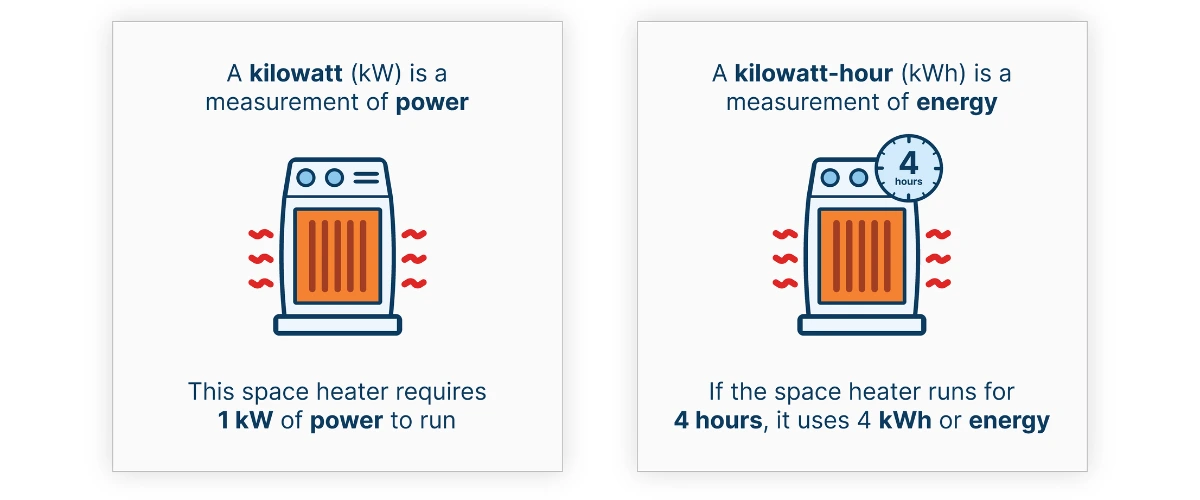
Electricity bills can be confusing for Southern California homeowners. Numbers like kW, kWh, and watts appear on your statements, leaving many homeowners wondering what they actually mean. Understanding the difference between kilowatts (kW) and kilowatt-hours (kWh) is essential for managing energy, sizing a solar system, or installing a home battery.
US Power offers factory-direct QCells panels and home battery storage, helping homeowners reduce electricity costs while getting the most out of their solar investment. In this guide, we’ll explain watts vs. kilowatts, show conversion formulas, and provide examples and online tools to make energy management simple.
What Are Watts, Kilowatts, and How Are They Measured?
A watt (W) is a unit of power, which measures the rate at which electricity is generated or consumed. When looking at household appliances or solar panels, power is the measure of energy at a given moment.
A kilowatt (kW) is simply 1,000 watts. Think of it as a larger unit to make power measurement easier for homes or solar systems.
Example:
- LED light bulb: 10–15 W
- Laptop: 30–70 W
- Microwave: 600 W–1 kW
- Coffee maker: 1 kW
- Central A/C: 3–5 kW
Understanding watts vs. kilowatts helps homeowners determine how much energy their devices use and how to convert watts into kilowatts using a simple formula:
Watts ÷ 1,000 = Kilowatts
This formula works vice versa if you need to convert back:
Kilowatts × 1,000 = Watts
What Are Kilowatt-Hours (kWh) and Why Do They Matter?
While kW measures power, kWh measures energy over time—how much electricity is actually consumed. Utilities charge homeowners based on kWh, so understanding this is key to saving money.
Formula to calculate kWh:
Watts × Hours ÷ 1,000 = kWh
Example:
150 W TV used for 4 hours → 150 × 4 ÷ 1,000 = 0.6 kWh/day

Multiply by 30 days → 18 kWh/month
Kilowatt-hours are also used to measure battery storage capacity or solar energy production. For instance, a 13.5 kWh home battery can power essential appliances for several hours, depending on your energy consumption.
Conversion Table: Watts, Kilowatts, and Beyond
A conversion table is a handy reference for power and energy units:
This power conversion table allows you to quickly convert watts, kilowatts, and kilowatt-hours, helping you plan your energy usage or solar system needs efficiently.
Pro tip: Online conversion calculators can do the math for you in seconds. Simply enter your watts, hours, or kWh, and let the calculator convert the units for you.
How to Convert Watts to Kilowatts: Step-by-Step
- Identify the power in watts of your device or appliance.
- Divide by 1,000 to get kilowatts.
- If you need energy over time, multiply by the number of hours the device runs.
Example:
Microwave draws 800 W and runs 2 hours:
800 ÷ 1,000 = 0.8 kW
0.8 kW × 2 hours = 1.6 kWh
This is the amount of energy used, which will appear on your electricity bill.
Why kW vs. kWh Is Critical for Solar Power
When reviewing solar quotes, you’ll see two numbers:
- System size in kW DC: This is the maximum power your panels can produce under standard conditions.
- Estimated energy production in kWh/year: This is the total electricity your system generates over a year.
Example with QCells Panels:
15 panels × 400 W each = 6 kW solar systemProduces ~9,500 kWh/year in Southern California, enough to offset most homes’ energy use.
Knowing your household kWh needs ensures your solar system is sized correctly and that your battery storage is adequate.
Home Battery Storage: Understanding kW vs. kWh
Solar batteries are rated in both kWh (energy capacity) and kW (power output).
- kWh: How much energy the battery can store
- kW: How much power it can deliver at once
Example: A 13.5 kWh battery can power your fridge, lights, and A/C for several hours, but if the total load exceeds the battery’s kW rating, not all devices can run simultaneously.
Sizing Tip: Use a conversion calculator to determine your daily energy needs, then match it to your battery’s kWh capacity and kW output.
Practical Examples for Homeowners
Example 1: Daily Household Energy
- Fridge: 200 W × 24 hours = 4.8 kWh
- Lights: 10 bulbs × 10 W × 5 hours = 0.5 kWh
- A/C: 4 kW × 5 hours = 20 kWhTotal Daily Use: ~25.3 kWh
Example 2: Electric Vehicle Charging
- Tesla Model 3 battery: 60 kWh
- Slow home charger: 16 kW per hour
- Charging time: ~3.75 hours
- Cost at 25¢/kWh → ~$15 for a full charge
These examples show why it’s important to learn how to measure and convert watts and kilowatts for both daily electricity use and solar system planning.
Online Tools and Conversion Calculators
Modern homeowners have access to online tools to simplify energy planning:
- Watts to kW conversion calculators
- kWh calculators for appliances
- Solar system sizing calculators
- Power conversion tables
These tools allow you to convert watt to kilowatt, calculate energy usage, and plan battery or solar storage with confidence.
Action Step: Use an online calculator or contact a US Power solar consultant to ensure your home’s solar system is sized right.
In Simple Form: kW vs. kWh
- kW = power at a given moment.
- kWh = energy used over time.
- Conversion formulas make it easy to calculate energy needs.
- Use online calculators and conversion tables for quick estimates.
- Understanding these units helps save money, size solar systems, and plan battery storage effectively.
US Power provides factory-direct QCells panels, home battery storage, and expert guidance to help Southern California homeowners reduce electricity bills and gain energy independence.
Speak with a solar consultant today to calculate your home’s exact kW and kWh needs and start saving on electricity.
Frequently Asked Questions
How many watts are in a kilowatt?
There are 1,000 watts in 1 kilowatt (kW). To convert watts to kilowatts, divide the number of watts by 1,000.
How much electricity does 300 watts use?
If a 300 W device runs for 1 hour, it consumes 0.3 kWh of electricity. Multiply the watts by the hours of use, then divide by 1,000:
300 W × 1 hour ÷ 1,000 = 0.3 kWh
How do I calculate my monthly electricity usage?
Add the kWh of all your appliances for each day, then multiply by the number of days in the month. For example, a fridge using 4.8 kWh/day × 30 days = 144 kWh/month.
What size solar system do I need for my home?
Your solar system size depends on your average daily kWh usage and roof space. Southern California homes typically use 25–35 kWh/day, which could require a 6–8 kW solar system. Online solar calculators or a solar consultant can help determine your exact size.
How long will a 13.5 kWh home battery last?
A 13.5 kWh battery can power essential appliances for several hours, depending on total power draw. For example, running a 4 kW A/C and a fridge simultaneously may deplete the battery in 3–4 hours, while lighter loads can last much longer.
Frequently Asked Questions



Do Solar Panels Reduce Indoor Heat in Your California Home?
Your roof is making your house hotter—here's how solar panels can help cool it down.

High Efficiency Solar Panels, Factory-Direct Pricing & Tax Credit
High-efficiency Qcells solar panels for maximum savings in Southern Califfornia.

How Big Are Solar Panels? What You Should Know
Understand solar panel sizes and how they fit different California rooftops.








Derechos de autor © 2025 US POWER | Energía solar y techosUS Power - Axia by QCells. All Rights Reserved.

¡Obtenga una estimación solar instantánea usando el satélite!