




Solar Panels for EV Charging in California: Worth It in 2026?

Charging your EV with solar in California sounds perfect—until you realize NEM 3.0 changed everything. Here's what actually works in 2026.
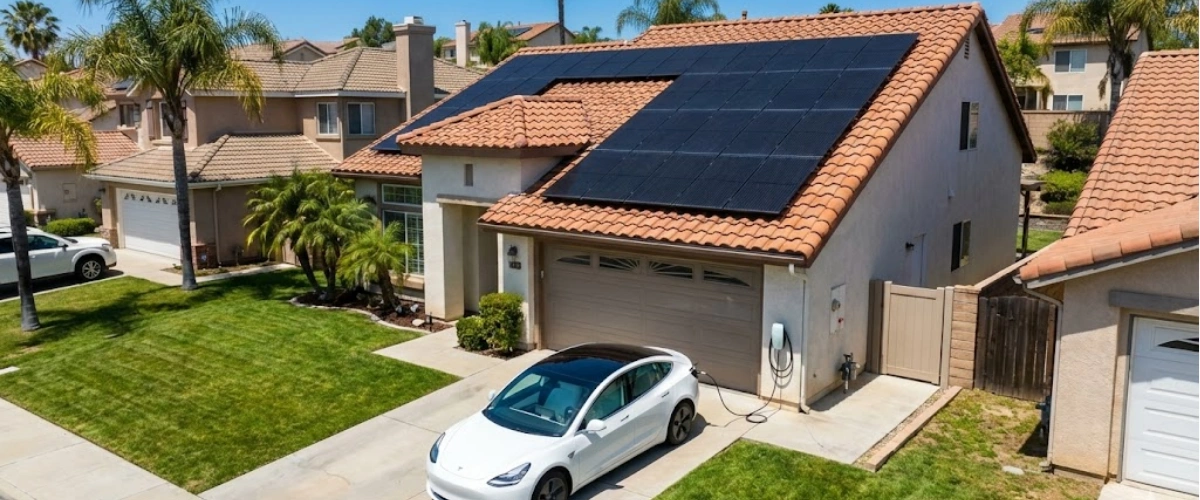
You bought an electric vehicle to save money and help the environment. Now you're wondering if solar panels can take those savings even further. The idea sounds perfect: charge your car with sunlight, never pay for gas or public charging again, and watch your electricity bill drop to nearly zero.
But if you live in Southern California, there's a problem. California's NEM 3.0 policy completely changed how solar works in 2026, and most EV owners don't realize it until after they've already installed their system. The Reddit threads are full of homeowners who sized their solar arrays for their house, bought an EV six months later, and now regret not planning ahead.
Here's what you actually need to know about pairing solar panels with EV charging in California right now.
Why Battery Storage Changes Everything Under NEM 3.0
Here's the reality that catches most California homeowners off guard: if you installed solar before April 2023, you probably have 1:1 net metering. That means the grid acts like a free battery. Your panels send excess power to SCE during the day, you get full credit, and you use those credits to charge your EV at night. Simple.
But battery storage is essential under NEM 3.0. Under the new policy, you only get about 5-8 cents per kilowatt-hour for excess solar you send back to the grid, but you pay 30-45 cents per kWh when you pull from the grid at night. That's a 75% loss on every kilowatt-hour.
The NEM 3.0 Reality for EV Owners
A typical EV uses about 200-250 kWh per month for average commuting. If you're charging at night without batteries, you're essentially buying expensive grid power while your daytime solar credits sit worthless. One homeowner on Reddit calculated they were losing $60-80 per month this way.
With battery storage, you capture your daytime solar production and use it to charge your EV at night. No grid power needed. No 75% loss on your solar investment.
Do You Absolutely Need Batteries?
Not if you work from home and can charge during peak solar hours (10 AM to 2 PM). Several Reddit users mentioned they charge their EVs exclusively during the day and avoid batteries entirely. But most people are at work during those hours, which makes batteries the only practical solution under NEM 3.0.
The question isn't really "do I need batteries?" It's "how much battery capacity do I need?" Most EV owners find that 13-20 kWh of storage handles daily charging without issues.
Sizing Your Solar System for EV Charging
This is where most homeowners make expensive mistakes. They size their solar system based on their current electricity usage, then six months later they buy an EV and realize their system can't handle the extra load.
How Much Energy Does Your EV Actually Use?
Here's the math that surprised most Reddit users: a Tesla Model 3 uses about 250 Wh per mile. If you drive 30 miles per day, that's 7.5 kWh daily just for the car. Over a month, that's 225 kWh added to your household consumption.
For reference, the average Southern California home uses 500-600 kWh per month. Adding an EV increases your total electricity needs by 35-40%. That's not a small bump.
The Solar Panel Calculation
To generate 225 kWh per month for your EV, you need approximately 3-4 kW of additional solar capacity (about 8-10 panels) in Southern California. But here's the catch: winter production drops by 40-50% compared to summer, so you need to size for worst-case scenarios.
Most installers recommend how many solar panels you'll actually need based on your annual driving patterns, not just summer averages. A system that works perfectly in July might leave you pulling expensive grid power in December.
Common System Sizes for EV Owners
Based on real homeowner experiences from Reddit:
One EV, moderate driving (1,000 miles/month): 10-12 kW solar array with 13.5 kWh battery
One EV, heavy driving (1,500+ miles/month): 14-16 kW solar array with 20+ kWh battery
Two EVs: 16-20 kW solar array with 30+ kWh battery storage
These numbers account for both household electricity and EV charging needs under NEM 3.0.
The Real Cost of Charging Your EV with Solar
Let's talk numbers. Grid charging in California costs about 30-45 cents per kWh depending on your SCE rate plan and time of use. For that 225 kWh monthly EV usage, you're paying $68-101 per month, or $816-1,212 per year.
Public DC fast charging? Even worse at 45-60 cents per kWh. That same 225 kWh costs $101-135 per month.
Solar + Battery Charging Costs
Once your system is installed, your cost per kWh drops to essentially zero (after you've paid off the equipment). Here's how the math works:
A 12 kW solar system with 13.5 kWh battery costs approximately $28,000-32,000 before incentives. With the 30% federal solar tax credit, that drops to $19,600-22,400. Some California homeowners also qualify for SGIP battery rebates worth $2,000-7,500.
If that system saves you $1,200 per year on EV charging alone (not counting household electricity savings), your payback period is 13-16 years. But factor in household savings of another $1,800-2,400 annually, and payback drops to 6-8 years.
What Solar Batteries Can Maximize Your Savings
The batteries don't just enable nighttime EV charging. They also protect you from SCE's time-of-use rates, provide backup power during outages, and store excess solar that would otherwise be sold back at pennies on the dollar.
One Reddit user with batteries reported saving $2,500 per year total: $1,200 from EV charging, $1,100 from avoiding peak electricity rates, and $200 from eliminating nonbypassable charges.
Common Mistakes EV Owners Make When Going Solar
The Reddit threads reveal patterns in what goes wrong. Here are the biggest regrets:
Undersizing the System
This is the number one complaint. Homeowners install an 8 kW system that perfectly covers their pre-EV usage, then buy an electric car and suddenly they're back to paying SCE $100+ per month. Adding panels later is possible but expensive and complicated.
Skipping Battery Storage
Some installers downplay batteries to reduce upfront costs. But under NEM 3.0, trying to charge your EV with solar at night without batteries means you're just buying expensive grid power. The solar panels become nearly useless for EV charging.
Not Planning for Winter
Your solar production in December and January can be 40-50% lower than summer months. If you size your system based on July production, you'll be pulling grid power all winter. How to size your solar system correctly accounts for seasonal variation.
Ignoring Future EV Purchases
Maybe you only have one EV now, but what about in three years when your spouse's car dies and you replace it with another electric vehicle? Planning ahead saves you from costly system expansions later.
What US Power Does Differently for EV Owners
Most solar companies treat EV charging as an afterthought. They size your system, tack on a few extra panels, and call it good. That approach fails under NEM 3.0.
Factory-Direct QCells Partnership
US Power is the exclusive QCells partner in Southern California, which means factory-direct pricing without middleman markups. For a typical 12 kW system with batteries, that saves homeowners $4,000-6,000 compared to competitors using the same equipment.
QCells panels are American-made with a 25-year comprehensive warranty covering panels, workmanship, and performance. That matters when you're counting on this system to power your transportation for the next two decades.
Integrated Solar + Battery + EV Planning
During your consultation, CSLB-licensed consultants calculate:
- Your current household electricity usage
- Your EV's energy consumption based on actual driving patterns
- Future EV purchases you're planning
- Seasonal production variations in your specific location
- Optimal battery size for nighttime charging
The result is a system sized correctly the first time. No regrets, no expensive add-ons later.
Fast Installation Timeline
Most competitors quote 8-12 weeks from contract to Permission to Operate. US Power's average is 3-6 weeks. That means you're capturing solar production and EV charging savings months earlier.
The company also handles all permitting, utility interconnection, and inspection coordination. You don't spend hours on hold with SCE trying to sort out net metering paperwork.
Is Solar Worth It If You Already Have an EV?
If you're already driving an EV and paying for grid charging, solar makes even more sense. You're already committed to the electric vehicle lifestyle, so why keep paying SCE's inflated rates?
The Break-Even Timeline
For EV owners, solar systems typically pay for themselves in 6-9 years when you factor in both transportation and household electricity savings. After that, you're essentially driving for free while everyone else watches gas prices fluctuate.
What If You Don't Have an EV Yet?
Install the solar system sized for future EV charging now while the 30% tax credit is still available. The credit drops to 26% in 2026 and 22% in 2027. On a $30,000 system, that's a $1,200-2,400 difference in tax savings.
You can start using the system for household electricity immediately, then add EV charging whenever you're ready. The system will already be sized correctly.
Your Next Steps for Solar-Powered EV Charging
The math is clear: pairing solar with EV charging in California makes financial sense, especially under NEM 3.0. But only if you size the system correctly and include battery storage.
Here's what to do next:
Calculate your monthly EV charging needs based on actual driving patterns. Check your electricity bills from the past year to understand household usage. Add these together to determine your total solar system requirements.
Get quotes from multiple installers, but make sure they're sizing specifically for NEM 3.0 and EV charging, not just copying a generic system size. Ask how they account for winter production drops and whether batteries are included.
Consider US Power for factory-direct QCells pricing, CSLB-licensed consultants who understand EV charging needs, and a 25-year comprehensive warranty that protects your investment. With 180+ five-star Google reviews and a 3-6 week installation timeline, you could be charging your EV with solar before the end of next month.
Frequently Asked Questions
Can I charge my EV with solar panels at night in California?
How much does it cost to install solar for EV charging in California?
Do I need special equipment to charge my EV with solar?
What happens if I sell my house with solar and an EV charger?
Will rising SCE electricity rates make solar more valuable?


Why More SoCal Homeowners Are Switching to Solar
Energy costs in Southern California aren’t slowing down—making it the clear choice.
Hybrid vs. Electric Cars: A Side-By-Side Comparison
Learn and choose the right car and reduce fuel and electricity costs in 2025.

Are QCells Panels Made in the USA? 2026 Manufacturing Guide
The surprising truth about where your QCells solar panels really come from.








Derechos de autor © 2025 US POWER | Energía solar y techosUS Power - Axia by QCells. All Rights Reserved.

¡Obtenga una estimación solar instantánea usando el satélite!