



Why Your SCE Bill Keeps Climbing in Southern California
Your SCE bill isn't just higher—it's part of a nationwide trend. Here's why electricity costs are skyrocketing and how to protect yourself.
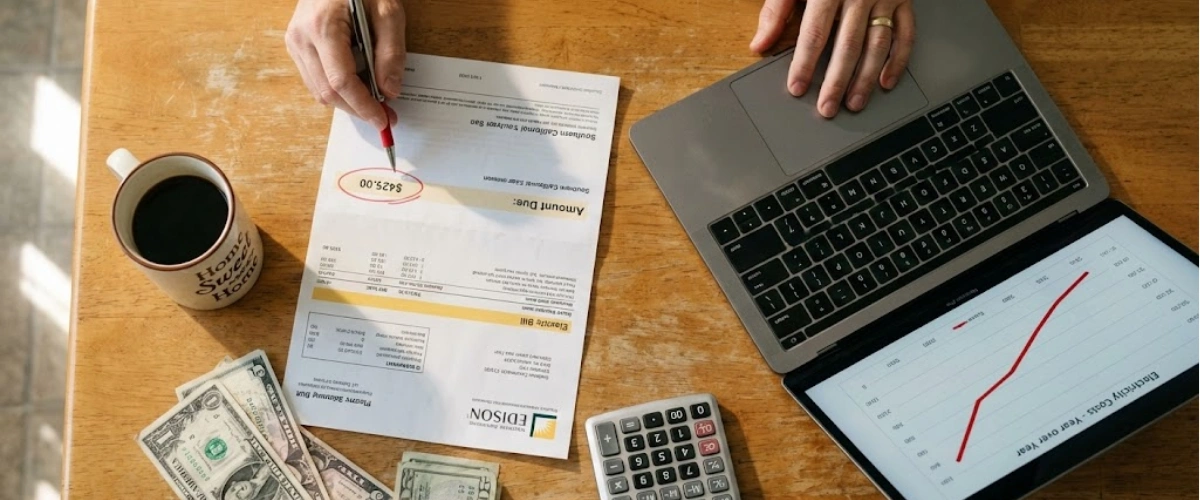
Your Southern California Edison bill arrives, and you do a double-take. Another increase? You haven't changed your habits, you're not running the AC more than usual, yet somehow your monthly electricity costs keep climbing. If this sounds familiar, you're not alone—and the problem is only getting worse.
Across the country, homeowners are watching their utility bills surge to record levels. From Michigan to California, the pattern is the same: massive industrial demand is driving up costs for everyone, while everyday families foot the bill. But unlike homeowners in other states who have limited options, Southern California residents have a powerful solution at their fingertips.
Why Electricity Rates Are Surging Across America (And Why California Is No Exception)
The nationwide conversation about rising electricity costs reveals an uncomfortable truth: utility companies are building infrastructure for massive industrial users, and residential customers are paying for it.
The Industrial Demand Problem
Recent discussions about data center construction have exposed how utility pricing actually works. When tech giants build facilities that consume as much power as entire cities, utility companies don't just charge them proportionally—they often give them special contract rates that are lower than what you pay at home.
Here's what's happening: A single large facility can demand 1% of a region's entire power supply, yet negotiate rates below residential pricing. Meanwhile, the infrastructure needed to support that demand—new substations, transmission lines, grid upgrades—gets financed through rate increases on everyday customers.
California's Unique Energy Challenges
Southern California faces its own perfect storm of rising costs. SCE has implemented multiple rate increases over the past few years, driven by:
- Wildfire prevention infrastructure investments
- Grid modernization requirements
- Increased demand during extreme weather
- Transmission system upgrades
- Regulatory compliance costs
These aren't temporary adjustments. They're structural changes that point to one clear reality: electricity from the grid is only going to get more expensive.
How Utility Rate Structures Actually Work (And Why They Don't Favor You)
Understanding why your bill keeps climbing requires looking at how utilities structure their pricing—and who benefits most from the current system.
The Residential vs. Industrial Pricing Gap
Most homeowners assume that electricity pricing works like buying anything else: use more, pay more proportionally. But utility rate structures don't work that way.
Large industrial users often receive volume discounts. They negotiate special contracts that lock in lower per-kilowatt rates because they commit to using massive amounts of power consistently. The utility gets guaranteed revenue, and the industrial customer gets a price break.
Meanwhile, residential customers pay higher per-unit rates and absorb the infrastructure costs when the grid needs expansion. When a utility builds a $400 million substation to support new industrial demand, those costs get passed to ratepayers through incremental rate increases over time.
Why "Peak Pricing" Doesn't Solve the Problem
Some utilities have introduced time-of-use pricing, charging more during peak afternoon and evening hours. While this sounds fair in theory—use power when it's expensive, pay more—it actually creates another burden for families.
You can't simply shift when you cook dinner, run your air conditioning during summer heat, or charge your electric vehicle. Your household needs power when it needs power. Peak pricing just means you pay extra for living your normal life, while industrial users with 24/7 operations negotiate contracts that minimize their exposure to these penalties.
The NEM 3.0 Factor in California
For Southern California homeowners considering solar, the NEM 3.0 policy change has fundamentally altered the economics. The new net metering structure significantly reduced the credit homeowners receive for sending excess solar power back to the grid—sometimes by 75% or more compared to NEM 2.0.
This change makes battery storage systems essential rather than optional. Instead of sending your excess solar production to the grid for reduced credits, you store that power for use during expensive evening hours when you actually need it.
The Solar + Battery Solution: How to Lock In Your Energy Costs
Here's the good news: while you can't control SCE's rate decisions, you can dramatically reduce your exposure to those rates. Solar panels combined with battery storage create energy independence that shields you from utility price volatility.
How Solar Panels Offset Rising Electricity Costs
When you install solar panels on your Southern California home, you're essentially prepaying for 25+ years of electricity at today's rate. Instead of being exposed to rate increases year after year, you lock in a fixed cost for power generation.
Let's break down the math with a typical scenario:
Without solar: You're paying SCE's current rates, which increase approximately 3-5% annually. Over 25 years, you'll pay the cumulative effect of those increases—potentially doubling or tripling your total electricity costs.
With solar: You finance or purchase a system once. Your cost per kilowatt-hour is fixed based on your system price divided by expected production. Even if SCE rates triple, your solar production cost stays the same.
Why Battery Storage Is Non-Negotiable Under NEM 3.0
Before NEM 3.0, homeowners could send excess solar power to the grid during the day and pull power back at night, essentially using the grid as a battery. Those days are over.
Under NEM 3.0, the credit you receive for exporting power during peak solar production (midday) is minimal compared to what you pay for importing power during peak demand (evening). This creates a huge gap that makes battery storage economically essential.
With a properly sized battery system, you:
- Store excess solar production during the day
- Use that stored power during expensive evening hours
- Minimize grid dependence when rates are highest
- Maintain power during outages and public safety power shutoffs
Battery storage transforms solar from a partial solution to a complete energy independence system.
Why US Power's Approach Protects You Better Than Traditional Solar Companies
Not all solar installations are created equal, and with rising electricity costs, choosing the right partner matters more than ever. US Power's factory-direct model offers advantages that directly address the economic concerns driving your interest in solar.
Factory-Direct QCells Pricing Eliminates Markup
US Power is an exclusive QCells partner, which means we source American-made panels directly from the manufacturer. There's no middleman markup, no distributor fees, no inflated costs.
This typically translates to 15-20% savings compared to market rates. When you're making a 25-year investment to protect yourself from rising electricity costs, that difference adds up to thousands of dollars—money that stays in your pocket instead of padding a contractor's margins.
Fast Installation Timeline Means Faster Savings
Many solar companies have 3-6 month backlogs. You're stuck paying rising SCE rates while waiting for installation. US Power typically completes installations within 3-6 weeks after approval and permitting.
That faster timeline means you start generating your own power sooner, protecting yourself from rate increases months earlier than you would with slower competitors. Every month you're not producing solar power is another month of full exposure to utility rate volatility.
25-Year Comprehensive Warranty Protects Your Investment
Our warranty isn't just about the panels—it covers everything:
- 25 years on panel performance
- 25 years on workmanship
- 25 years on system output guarantees
When you're investing in solar specifically to lock in energy costs and avoid future rate increases, you need absolute confidence that your system will perform as promised for decades. Our comprehensive warranty ensures your protection from rising electricity costs is guaranteed, not just hoped for.
CSLB-Licensed Consultants Give You Honest Numbers
With 175+ five-star Google reviews, our reputation is built on transparency. Our CSLB-licensed consultants don't work on commission pressure—they give you accurate projections of what solar + battery will actually save you based on your real usage and SCE's rate structure.
You'll see exactly how solar financing options compare to your current electricity trajectory, helping you make an informed decision about protecting your household from rate increases.
What About Future Rate Increases? The Long-Term Protection Perspective
One question we hear constantly: "What if rates don't keep rising?" It's a fair concern, but the evidence overwhelmingly points in one direction.
Historical Rate Increase Patterns
SCE rates have increased consistently over the past decade, averaging 3-5% annually with some years seeing much steeper jumps. These increases aren't random—they're driven by structural factors that aren't going away:
- Aging infrastructure that requires constant upgrades
- Climate change driving more extreme weather and grid stress
- Wildfire prevention and liability costs
- Regulatory compliance for renewable energy mandates
- Growing demand from electrification of vehicles and buildings
Even in the unlikely scenario that rates stabilize temporarily, the long-term trajectory is clear. Every major utility in California has filed for or received approval for significant rate increases in recent years.
The Insurance Policy Analogy
Think of solar + battery as insurance against rate volatility. You're not gambling that rates will increase—you're protecting yourself in case they do, while still benefiting even if they don't.
If rates increase aggressively (the most likely scenario), your solar system saves you massive amounts compared to staying on the grid. If rates somehow stabilize, you're still generating clean power at a fixed cost without exposure to any future changes in utility policy or pricing.
Calculating Your Break-Even Point
With rising rates, your solar system's break-even point actually accelerates over time. Here's why:
Year 1: Your solar savings are based on current SCE rates.
Year 5: SCE rates have increased 15-25%, so each kilowatt-hour your solar produces is worth more.
Year 10: Rates have potentially doubled, making your fixed-cost solar production dramatically more valuable.
Most Southern California homeowners see break-even in 6-8 years under current rate projections. If rates increase faster than expected, that timeframe shrinks. After break-even, every kilowatt-hour is pure savings—and those savings grow larger as rates continue climbing.
The Political Reality: Why Progressive Pricing Won't Save You
You might wonder: couldn't utilities just implement fairer pricing structures that protect homeowners? Theoretically, yes. Realistically, don't count on it.
The Lobbying Power Gap
The Reddit discussion about data centers in Michigan revealed something many homeowners don't realize: utility companies and large industrial users have sophisticated lobbying operations that consistently shape policy in their favor.
California is no exception. While residential ratepayers vastly outnumber corporate customers, they don't have the lobbying budget or political access that major utilities and industrial electricity users have. Policy changes that would truly protect homeowners from rising rates face an uphill political battle.
Why Waiting for Policy Solutions Is Risky
Even if progressive pricing or other consumer protections eventually pass, they'll take years to implement—years during which your electricity costs keep rising. And any policy solution will likely be watered down through compromise, leaving homeowners with only partial protection.
You can't control utility policy. You can't control SCE's rate-setting process. But you can control whether you're dependent on the grid or producing your own power. That's the fundamental distinction solar energy provides.
Take Control Before Rates Climb Even Higher
Rising electricity costs aren't a temporary problem—they're the new normal. While homeowners in other states scramble to understand why their bills keep increasing, Southern California residents have a proven solution.
The combination of SCE rate increases and NEM 3.0 changes has created an environment where solar + battery systems offer unprecedented value. Every month you wait is another month of full exposure to utility rate volatility, another month of watching your hard-earned money go to electricity costs that will only keep rising.
US Power's factory-direct QCells partnership, 3-6 week installation timeline, and 25-year comprehensive warranty make the switch to solar as seamless and risk-free as possible. With transparent pricing, CSLB-licensed consultants, and 175+ five-star reviews, you can trust that you're getting honest advice and quality installation.
The question isn't whether electricity rates will keep rising—it's whether you'll still be paying them when they do.
Frequently Asked Questions
How much can solar actually save me with rising SCE rates?
Is battery storage really necessary, or can I save money with just solar panels?
How long does US Power's installation process take?
What happens if I sell my house after installing solar?
Can I really trust the 25-year savings projections?


What to Expect from Qcells Solar Panel Performance
Get the real performance & realistic savings with Qcells panels in California.

Q.HOME CORE Might Be the Energy Storage Solution Your Home
Comparing Q.HOME CORE to other batteries to find the best for your CA home.

The Truth About Flat Roof Solar in California: Savings vs. Challenges
Flat-roof solar cuts upfront costs and delivers up to $45k in lifetime savings.







Derechos de autor © 2025 US POWER | Energía solar y techosUS Power - Axia by QCells. All Rights Reserved.

¡Obtenga una estimación solar instantánea usando el satélite!