




Does the New PG&E and SCE Base Service Charge Hurt Solar Customers?

Southern California utilities just added a $24 monthly base service charge that solar panels can't offset. Here's what changed, how it affects your solar investment, and the smart solution that protects your savings.
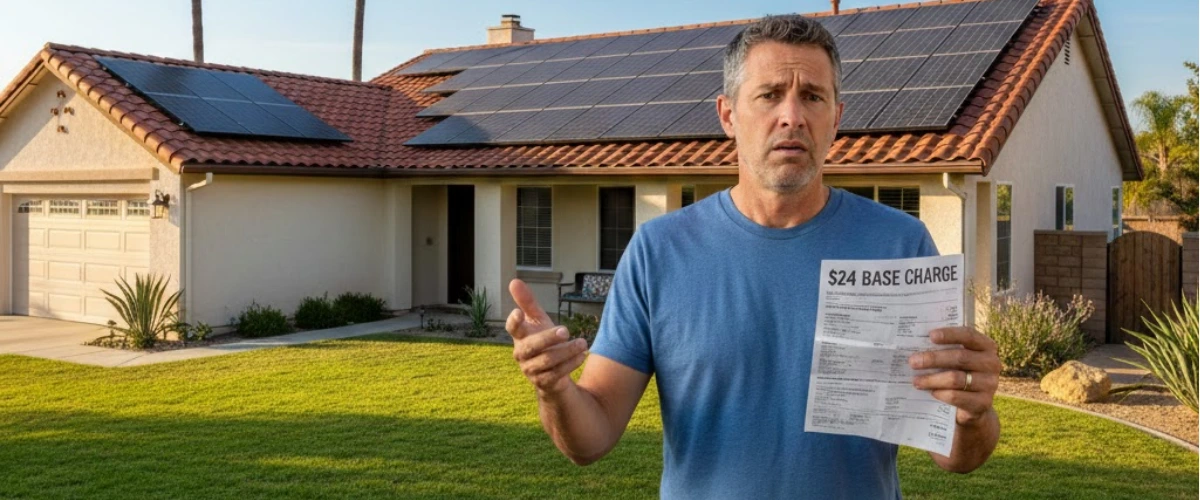
If you have solar panels in Southern California, you probably noticed something alarming on your latest utility bill. A new fixed charge that your solar production can't touch.
PG&E and SCE customers are now paying around $24 per month just to stay connected to the grid—regardless of how much electricity they use or produce. For solar homeowners who invested thousands to achieve net-zero bills, this feels like a betrayal.
The frustration is real. As one solar owner put it: "Does that mean homes with solar that had a net bill of zero will have a minimum bill of $24 per month going forward?" The answer, unfortunately, is yes. But here's what you need to know about this change, why it happened, and—most importantly—how battery storage transforms this challenge into an opportunity.
Why Southern California Utilities Added Fixed Grid Fees
Starting in late 2025, California's major utilities rolled out mandatory fixed charges for all customers:
- SCE (Southern California Edison): $24.15/month (started November 2025)
- PG&E (Pacific Gas & Electric): ~$24/month (starts March 2026)
- SDG&E (San Diego Gas & Electric): ~$24/month (started October 2025)
These "base service charges" cover infrastructure maintenance, customer service, and grid operations. The California Public Utilities Commission (CPUC) approved these fees to shift costs from per-kilowatt-hour (kWh) charges to fixed monthly fees.
The Stated Justification
Utilities claim this makes electricity rates "more equitable." The per-kWh rate dropped slightly (by a few cents), while the fixed charge supposedly helps lower-income customers who use less electricity. However, the reality is more complex.
Solar customers who carefully sized their systems to eliminate their bills now face an unavoidable $288 annual charge ($24 × 12 months). This adds to why electricity bills are so high in Southern California in the first place.
The worst part? This charge cannot be offset by solar production. Even if you produce 150% of your usage and send excess power back to the grid, you'll still owe $24 every single month.
What This Means for Existing Solar Customers
The impact varies depending on when you installed solar and which net metering program you're on.
NEM 2.0 Customers (Grandfathered Until 2045)
If you installed solar before April 2023, you're on NEM 2.0 with generous 1-to-1 credit rates. The base service charge still applies, but your existing rate structure remains intact for 20 years from your interconnection date.
Your minimum annual cost just increased by $288, even if you previously had zero-dollar bills. Courts ruled that CPUC couldn't change NEM 2.0 terms, but this fixed fee sidesteps that protection entirely.
NEM 3.0 Customers (Installed After April 2023)
You already face reduced export credits (about 75% lower than NEM 2.0). The base service charge adds another layer of unavoidable costs. This double-whammy makes solar-only systems far less attractive than they were just two years ago.
Solar Billing Plan Customers
PG&E's Solar Billing Plan participants also pay the base service charge. There are no exceptions based on your billing structure. For more details on how this interacts with different rate plans, see our guide on understanding SCE's new solar billing plan.
How Battery Storage Changes the Base Charge Equation
Here's where the conversation shifts from frustration to strategy.
While you can't eliminate the $24 base charge, battery storage fundamentally changes your relationship with the grid—and your actual electricity costs.
Why Batteries Matter More Than Ever
Under the new rate structure, the goal isn't just generating solar power. It's about reducing grid dependence entirely. Batteries allow you to:
- Store daytime solar production instead of exporting it at low rates
- Use stored power during expensive peak hours (4-9 PM when rates spike)
- Avoid grid imports that trigger higher time-of-use charges
- Maintain power during outages (an increasingly valuable feature in wildfire-prone areas)
With NEM 3.0's reduced export rates, selling power back to the grid already makes little financial sense. The base charge makes this even clearer: your best financial strategy is self-consumption, not grid interaction.
Learn more about how Solar Batteries Can Maximize Your Savings under these new rate structures.
The Real ROI Calculation
Let's compare two scenarios for a typical Southern California home using 850 kWh/month:
Solar-Only System (Post-Base Charge):
- Monthly grid charge: $24 (fixed) + ~$15 (residual usage) = $39/month
- Annual cost: $468
- Savings vs. no solar: ~$2,500/year (based on $250/month average bill)
Solar + Battery System:
- Monthly grid charge: $24 (fixed) + $0-5 (minimal usage) = $24-29/month
- Annual cost: $288-348
- Savings vs. no solar: ~$2,650/year
- Additional benefit: Blackout protection worth thousands
The math is clear. Batteries don't just offset the base charge's impact—they maximize your solar investment's value. Understanding why NEM 3.0 made batteries essential helps clarify this shift in California solar economics.
Why Solar-Only Systems Lost Value (And What to Do)
The combination of NEM 3.0 and fixed grid fees has fundamentally changed California solar economics.
The Policy Shift Timeline
- Pre-2023: NEM 2.0 made solar-only systems highly profitable
- April 2023: NEM 3.0 reduced export credits by 75%
- Late 2025: Base service charges eliminate the possibility of zero-dollar bills
Each policy change eroded the value of solar-only installations. What made financial sense in 2022 no longer applies in 2025.
If You Already Have Solar-Only
You have three strategic options:
- Accept the $24 charge as your new minimum bill (still far better than no solar)
- Add battery storage to maximize self-consumption and minimize grid interaction
- Optimize usage patterns to consume solar during production hours (limited effectiveness)
Most homeowners choose option two. Adding a battery to an existing solar system qualifies for the 30% federal tax credit (expires December 31, 2025), making 2025 the optimal year to upgrade.
If You're Planning New Solar
Installing solar without batteries in 2025 means leaving money on the table. The upfront cost is higher, but the ROI is significantly better when you factor in:
- Avoided peak-rate charges (4-9 PM electricity costs 3-4× more than midday)
- Minimized grid interaction (reducing your exposure to future rate increases)
- Backup power (protection against SCE and PG&E's increasingly frequent Public Safety Power Shutoffs)
The policy changes of recent years have fundamentally transformed the economics. Here's more on why NEM 3.0 made batteries essential for new California solar installations.
Should You Still Go Solar in 2025?
Despite the base service charge, solar remains one of the smartest investments Southern California homeowners can make.
The Real Math: Is Solar Still Worth It with Fixed Fees?
Let's run actual numbers for a typical Los Angeles home:
Without Solar:
- Average monthly bill: $250-300
- Annual electricity cost: $3,000-3,600
- 25-year total: $75,000-90,000 (assuming 3% annual rate increases)
With Solar + Battery (Including Base Charge):
- System cost: $35,000-45,000 (before incentives)
- After 30% tax credit: $24,500-31,500
- Monthly grid charge: $24-30 (base fee + minimal usage)
- Annual cost: $288-360
- 25-year total: $7,200-9,000
- Net savings: $68,000-81,000
Even with the base charge, you're saving tens of thousands over your system's lifetime. The payback period extends by about 6-12 months compared to pre-base-charge calculations, but the long-term value remains substantial. For a deeper dive into current solar economics, read our analysis on whether solar is still worth it for Southern California homeowners.
Why December 31, 2025 Matters
The 30% federal tax credit expires December 31, 2025, dropping to 26% in 2026, then 22% in 2027, before expiring entirely for residential installations in 2035. On a $40,000 system, that's:
- 2025: $12,000 tax credit
- 2026: $10,400 tax credit
- Difference: $1,600 lost by waiting
When you combine the tax credit deadline with rising electricity rates (SCE increased rates by 32% since 2014), the case for acting in 2025 is compelling.
How US Power Helps You Maximize Value Despite New Fees
At US Power, we've adapted our solar + storage solutions specifically for California's new rate reality.
Factory-Direct QCells Advantage
As the exclusive QCells partner in Southern California, we offer:
- American-made panels from Dalton, Georgia (superior quality + supports US manufacturing)
- Factory-direct pricing (15-20% below market rates)
- Integrated battery solutions (QCells batteries designed to work seamlessly with QCells panels)
- 25-year comprehensive warranty (panels, workmanship, and performance guaranteed)
Right-Sized Systems for 2025
We don't over-promise or under-deliver. Our approach:
- Analyze your actual usage patterns (not just annual kWh totals)
- Size solar for your needs (typically 100-120% of usage)
- Recommend appropriate battery capacity (usually 13-27 kWh for homes)
- Optimize for time-of-use rates (maximum self-consumption during peak hours)
This ensures you're not paying for more capacity than you need while still achieving maximum savings under the new rate structure. When evaluating options, our guide on how to choose a solar company in Los Angeles can help you ask the right questions.
Faster Installation Timeline
While some solar companies quote 3-6 months for installation, US Power typically completes projects in 3-6 weeks after approval:
- Week 1-2: Permitting and approvals
- Week 3-4: Installation
- Week 5-6: Utility inspection and Permission to Operate (PTO)
This matters in 2025 because you need PTO before December 31 to claim the full 30% tax credit. Starting in November or early December means you can still qualify.
Your Next Steps: Smart Solar Planning in 2025
If you're considering solar, or already have solar and want to add batteries, here's your action plan.
For New Solar Customers
- Get multiple quotes that include battery storage (compare total cost of ownership, not just upfront price)
- Verify licensing (CSLB license required for all California solar installers)
- Understand your rate plan (time-of-use rates significantly impact battery value)
- Review warranty terms (comprehensive coverage vs. limited protection)
- Confirm tax credit eligibility (ensure installation completes before December 31, 2025)
For a comprehensive pre-installation checklist, review our guide on Things You Must Know Before Going Solar in California.
For Existing Solar Customers
If you installed solar before batteries became essential, adding storage now makes financial sense:
- Existing system compatibility: Most solar installations can integrate batteries
- Stacked incentives: 30% federal tax credit + possible SGIP rebates (California)
- Improved ROI: Batteries maximize your existing solar investment's value
- Energy independence: Reduce reliance on grid during peak hours and outages
Questions to Ask Any Solar Company
Before signing a contract, confirm:
- What happens with the base service charge? (Any company claiming you can avoid it is misleading you)
- How is the system sized for time-of-use optimization? (Not just annual kWh matching)
- What's the realistic payback period? (Factor in the $24/month charge)
- Does the warranty cover all components? (Panels, inverters, batteries, workmanship)
- What's the actual installation timeline? (Important for 2025 tax credit deadline)
The Right Base Service Charge Should Be
The new base service charge feels like a setback for solar customers who invested in energy independence. But while the $24 monthly fee is unavoidable, it doesn't change the fundamental value proposition of solar + storage in Southern California.
With electricity rates climbing 32% since 2014 and no signs of slowing, owning your power production remains the smartest long-term strategy. The key is adapting to the new reality: batteries are no longer optional—they're essential for maximizing your solar investment.
The clock is ticking on the 30% federal tax credit. If you start now, you can lock in thousands in savings before the December 31, 2025 deadline. Whether you're adding to an existing system or going solar for the first time, properly sized solar + storage protects you from future rate increases while eliminating the sting of unavoidable grid fees.
Frequently Asked Questions
Can solar customers avoid the base service charge?
Will the base charge increase in the future?
Does the charge apply to battery-only systems?
Can I use existing solar credits to offset the base charge?
Is it worth adding batteries to my existing solar system?



Should You Wait to Go Solar in 2026 or Act Now? | Market Analysis
The 2025 solar install rush is already over. So is waiting finally the smart move?
Can You Charge a 12V Battery with a Solar Panel?
Your solar system's voltage could be costing you 75% of your power. Start saving now!

Future-Proof Your SoCal Home with the Right Solar System Size
PTO delayed into 2026? Your system may still qualify for 30% solar tax credit.








Derechos de autor © 2025 US POWER | Energía solar y techosUS Power - Axia by QCells. All Rights Reserved.

¡Obtenga una estimación solar instantánea usando el satélite!