




DC vs AC Coupled Battery Storage: Which Saves More Money in 2026?

DC or AC battery? Learn which saves more for your existing solar system.
You've already made the smart move by installing solar panels on your Southern California home. Now you're ready to add battery storage to protect yourself from rising SCE rates and frequent grid outages. But here's where things get confusing.
Your solar installer hands you two quotes. One for a DC coupled battery system that costs significantly more but promises better efficiency. Another for an AC coupled system with more storage capacity at a lower price. You feel like you're comparing apples to oranges, and honestly, you are.
The question keeping you up at night: which one actually saves you more money over the long run? Let's cut through the technical jargon and give you a straight answer based on real Southern California homeowner situations.
Why Battery Coupling Matters for Your Wallet
Understanding the Energy Conversion Game
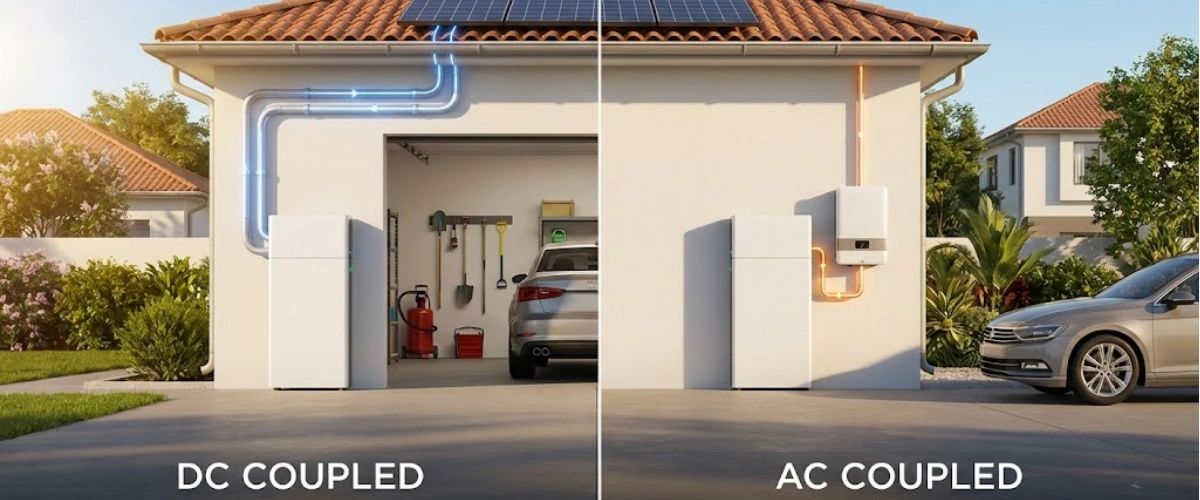
Here's the simple truth about solar energy: it travels through your home as either DC (direct current) or AC (alternating current) power. Your solar panels produce DC power, but your home runs on AC power. Batteries store DC power. Every time energy converts from one type to another, you lose a small percentage to inefficiency.
DC coupled batteries connect directly to your solar panels before the inverter. This means solar energy goes straight into storage with minimal conversion losses, achieving about 90% round-trip efficiency. Learn more about choosing between AC vs DC solar batteries and how these differences impact your home.
AC coupled batteries connect after your existing inverter has already converted solar power to AC. Then the battery converts it back to DC for storage, and back to AC again when you use it. This extra conversion step drops efficiency to around 80%. That 10% difference sounds significant until you run the actual numbers.
The Hidden Cost Everyone Overlooks
Most homeowners focus entirely on efficiency percentages without considering the upfront cost difference. If a DC coupled 20 kWh system costs $8,000 more than an AC coupled 24 kWh system, you need to calculate how long it takes to recoup that premium through efficiency gains.
Here's the reality for a typical Southern California home: that 10% efficiency advantage might save you $200-$300 annually in avoided electricity purchases. At that rate, you're looking at 25-30 years just to break even on the price difference. Your warranty will likely expire first.
When DC Coupled Actually Makes Sense
The New Installation Scenario
DC coupled batteries shine when you're installing solar and storage together from scratch. You avoid buying a separate inverter, and the integrated system works more efficiently. The cost premium becomes much smaller, sometimes even negligible.
If you're building new or doing a complete electrical overhaul, DC coupling deserves serious consideration. The streamlined installation can actually save money compared to buying separate components.
The Serious Solar Clipping Problem
Solar clipping happens when your panels produce more power than your inverter can handle. With a typical 10 kW panel array and 8 kW inverter (like the Reddit homeowner in our research), you're clipping peak production during optimal conditions.
A DC coupled battery can capture that clipped energy before it's lost. If you see flat-topped production curves on your monitoring app for several hours daily, this lost energy adds up. In these specific cases, DC coupling recovers real value that AC coupling cannot.
However, most Southern California homes don't experience severe clipping for enough hours annually to justify the cost premium. Your solar consultant should show you actual clipping data before recommending DC based on this argument.
Why AC Coupled Usually Wins for Existing Systems
You Already Own a Working Inverter
This is the game-changer most installers won't tell you upfront. If you already have solar panels with a functioning inverter, switching to DC coupled means replacing that perfectly good inverter. You're essentially throwing away a $2,000-$3,000 component that still has years of life left.
AC coupled batteries simply add onto your existing system. No replacement needed. No additional electrical work beyond the battery installation itself. If you're considering adding battery to existing solar system, AC coupling makes the most financial sense.
More Storage Capacity for Your Dollar
The numbers speak for themselves. That Reddit homeowner comparing quotes saw a 20 kWh DC system priced higher than a 24 kWh AC system. That's 20% more usable storage at a lower total cost.
For most Southern California homes under NEM 3.0, storage capacity matters more than efficiency. You need enough battery to shift your evening consumption away from expensive peak rates. An extra 4 kWh of storage capacity delivers more bill savings than a 10% efficiency improvement on a smaller battery. Understanding how solar batteries can maximize your savings helps you make the right sizing decision.
Independent System Reliability
Here's a practical consideration: AC coupled batteries operate independently from your solar inverter. If your solar inverter fails, your battery still works. If your battery has issues, your solar keeps producing.
With DC coupling, a single inverter handles both functions. One component failure takes out your entire system until repairs arrive. That's a significant reliability disadvantage for time-sensitive backup power needs.
How US Power Solves the Battery Coupling Dilemma
Factory-Direct QCells Battery Pricing
US Power is the exclusive QCells partner in Southern California, which means you get factory-direct pricing on the Q Home Core battery storage solution without dealer markups. This pricing advantage often makes the coupling debate irrelevant because both options become genuinely affordable.
Our CSLB-licensed consultants evaluate your existing solar setup and provide honest recommendations. If AC coupling saves you $6,000 while only sacrificing $150 annually in efficiency, we'll tell you exactly that. We're not here to upsell you on unnecessary premium equipment.
The 3-6 Week Installation Advantage
Traditional battery retrofits can drag on for months due to permitting delays and installer backlogs. US Power's streamlined process gets AC coupled batteries installed and operational in 3-6 weeks after approval. That means you start saving on electricity bills faster, which directly improves your ROI calculations.
Our 180+ five-star Google reviews consistently mention installation speed as a standout benefit. Time is money, especially when SCE rates keep climbing.
Comprehensive 25-Year Warranty Coverage
Whether you choose DC or AC coupling through US Power, you get the same industry-leading 25-year warranty covering panels, workmanship, and performance. This warranty eliminates the reliability concerns some homeowners worry about with AC coupled systems.
You're not making a tradeoff on protection or long-term peace of mind. The warranty coverage equalizes the risk equation between both coupling approaches.
What NEM 3.0 Means for Your Battery Decision
Why Every California Solar Home Needs Storage Now
California's NEM 3.0 policy fundamentally changed the economics of solar. Export rates dropped so dramatically that sending excess solar to the grid barely covers the cost of pulling it back during evening hours. This is precisely why solar panels alone aren't enough in 2025 for meaningful bill reduction.
This policy shift makes battery storage nearly mandatory for meaningful bill savings. The question isn't whether to add a battery, it's which type delivers the best financial return under these new rules.
Time-of-Use Rates Favor Capacity Over Efficiency
SCE's time-of-use rates create massive price swings throughout the day. Evening peak rates can hit $0.50-$0.60 per kWh while midday solar export might earn you just $0.08 per kWh. When evaluating whether batteries are worth it for solar in California, these rate structures are the deciding factor.
This dramatic spread means having enough storage capacity to cover your evening consumption matters far more than squeezing an extra 10% efficiency from DC coupling. A bigger AC coupled battery that stores more of your midday solar for evening use wins every time.
Making the Right Choice for Your Home
Run the Actual Numbers for Your Situation
Don't let any installer pressure you based on theoretical efficiency advantages. Demand to see calculations based on your specific electricity usage, existing solar production, and local utility rates.
A reputable solar consultant will show you detailed financial projections for both options. If they can't or won't provide this analysis, that's a major red flag about their expertise and intentions. Understanding whether solar batteries are worth the cost requires personalized financial modeling, not generic claims.
Consider Your Timeline and Budget
If you need backup power urgently due to frequent outages, AC coupled batteries get you operational faster and cheaper. If you're planning a complete home electrical upgrade anyway, DC coupling becomes more attractive as part of the larger project.
Your personal financial situation matters too. Spending an extra $8,000 for marginal efficiency gains doesn't make sense if that money could go toward a larger AC coupled battery that provides more backup runtime. Get everything you need to know about solar and battery storage before making your final decision.
Think About Future Expansion
AC coupled systems offer more flexibility for future additions. Want to add more panels later? No problem with AC coupling. Considering a second battery? Easy to integrate. Planning an EV charging setup? AC coupled batteries work seamlessly with diverse electrical configurations.
DC coupling locks you into a more rigid system architecture that can complicate future modifications.
Your Path Forward: Making an Informed Decision
The "best" battery coupling choice depends entirely on your specific situation. AC coupling makes overwhelming financial sense for most Southern California homeowners with existing solar systems. You get more storage capacity, faster installation, lower upfront costs, and complete system independence.
DC coupling shines in new installations or situations with severe solar clipping and complete electrical system overhauls. The efficiency gains are real but rarely significant enough to justify the cost premium for retrofits.
Don't let any installer push you toward more expensive options without showing you detailed financial projections. The right choice should be obvious once you see the numbers specific to your home, usage patterns, and utility rates.
US Power's CSLB-licensed consultants provide this analysis completely free with zero obligation. We'd rather you make the right choice for your situation than sell you something that doesn't maximize your investment.
Frequently Asked Questions
Will DC coupling really save me more money over 10 years?
Can I add a DC coupled battery to my existing solar system?
Does the warranty differ between AC and DC coupled batteries?
How much solar clipping would justify DC coupling?
Will AC coupling limit my battery charging speed?


Are Batteries Worth It for Solar in California?
Explore whether adding a battery to your solar system maximizes your savings.
Why Every California Homeowner Needs a Solar Battery in 2025
California’s new solar rules, it’s no longer enough to just go solar— storage is key.

Pros & Cons of Today’s Solar Batteries: A Guide for Homeowners
Weigh the benefits and drawbacks of each solar battery to maximize energy savings.








Derechos de autor © 2025 US POWER | Energía solar y techosUS Power - Axia by QCells. All Rights Reserved.

¡Obtenga una estimación solar instantánea usando el satélite!