




Can You Add Batteries to Solar Panels Later in California?

Worried about the upfront cost of solar batteries? You're not alone. Thousands of Southern California homeowners face $15k+ battery quotes and wonder if they can install panels now and add storage later. The answer is yes—but only if you plan ahead.
You're sitting at your kitchen table in Los Angeles, looking at a solar quote that makes perfect sense—until you see the battery line item. Another $15,000. Your stomach drops. You desperately need to kill those daytime SCE bills that hit $400+ last month, but you simply don't have an extra $15k lying around right now.
Here's the question keeping you up at night: Can you install solar panels now and add batteries later when you have the cash? And more importantly, will you have to pay for the same equipment twice?
The short answer is yes, you can absolutely add batteries later. But there's a right way and a wrong way to do it. Thousands of Southern California homeowners have successfully retrofitted batteries to existing solar systems—and just as many have paid thousands in unnecessary costs because their installer didn't plan ahead.
Let me show you exactly how to set up your solar system today so you're battery-ready tomorrow, without wasting a single dollar.
Why More Southern California Homeowners Are Asking This Question
Five years ago, batteries were a luxury add-on. Today under NEM 3.0, they're practically essential for maximizing your solar investment in Southern California.
Here's what changed. Under the old net metering rules (NEM 2.0), you could send excess solar power back to the grid and get credited at nearly retail rates. Your meter spun backward. Storage wasn't critical because the grid acted like a giant battery.
NEM 3.0 flipped everything in April 2023. Now when you export solar power to SCE or PG&E during the day, you might get credited only $0.08 per kilowatt-hour. But when you pull that same power back at night? You're paying $0.50 or more during peak hours.
That's a 6x difference. Suddenly, storing your daytime solar production in batteries makes financial sense. You're not giving away cheap power and buying back expensive power. This is exactly how solar batteries maximize your savings under the new rules.
But here's the reality check: Not everyone has $15,000-$20,000 sitting around for a battery system when they're already investing $20,000-$30,000 in solar panels. The upfront cost is brutal, especially when your primary goal is simply to stop hemorrhaging money on electric bills.
The Numbers That Drive This Decision
Southern California homeowners on NEM 3.0 without batteries typically see:
- 40-60% offset in annual electricity costs (not 90-100% like NEM 2.0 customers)
- Peak evening charges when solar isn't producing
- Lower returns on exported solar power
With batteries added later, those same homeowners achieve:
- 80-95% electricity bill offset
- Protection from time-of-use peak rates
- Energy security during outages
The question isn't whether batteries add value. They absolutely do. The question is whether you can afford them right now—and whether waiting will cost you more money.
Understanding NEM 3.0 and Why Battery Timing Matters
Let's talk about something that confuses every solar shopper in California: net energy metering and the NEM 3.0 billing changes that took effect in April 2023.
Under NEM 3.0, the value of your solar power depends entirely on when you use it. Generate power at noon and use it at noon? Full retail value. Generate at noon, send it to the grid, and pull it back at 7 PM? You just lost 80% of its value in that round trip.
This is why storage timing matters more than ever. But here's the catch—you don't necessarily need batteries on day one to benefit from solar. Your situation depends on three things.
Your Energy Usage Pattern
If you work from home and run your AC, pool pump, and appliances during sunny hours, you're already consuming most of your solar production when it's generated. Batteries can wait. You're getting near-retail value for every kilowatt-hour your panels produce.
But if your house is empty from 8 AM to 6 PM, and your family comes home just as the sun sets? You're exporting cheap power all day and importing expensive power all evening. Batteries should be a priority, even if you have to phase the installation.
Your Budget Reality
Here's what many Southern California homeowners don't realize: While you're waiting to save up for batteries, SCE and PG&E rates keep climbing. These utilities have increased rates by over 50% in the past five years, and there's no sign of slowing down.
This means if you need to split your investment, you're at least stopping the bleeding on daytime electricity costs immediately with solar panels. Then when batteries come online, you eliminate those expensive evening charges too. The key is getting solar working for you now rather than waiting until you can afford everything at once.
Your Utility's Interconnection Timeline
SCE and PG&E are currently taking 6-8 weeks (sometimes longer) to approve solar interconnection applications. If you wait and add batteries a year later, you're going through permitting and interconnection again. That's another 2-3 months of delays, more paperwork, and additional soft costs.
Smart homeowners plan the battery addition during their initial solar design, even if they don't install it immediately. The permitting groundwork gets laid now, making the retrofit seamless later.
What Makes a Solar System "Battery-Ready"?
This is where most homeowners get burned. They install a standard grid-tie inverter, then discover a year later that adding batteries requires replacing the inverter completely. You just paid for the same equipment twice.
Let's break down the three battery-compatible system types so you know exactly what to ask your installer for.
AC-Coupled Battery Systems
This is the most flexible option for retrofits. Your solar panels connect to one inverter (your existing string inverter or microinverters), and the battery connects to a separate battery inverter.
The beauty of AC coupling is that it works with any existing solar setup. You don't need to rip out your current equipment. Enphase microinverter systems, SolarEdge inverters, and most other configurations can add an AC-coupled battery later with minimal changes.
The downside? Slight efficiency loss (around 4-8%) because you're converting DC to AC, then back to DC for battery storage, then back to AC again for home use. But for most Southern California homeowners, the flexibility far outweighs this minor efficiency hit.
DC-Coupled Battery Systems
With DC coupling, your panels and batteries both connect to a hybrid inverter on the DC side, before the power gets converted to AC for your home. This is more efficient—you're skipping one of those conversion steps—and it's usually cheaper if you're installing everything at once.
But here's the catch: You need a hybrid inverter from day one. These cost $1,000-$2,000 more than standard inverters, and not all battery brands work with all hybrid inverters. You're locking yourself into a specific battery ecosystem.
If you choose this route, make absolutely sure your installer documents which battery models are compatible with your hybrid inverter. Don't take "any battery will work" as an answer.
The "Battery-Ready" Configuration
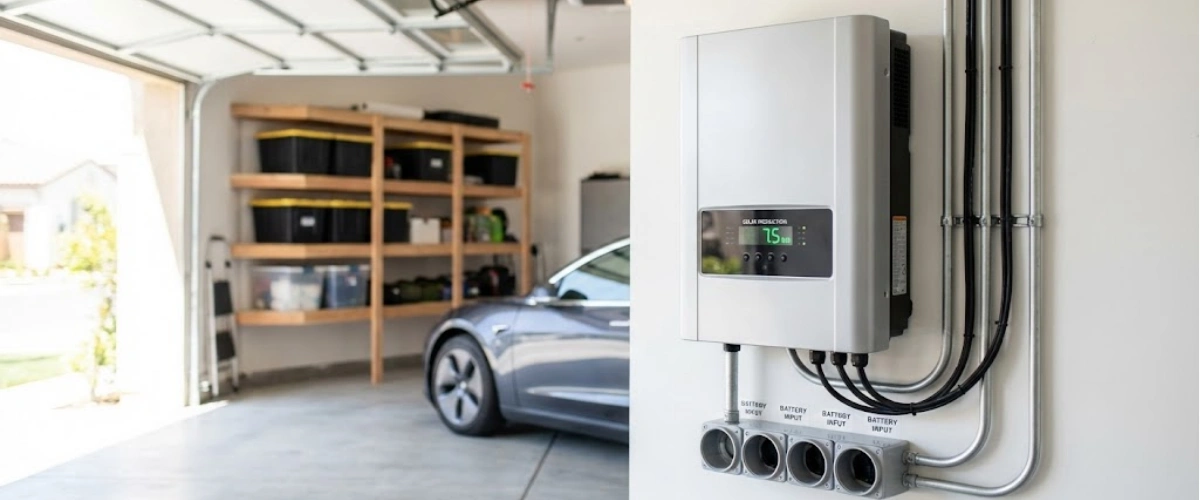
Here's what US Power recommends for most budget-conscious Southern California homeowners: Install a hybrid inverter now, but don't connect batteries yet.
You pay the extra $1,500-$2,000 for the hybrid inverter upfront. When you're ready for batteries (six months, a year, two years later), you simply connect them to the existing inverter. No equipment replacement. No compatibility headaches. Total retrofit cost: Just the battery and installation labor.
This is the sweet spot—battery-ready without the full battery investment today. Learn more about battery-ready inverter systems and storage options to understand which configuration works best for your situation.
The Real Cost of Waiting: What You Need to Know
Let's talk numbers because this is what actually matters when you're making the decision.
Retrofit Installation Costs
Adding batteries to an existing solar system typically costs $2,000-$3,500 more than installing everything together. This covers:
- Second site survey
- Additional engineering and plan revisions
- Separate permitting and city inspections
- Second interconnection application with your utility
- Labor costs for returning to your home
That $2,500 average retrofit premium is real money. But compare it to the $15,000-$20,000 you'd need to borrow or save for batteries today. For many homeowners, that extra cost is worth the breathing room in their budget.
Incentive Timing Considerations
California's SGIP battery rebate program is one consideration for timing. Funding gets exhausted quickly, and the rebate amount drops as more people apply. If you're in SCE or PG&E territory, check current SGIP availability before assuming it'll be there when you're ready for batteries.
But here's what matters more than any rebate: SCE and PG&E rates are projected to increase another 20-30% over the next three years. Every month you wait to go solar is another month paying premium rates. And every month without batteries after going solar means you're still exposed to those brutal evening peak charges that can hit $0.50-0.60 per kWh.
Still wondering if the investment makes sense for your specific situation? Read our detailed analysis on whether batteries are worth it for solar in California based on your usage patterns and utility rates.
The "Waiting Tax" on Your Electric Bills
Here's what nobody talks about: While you're saving up for batteries, you're still paying peak-time rates to your utility.
Let's say you're exporting 500 kWh per month during off-peak hours (getting credited $0.08/kWh = $40), then importing 400 kWh during evening peak hours (paying $0.52/kWh = $208). Your net utility cost: $168/month, or about $2,000/year.
With batteries storing that daytime production and feeding your home at night, your utility bill drops closer to $30-50/month. That's $1,400-$1,700 in annual savings.
If you wait two years to add batteries, you've paid your utility an extra $3,000-$4,000 during that time. Suddenly that $2,500 retrofit premium doesn't look so bad, does it?
Avoiding the "Pay Twice" Trap
I've talked to dozens of Southern California homeowners who made this mistake. They went with the cheapest solar quote, got a standard string inverter, and were told "sure, you can add batteries later."
A year later, they discovered that "later" meant replacing their $3,000 inverter with a $5,000 hybrid inverter, plus the battery costs. They essentially paid for two inverters.
Here's how to protect yourself.
Ask These Questions During Your Solar Consultation
Before you sign any contract, get clear answers to these questions:
- "Is this system AC-coupled or DC-coupled, and what does that mean for battery retrofits?"
- "If I want to add batteries in 12-24 months, what equipment will need to be replaced?"
- "Can you provide a written quote for battery installation costs as a future retrofit?"
- "Which battery brands are compatible with this inverter model?"
- "Will adding batteries later void any warranties on my current equipment?"
If your installer can't answer these clearly, or acts annoyed that you're asking, find a different installer. Understanding how to choose the right solar company in Los Angeles can save you from costly mistakes down the road.
Red Flags to Watch For
Walk away from any solar company that:
- Tells you "any battery will work with any inverter" (not true)
- Won't provide future battery pricing in writing
- Pushes you to finance batteries you can't afford right now
- Claims you "must" install batteries immediately or lose all benefits
- Won't explain the difference between AC and DC coupling
These are signs of either incompetence or dishonesty. Either way, you don't want them designing your $30,000+ energy system.
How US Power Makes Battery Retrofits Simple
At US Power, we design every system with future battery integration in mind—even if you're not installing batteries today. Here's exactly how we handle it.
Phase 1: Battery-Ready Design (At Initial Installation)
When you sign with US Power for solar panels, we specify a hybrid inverter unless you specifically request otherwise. This costs roughly $1,500 more upfront, but it eliminates the need to replace equipment later.
We document in your contract:
- Exact battery models compatible with your inverter
- Current pricing for future battery installation
- Labor cost estimates for retrofit
- Wiring and electrical panel preparation needed
Your system gets installed and commissioned. You start saving on electricity immediately with just the panels. The hybrid inverter sits ready for batteries whenever you're ready.
Phase 2: Battery Installation (When You're Ready)
Six months later, a year later, whenever—you call us and say "I'm ready for batteries now." Here's what happens:
- Quick site visit - We verify your electrical panel can handle the battery, check for any code changes since original install
- Permitting - Submit battery addition permit (much faster than full solar + battery permit)
- Installation - 1-2 day installation, connecting batteries to your existing hybrid inverter
- Inspection and activation - City inspection, then we activate the system
Total timeline: 3-4 weeks from your call to batteries operational. Compare that to 8-12 weeks for a full solar + battery project. Learn more about our streamlined solar installation timeline in California and what makes US Power different.
The US Power Advantage
Here's what makes us different from typical solar companies in Southern California:
Factory-direct QCells partnership means we're not marking up equipment 30-40% like retail installers. You're getting American-made panels at wholesale pricing, which frees up budget for batteries sooner.
CSLB-licensed consultants (not commissioned salespeople) means we're not pushing you into equipment you don't need or can't afford. We're designing the optimal phased approach for your specific situation.
25-year comprehensive warranty covers both your panels and any batteries added later. One warranty, one point of contact, zero headaches if something goes wrong.
3-6 week installation timeline after approvals means you're saving money faster. Every week of delay is another week of high utility bills.
How Rising Utility Rates Impact Your Battery Decision
Let's talk about the real financial pressure facing Southern California homeowners: relentless utility rate increases that show no signs of stopping.
Since 2014, SCE and PG&E rates have climbed over 80% for residential customers. And the pace is accelerating. In 2025 alone, rates increased by 8-12% depending on your utility and rate plan. Industry analysts project another 20-30% increase by 2028.
Here's how this affects your solar and battery timing decisions.
Why Waiting Costs More Than You Think
SCE's current rate structure under NEM 3.0 means you're paying vastly different rates depending on when you use electricity:
Off-Peak Hours (9 AM - 4 PM):
- Export rate (what you get): $0.08-0.10/kWh
- Import rate (what you pay): $0.35-0.40/kWh
Peak Hours (4 PM - 9 PM):
- Export rate: $0.08-0.10/kWh (same low rate)
- Import rate: $0.52-0.60/kWh (ouch!)
Without batteries, you're exporting power during the day at $0.08 and importing at night at $0.52. That's a 6.5x price differential eating into your solar savings every single day.
The Compounding Effect of Rate Increases
Here's the math that should concern every homeowner considering solar:
If your current electric bill is $300/month:
- 2026: $300/month = $3,600/year
- 2027 (5% increase): $315/month = $3,780/year
- 2028 (5% increase): $331/month = $3,969/year
- 2029 (5% increase): $348/month = $4,176/year
Over just four years, that's $15,525 paid to your utility company. And these are conservative estimates—recent years have seen 8-12% annual increases.
Solar Stops the Daytime Bleeding
The moment your solar panels go live, you stop paying for daytime electricity. For a typical Southern California home, that eliminates 40-60% of your bill immediately. You're still paying those evening peak charges, but you've cut your utility dependence in half.
Batteries Eliminate the Evening Penalty
When you add batteries 6-18 months later, you eliminate the remaining 40-60% by storing your daytime solar production and using it during expensive peak hours. Now you're only paying the $10-30 monthly grid connection fee.
The bottom line: Every month without solar costs you $300+. Every month with solar but without batteries costs you $120-180. Every month with solar + batteries costs you $10-30.
Your Next Steps: Planning for Future Battery Installation
You're convinced that batteries make sense eventually. You're committed to setting up your system the right way now. Here's your action plan.
Step 1: Choose a Battery-Compatible System Design
During your solar consultation, explicitly tell your installer: "I want this system designed to add batteries within the next 1-2 years, without replacing equipment."
Request written documentation of:
- Inverter model and specifications
- Compatible battery brands and models
- Estimated retrofit costs
- Warranty terms for phased installations
Don't let them rush you past this. These details matter more than panel wattage or efficiency ratings. Review our comprehensive guide on things you must know before going solar in California to ensure you're asking all the right questions.
Step 2: Prepare Your Electrical Infrastructure
Even if you're not installing batteries today, you can prepare your electrical panel and wiring to make the retrofit cheaper and faster:
- Ensure adequate panel space - Batteries need 2-4 dedicated breaker spaces
- Verify main panel amperage - Most battery systems require 200-amp service
- Plan battery location - Inside garage or outside wall? Decide now so wiring gets routed correctly
- Consider backup loads panel - If you want whole-home backup, the subpanel should be installed during initial solar work
These preparations might add $500-$1,000 to your upfront solar costs but save $1,500-$2,000 when you add batteries later.
Step 3: Set a Battery Timeline and Budget
Be honest with yourself about when batteries become affordable. If you're planning to:
Add batteries within 6 months: Consider financing them together now. The retrofit premium might cost more than interest savings.
Add batteries in 12-18 months: Perfect timeline. Solar savings start building your battery budget, and you'll have real usage data to size the battery correctly.
Add batteries in 2+ years: Make sure your installer confirms equipment compatibility won't expire. Inverter models change; you need a system that works with multiple battery generations.
Step 4: Monitor Your Usage Patterns
Once your solar is operational, watch your utility bills closely for 2-3 months. Look for:
- How much power you're exporting during the day
- What percentage of evening usage comes from the grid
- Your highest-cost time-of-use periods
- Total monthly grid charges
This data tells you exactly what size battery you need. Many homeowners over-buy or under-buy batteries because they guess instead of measuring.
Making the Right Choice for Your Situation
You don't need to have everything figured out perfectly before you start saving money with solar. But you do need to work with an installer who understands that your situation might evolve—and who designs your system accordingly.
The reality for most Southern California homeowners is this: Solar panels deliver immediate savings on your daytime electricity consumption. Batteries amplify those savings by capturing and storing your excess production for evening use. Both are valuable. Both reduce your dependence on expensive utility power.
If your budget allows for panels and batteries together, that's typically the most cost-effective approach. You avoid retrofit premiums, you maximize NEM 3.0 benefits immediately, and you're protected during grid outages from day one.
But if batteries stretch your budget beyond comfort, installing solar now with a battery-ready design is perfectly reasonable. You start saving immediately, you give yourself time to evaluate actual usage patterns, and you maintain the flexibility to add storage when it makes sense financially.
The worst choice? Installing solar with a non-compatible inverter, hoping batteries work out somehow, then discovering you have to replace equipment. That's the "pay twice" trap that costs Southern California homeowners thousands of unnecessary dollars every year.
Work with US Power, and that won't be you.
Frequently Asked Questions
Can I add batteries if I already have solar panels installed?
How long does battery retrofitting take?
Will adding batteries void my solar warranty?
Do I need to replace my solar inverter to add batteries?
Can I still save money without batteries right away?


AC vs DC Power in Solar: A California Homeowner’s Guide
Understand AC vs DC power and how it drives reliable solar energy in California.

3 Things to Do Before Your Solar Consultation
Prepare effectively for your solar consultation with these essential steps.

Do Solar Panels Work in Hot Weather? Southern California Guide
California hot weather reduces solar efficiency slightly—but savings remain massive.








Derechos de autor © 2025 US POWER | Energía solar y techosUS Power - Axia by QCells. All Rights Reserved.

¡Obtenga una estimación solar instantánea usando el satélite!