




Automatic Transfer Switch Solar Battery: Essential Guide 2026

Confused about automatic vs manual switching for your solar battery backup? Most California homeowners don't realize what they're missing.
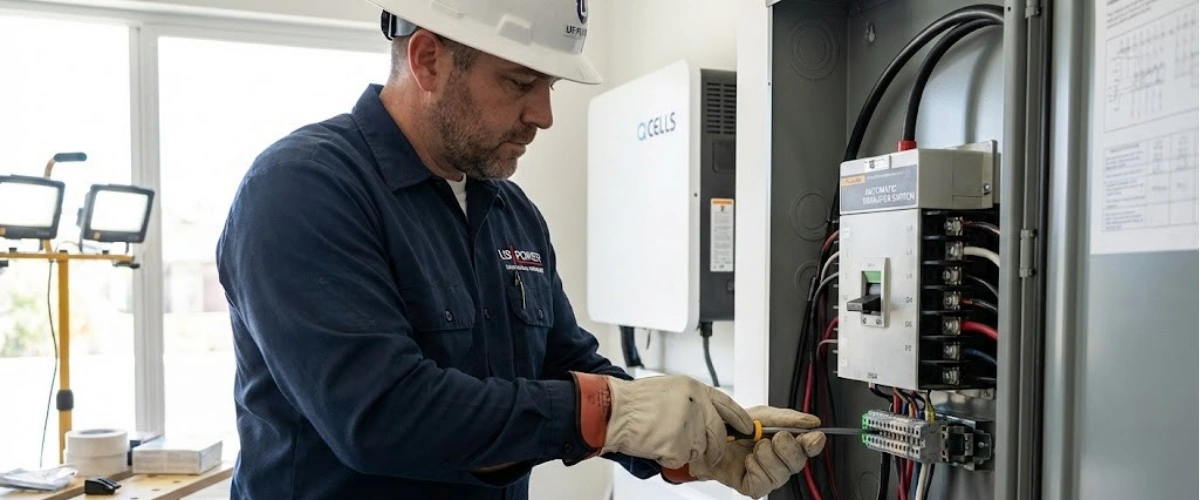
You're researching solar batteries for your Southern California home when your installer drops a bombshell: "The backup circuit uses a manual switch you'll need to flip during blackouts." You pause. Isn't the whole point of battery backup to keep the lights on automatically?
You're not alone in this confusion. A recent discussion among solar homeowners revealed something troubling: many installers are cutting corners by installing manual transfer switches instead of automatic ones—then claiming it's "normal." The truth? Modern solar battery systems should switch automatically, keeping your power running without you lifting a finger.
What Is an Automatic Transfer Switch for Solar Batteries?
An automatic transfer switch (ATS) is the brain of your solar battery backup system. Think of it as an intelligent traffic controller that instantly directs power from different sources—your solar panels, battery storage, and the utility grid—to keep your home running smoothly.
When Southern California Edison or other utilities experience an outage, your ATS detects the power loss within milliseconds. It immediately isolates your home from the grid (preventing dangerous backfeeding) and seamlessly switches to battery power. The transition happens so fast—typically 20 milliseconds—that your Wi-Fi router, refrigerator, and computer don't even notice.
How Does an ATS Work with Your Solar Battery System?
Your automatic transfer switch constantly monitors three things: grid voltage, battery charge level, and solar production. Modern systems like those used by US Power integrate directly with your inverter and battery management system.
Here's what happens during a typical outage. The grid voltage drops to zero. Your ATS senses this immediately and opens the connection to the grid. Within 20 milliseconds, it closes the connection to your battery system. Your inverter begins drawing from stored solar energy. Your lights stay on, your meeting doesn't drop, and your food stays fresh.
When grid power returns, the process reverses automatically. No manual intervention required.
The Technology Behind Modern Transfer Switches
Today's automatic transfer switches use solid-state electronics and smart monitoring. They're programmed to prioritize your solar energy first, then battery storage, and only pull from the grid when necessary. This "solar-first" approach is especially valuable under California's NEM 3.0 policy, where battery storage is now essential under NEM 3.0 to make financial sense.
The most advanced systems can even manage load prioritization. If your battery charge drops below a certain threshold during an extended outage, the ATS can shed non-critical loads (like your pool pump) while keeping essential circuits (refrigerator, medical equipment) powered.
Automatic vs. Manual: What's Industry Standard in 2026?
Let's be clear: automatic transfer switches are the industry standard for professionally installed solar battery systems in California. Manual switches are outdated technology that should only be used in specific off-grid or emergency-only scenarios.
Why Some Installers Still Push Manual Switches
Cost cutting. A quality automatic transfer switch costs $800-$1,500 installed. Some installers try to save money by using manual switches or simple interlock devices that cost $200-$400. They pocket the difference and hope you don't know better.
Another reason? Lack of expertise. As one solar professional noted in response to homeowner confusion: "Your installer is misleading you, either out of ignorance or malice." Many newer installers lack the electrical expertise to properly configure automatic systems.
The Real Difference: Speed and Reliability
Manual switching means you need to physically walk to your electrical panel, flip a switch or throw a breaker, and manually activate your backup power. If the outage happens at 2 AM while you're sleeping, you wake up to a dark house. If you're away on vacation, your refrigerator food spoils and your security system goes offline.
Automatic switching happens in 20 milliseconds. You often don't even know the grid failed. One California homeowner with a properly installed system said: "Sometimes I don't know it happened. May be very different where you are." That's the experience you deserve—and the experience modern technology delivers.
Why Seamless Switching Matters for California Homes
Under NEM 3.0, California solar economics have changed dramatically. Export rates dropped by approximately 75%, making solar battery backup systems crucial for maximizing your investment. But batteries only deliver their full value when they work reliably during outages.
Real-World Scenarios Where Automatic Matters
Working from home has become permanent for many Southern Californians. A manual switch means dropped Zoom meetings, lost work, and frustrated clients when the grid fails. With automatic switching, your home office stays online seamlessly.
Consider a homeowner in Pasadena who invested in solar and batteries specifically for medical equipment. During a planned PSPS (Public Safety Power Shutoff), their automatic system kicked in instantly, keeping critical devices running without interruption. A manual system would have required them to rush to the panel—not acceptable when health is on the line.
Understanding How Long a Solar Battery Can Power Your House and System Performance
Automatic systems also optimize battery performance. They prevent over-discharge by switching to grid power before your battery hits critical lows. They avoid the inefficiencies of manual switching, where homeowners often forget to switch back to solar when the grid returns, wasting stored energy.
Modern automatic systems can provide protection for your home during grid failures by intelligently managing your energy use during extended outages.
What to Expect: Installation and Costs in Southern California
A properly installed automatic transfer switch system should be included in your solar battery quote—not presented as an expensive add-on. Here's what fair pricing looks like in 2026.
Typical Cost Breakdown
For a complete solar-plus-battery system with automatic transfer capability, expect $800-$1,500 for the ATS equipment and installation. This includes the physical switch, wiring to your main panel, programming and integration with your battery system, and all necessary permits and inspections.
Beware of quotes that itemize the ATS separately at $2,000+ or that lowball the initial quote only to hit you with "required upgrades" later. US Power includes automatic transfer capability in our standard battery installations because it's the right way to do it.
Installation Timeline and Requirements
The physical installation of an ATS takes 4-6 hours for a qualified electrician. It must be installed by a CSLB-licensed contractor and requires inspection by your local building department. This is typically bundled into your overall solar and battery installation timeline of 3-6 weeks from approval to Permission to Operate.
Your installer should configure the system to match your specific needs. This includes setting battery reserve levels, configuring which circuits receive backup power, and programming load management rules if needed. This configuration is as important as the physical installation.
Choosing Solar Battery Installers Who Understand ATS Requirements
Not all solar installers have the electrical expertise to properly specify and configure automatic transfer systems. Look for contractors who can explain how your system will behave during outages, what your transfer time will be, and how the system integrates with your specific battery brand.
How US Power Ensures Proper Automatic Transfer Installation
At US Power, we treat automatic transfer switching as a fundamental requirement—not an optional luxury. Our approach reflects our commitment to delivering systems that actually work as promised.
Factory-Direct QCells Integration
As the exclusive QCells partner in Southern California, we specify transfer switches that integrate seamlessly with QCells inverters and battery systems. This isn't just about compatibility—it's about optimization. Your system responds faster and manages power more intelligently when all components are designed to work together.
Our factory-direct relationship also eliminates middleman markup on critical safety equipment. You get professional-grade automatic transfer switches at fair prices, not inflated retail costs.
CSLB-Licensed Installation and 25-Year Warranty Coverage
Every US Power installation is performed by CSLB-licensed electricians who understand California electrical code requirements for backup power systems. Our comprehensive 25-year warranty covers not just your panels and batteries, but the entire integrated system—including your automatic transfer switch.
This matters because transfer switches have mechanical components (contactors) that can wear over time. Inferior systems use cheap contactors that fail after a few years. We specify commercial-grade components built for decades of reliable operation.
How Solar Batteries Maximize Your Savings Through Smart Energy Management
Our automatic systems don't just switch power sources—they actively manage your energy to maximize savings under NEM 3.0. The system learns your usage patterns and optimizes when to draw from batteries, when to charge, and when to export to the grid during high-value evening hours.
This intelligent automation is only possible with a properly configured automatic transfer system. Manual switching leaves money on the table every month.
Understanding Transfer Switch Specifications and Features
When reviewing solar battery quotes, you need to understand what specifications actually matter for automatic transfer switches.
Transfer Time: Why Milliseconds Matter
The industry standard for quality automatic transfer switches is 20-30 milliseconds. This is fast enough that computers, internet routers, and entertainment systems experience no interruption. Cheaper systems may take 50-100 milliseconds, which can cause brief flickers or device resets.
Some installers will quote systems with 1-2 second transfer times. These are essentially automated manual switches—they eliminate the need to walk to your panel, but they still interrupt sensitive electronics. For a true "lights stay on" experience, insist on sub-30ms transfer time.
Amperage and Circuit Coverage
Your ATS must be sized to match your backup power needs. Common configurations include 100-amp switches for partial home backup (essential circuits only) or 200-amp switches for whole house battery storage system capability.
Be wary of installers who try to save money by undersizing your transfer switch. A 50-amp switch might be cheaper, but it severely limits which circuits you can back up. Most California homes need at least 100 amps for reasonable backup coverage.
Smart Features and Grid Interaction
Modern automatic transfer switches offer features beyond simple on/off switching. Look for systems that support load shedding (automatically dropping non-essential loads during extended outages), generator integration (for truly critical backup needs), and remote monitoring so you can see system status from your phone.
Some systems also support grid services programs where your battery can provide power to the grid during peak demand events in exchange for compensation. These features require sophisticated automatic switching—impossible with manual systems.
Questions to Ask Your Solar Installer About Transfer Switches
Before signing any solar battery contract, get clear answers to these critical questions. A quality installer will welcome these questions and provide detailed answers.
"What is the transfer time of your automatic switch?"
Accept nothing slower than 30 milliseconds. If they quote seconds, or if they hedge about whether it's truly automatic, that's a red flag. If they suggest manual switching is "just as good," find a different installer.
"Is the ATS included in the quoted price?"
Your quote should explicitly include the automatic transfer switch and its installation. If it's listed as an optional add-on or if the installer suggests starting with manual and "upgrading later," that's a sign they're trying to lowball the initial quote.
"Which circuits will have backup power?"
Get a written diagram showing exactly which breakers in your panel will receive battery backup. Understand whether it's whole-house or partial backup. Make sure critical circuits like refrigeration, internet, and medical equipment are covered.
"What happens if the ATS fails?"
Quality installers will explain their warranty coverage on the transfer switch hardware and discuss typical lifespans (20+ years for commercial-grade components). They should also explain monitoring features that alert you to any system issues before they cause problems.
Common Mistakes Homeowners Make with Backup Power Systems
Even educated homeowners can fall into these traps when evaluating solar battery systems with automatic transfer capability.
Assuming All "Automatic" Systems Are Equal
Not all automatic transfer switches are created equal. Some cheap systems use technology from the 1990s—slow, loud, and unreliable. Others use residential-grade components that fail after a few years. Insist on commercial-grade contactors and modern electronics.
Forgetting About Permitting and Code Compliance
Your automatic transfer switch must comply with California electrical code and NEC requirements. It needs proper grounding, anti-islanding protection, and approved interconnection with your utility. Unlicensed installers sometimes cut corners here, leaving you with a system that fails inspection.
Not Testing the System After Installation
Demand that your installer demonstrate the automatic switching during final commissioning. They should simulate a grid outage and show you that the transfer happens seamlessly. Document the transfer time and make sure all expected circuits receive power.
Choosing Based on Battery Price Alone
The cheapest battery quote often comes with compromises—including manual switching or undersized transfer switches. Choosing the right backup power solution means looking at the complete system, not just the battery price.
Making the Right Choice for Your Southern California Home
Automatic transfer switches aren't a luxury feature—they're a fundamental component of any properly designed solar battery backup system. In 2026, with California utilities raising rates and climate-driven outages becoming more common, reliable backup power isn't optional.
The difference between automatic and manual switching is the difference between genuine energy independence and a system that requires your constant attention. It's the difference between seamless protection and scrambling to flip switches during 2 AM outages.
When evaluating solar battery quotes, don't let installers convince you that manual switching is "normal" or that automatic is a premium add-on. It's standard equipment that should be included in every professional installation.
Frequently Asked Questions
Do I need an automatic transfer switch if I have solar panels without batteries?
Can I add an automatic transfer switch to my existing solar battery system?
How long do automatic transfer switches last?
Will an automatic transfer switch work with generators?
What maintenance does an automatic transfer switch require?


Can Solar Panels Really Charge Your Electric Car for Free?
Stop paying SCE $0.52/kWh to charge your Tesla this 2026. Switch to solar, go solar!
%20Thumbnail.png)
¿Debería comprar o arrendar sus paneles solares en 2025?
Discover if buying or leasing solar panels in 2025 offers the best value for you.

Guía para propietarios de viviendas sobre la compra de paneles solares
A simple guide to buying the right solar panels for Southern California homes.








Derechos de autor © 2025 US POWER | Energía solar y techosUS Power - Axia by QCells. All Rights Reserved.

¡Obtenga una estimación solar instantánea usando el satélite!