



Why California Solar Costs 3X What It Should
Southern California homeowners are paying 3X more for solar than they should. Here's why installation costs are inflated—and how to get factory-direct pricing without the middleman markup.
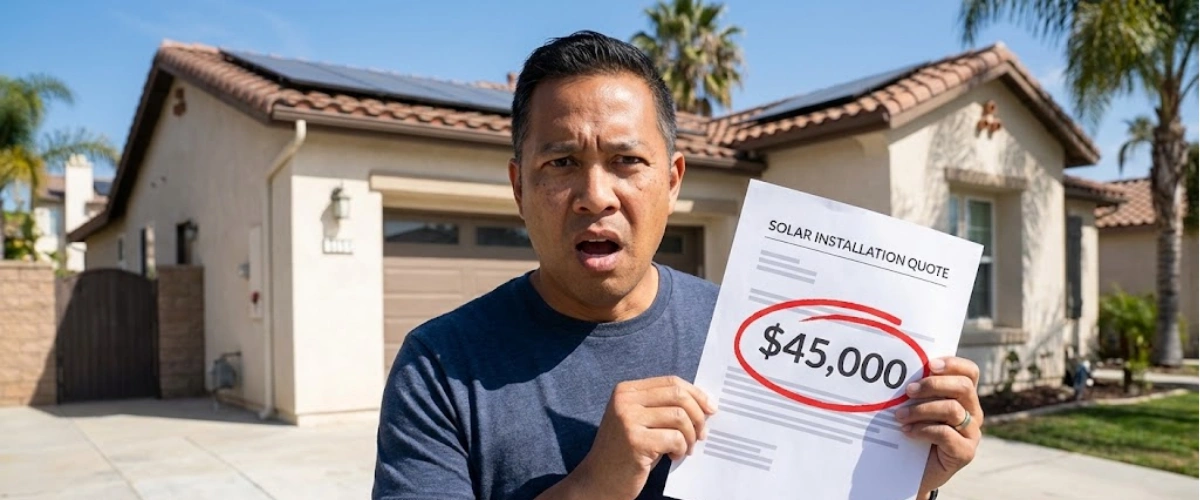
If you've gotten a solar quote recently, you probably felt your stomach drop. $40,000? $50,000? Maybe even $70,000 for a system that should cost a fraction of that?
You're not crazy. And you're definitely not alone.
Southern California homeowners are paying 2-3 times more for solar than homeowners in Australia, Mexico, and even parts of Europe—for the exact same panels, inverters, and batteries. A system that costs $8,500 in Sydney runs $40,000+ in Los Angeles. Same equipment. Same installation process. Wildly different price tags.
So what's going on? Why is California solar so expensive—and more importantly, how do you avoid overpaying?
The Real Reason California Solar Costs 3X More Than It Should
Let's start with the numbers that homeowners across the country are talking about online.
In Australia, a 5 kW system with 24 kWh battery storage costs around $8,500 USD installed. No tax credits. No rebates. Just the actual market price with transparent labor and equipment costs.
In Southern California? That same system—same panels, same battery capacity, same inverter technology—runs $40,000 to $50,000 before any incentives. Even after accounting for higher U.S. labor costs and stricter building codes, the math doesn't add up.
The "Soft Costs" Driving Up Your Quote
Here's the dirty secret the solar industry doesn't want you to know: the panels themselves are cheap. Really cheap.
Solar panel prices have dropped 90% in the last decade. High-quality panels now cost around $0.30 per watt globally—sometimes even less. A typical 10 kW residential system needs about $3,000 worth of panels. Add inverters, racking, and batteries, and your hardware costs are still under $15,000 for most systems.
So where does the other $25,000 to $55,000 go?
Welcome to the world of "soft costs"—the bloated expenses that have nothing to do with the actual solar equipment on your roof:
- Sales commissions: Door-to-door salespeople earning $3,000-$8,000 per closed deal
- Marketing budgets: Lead generation, online ads, and aggressive outreach campaigns
- Multilayer middlemen: Brokers, subcontractors, and private equity firms all taking their cut
- Permitting bureaucracy: Engineers, plan reviewers, and consultants navigating California's complex approval process
- Liability insurance: Sky-high premiums to cover warranty claims and installation defects
One California homeowner shared online that their installer quoted 6 months from contract signing to Permission to Operate (PTO). Six months of project management overhead. Six months of carrying costs. Six months of bureaucratic delays—all baked into your final price.
Learn more about why solar costs are so high in California and how utility rate structures compound the problem.
Why Australia Pays $8,500 and You Pay $45,000
The cost gap isn't about geography or regulations—it's about business models.
In Australia, solar is a commodity purchase. Homeowners research panel specs, compare quotes, and buy directly from installers who operate on slim margins. There's no high-pressure sales pitch. No 20% commission structure. No private equity firm demanding 30% profit margins.
In California, solar became a sales industry. Companies spend millions on lead generation, employ armies of commissioned salespeople, and structure deals around monthly payment amounts rather than total system costs. The goal isn't to sell you the best system—it's to maximize the sale price.
Want proof? Check the fine print on any big-name solar company's contract. You'll often find clauses allowing them to change equipment brands, timelines, or even system size—with little recourse for you as the customer.
Why So Many Homeowners Regret Their Solar Purchase
The pricing problem is only half the story. The other half? Trust.
Southern California homeowners have been burned—badly—by the solar industry's Wild West era. Companies that promised the world, then disappeared. Leases that locked families into 25-year payment plans that cost more than their old utility bills. Installations so poorly done that roofs leaked within months.
The Predatory Contract Problem
Many large solar companies aren't actually solar installers—they're lead generation machines selling contracts to subcontractors.
Here's how it works:
- You sign a contract with "Big Name Solar Co."
- They sell your contract to a subcontractor who does the actual work
- The subcontractor rushes the job to maximize their slim profit margin
- Big Name Solar Co. files for bankruptcy or restructures to avoid warranty claims
- You're left with a broken system and no one to call
Sound familiar? It should. This exact scenario played out with SunRun, Sungevity, and dozens of smaller companies over the past decade.
One homeowner on Reddit summed it up perfectly: "In the USA everyone is afraid of solar because so many install companies are screwing people over with shitty loans and inflated prices for companies that go out of business routinely to avoid liabilities."
Learn how to protect your family from predatory solar contracts in Southern California.
The Financing Trap
Then there's the financing issue.
Walk into most solar consultations and the salesperson will ask one question: "What monthly payment works for your budget?"
They're not asking about your energy usage. They're not calculating optimal system size. They're reverse-engineering a sale based on what monthly payment you'll agree to—then structuring a 20-year loan with interest rates that make the total cost balloon to $80,000 or more.
Compare that to Australia, where interest-free government loans let homeowners pay off systems over 10 years with zero additional cost.
The Hidden Costs Inflating Your Solar Quote
Let's break down exactly where your $45,000 solar quote goes—and what you're actually paying for.
Installation Company Overhead
A typical California solar installation company has massive overhead:
- Sales team salaries and commissions: 20-25% of system cost
- Lead generation and marketing: 10-15% of system cost
- Office space, project managers, and admin staff: 8-12% of system cost
- Liability insurance and warranty reserves: 5-8% of system cost
Before a single panel touches your roof, 40-60% of your quote is already spoken for by operational expenses.
If you're overwhelmed by options, this guide on how to choose a trustworthy solar company can help you separate legitimate installers from fly-by-night operations.
Permitting and Interconnection Delays
California's permitting process is notoriously complex. Some jurisdictions require:
- Structural engineering reports (even for lightweight panels)
- Fire department plan reviews and setback requirements
- Utility interconnection studies that take 3-6 months
- Multiple inspection rounds with unclear approval criteria
Each delay costs money. And every consultant, engineer, and expediter hired to navigate this maze? Their fees get added to your bill.
The Middleman Markup
Here's the kicker: Many solar companies don't even own their inventory.
They order panels and equipment from distributors who mark up prices by 30-50% over factory-direct costs. Then the solar company marks it up again before presenting your quote.
By the time you see the number, you're paying 2-3 layers of markup on hardware that should cost $12,000-$18,000 total.
How US Power Eliminates the "Solar Tax"
This is where US Power is different.
As the exclusive California partner for QCells, US Power operates on a factory-direct model. There's no distributor markup. No multilayer sales structure. No private equity overlords demanding maximum profit extraction.
Factory-Direct Pricing = 15-20% Below Market
When you work with US Power, you're buying directly from the manufacturer. QCells panels ship from their Georgia factory to your roof—no middlemen, no markup.
This structure alone saves Southern California homeowners $6,000-$12,000 compared to traditional solar companies selling the same equipment.
Discover more about factory-direct QCells pricing and why it matters for your bottom line.
CSLB-Licensed Consultants, Not Commissioned Salespeople
US Power doesn't employ door-to-door salespeople working on commission. Instead, you work with CSLB-licensed solar consultants who are paid a salary—not a percentage of your sale.
What does that mean for you? Honest recommendations. Your consultant's job is to design the right system for your home, not maximize the sale price to hit a commission target.
3-6 Week Installation Timeline
Remember that 6-month horror story from earlier? US Power's average timeline from contract to Permission to Operate is 3-6 weeks.
How? Streamlined permitting relationships, in-house installation crews (not subcontractors), and a process honed over thousands of Southern California installations.
Less time = lower carrying costs = lower prices for you.
See how US Power delivers solar faster than the competition with streamlined permitting.
What You Actually Need (And What You Don't)
Here's another reason California solar quotes are inflated: overselling.
Under NEM 3.0, batteries are essential for maximizing savings. But some companies push unnecessarily large battery systems or premium features you don't need to inflate the sale.
Right-Sizing Your System
A properly sized system should:
- Offset 90-110% of your annual electricity usage
- Include enough battery storage to cover evening peak hours (typically 10-15 kWh for most homes)
- Account for future needs like EV charging—but not 10 years of hypothetical growth
Most Southern California homes need a 8-12 kW solar system with 10-20 kWh of battery storage. Not the 15 kW system with 40 kWh batteries some salespeople push.
Learn how battery storage systems work under NEM 3.0 and what capacity actually makes sense for your home.
What Premium Features Are Worth It
Some upgrades make sense:
- 25-year comprehensive warranties (panels + workmanship + performance)
- American-made panels (better quality control and long-term support)
- Monitoring systems that let you track production in real-time
What's usually not worth the premium:
- "Premium black panels" (aesthetic upgrade, not performance)
- Oversized inverters "for future expansion" you'll never do
- Extended service plans beyond manufacturer warranties
5 Red Flags That Your Quote Is Inflated
Before you sign anything, watch for these warning signs:
1. Refusal to Provide Itemized Costs
If a company won't break down equipment costs, labor, and permits separately, walk away. Transparent companies have nothing to hide.
Here's a full guide on how to avoid overpriced solar quotes from any solar company.
2. Pressure to Sign "Today Only" Deals
Legitimate solar companies don't need fake urgency tactics. If your salesperson is pushing a "special price that expires tonight," it's a red flag.
3. Monthly Payment Focus (Not Total Cost)
Ask: "What's the total cost over the life of the loan?" If they dodge the question or only talk about monthly payments, you're being sold on payment terms—not value.
4. Vague Equipment Specifications
Your quote should specify exact panel models, inverter brands, and battery capacities. Generic descriptions like "premium tier 1 panels" mean they'll install whatever's cheapest when your system goes in.
5. No Local Presence or Track Record
Google the company name + "complaints" or "bankruptcy." Check their license status with the CSLB. If they've only been in business 2 years or have dozens of negative reviews, keep looking.
What a Fair Solar Quote Should Look Like
Here's what you should see in a legitimate, fairly-priced solar proposal:
Transparent Equipment Costs
- Solar panels: Brand, model, wattage, quantity, and per-watt cost
- Inverter: Brand, model, and capacity
- Battery storage: Brand, model, and usable kWh capacity
- Racking and electrical: Itemized materials list
See the 5 essential elements every solar quote should include for a complete breakdown.
Clear Labor and Soft Cost Breakdown
- Installation labor (per hour or flat rate)
- Permitting fees (actual costs, not marked-up)
- Interconnection fees
- Engineering and plan sets
Warranty Details
- Panel performance warranty (typically 25 years)
- Workmanship warranty (should match panel warranty)
- Inverter and battery warranties
- Who honors warranties if the installer goes out of business?
Production Estimates
- Expected annual kWh production
- Month-by-month production estimates
- Assumptions used (shading, tilt, azimuth)
Your Next Steps: Getting Started with US Power
If you're tired of inflated quotes and high-pressure sales tactics, here's how to get solar done right:
1. Schedule a Free Consultation (Virtual or On-Site)
US Power offers free consultations with CSLB-licensed solar consultants—not salespeople. You'll get:
- Honest assessment of whether solar makes sense for your home
- Right-sized system recommendation based on your actual usage
- Transparent pricing breakdown with factory-direct costs
2. Compare Your Quote to Market Rates
Take your US Power quote and compare it to 2-3 other companies. You'll see the factory-direct pricing advantage immediately.
3. Move Forward with Confidence
Once you're ready, US Power handles everything:
- Permitting and utility interconnection
- Professional installation (not subcontractors)
- Inspection and activation
- 25-year comprehensive warranty
Average timeline? 3-6 weeks from contract to producing power.
Stop Paying the "Solar Tax"
California homeowners deserve better than inflated quotes and predatory contracts.
Solar should be affordable. Transparent. Straightforward.
That's what US Power delivers: Factory-direct QCells panels, honest consultations, and pricing 15-20% below market—without sacrificing quality, warranties, or service.
You wouldn't pay 3X markup for a car or a kitchen remodel. Why accept it for solar?
Frequently Asked Questions
Why does solar cost so much more in California than other countries?
Is factory-direct pricing really 15-20% cheaper?
How do I know if a solar quote is fair?
What's the real payback period with honest pricing?
Should I wait for prices to drop further?


What to Expect from Qcells Solar Panel Performance
Get the real performance & realistic savings with Qcells panels in California.
Can Solar Power My Whole House in California? 2025 Guide
You don't need to power a crypto mine—just your home and your daily life routine.

The Truth About Flat Roof Solar in California: Savings vs. Challenges
Flat-roof solar cuts upfront costs and delivers up to $45k in lifetime savings.







Copyright © 2025 US Power - Axia by QCells. All Rights Reserved.

Get an instant solar estimate using satellite!