




Can You Install Multiple Batteries with Solar Panels in California?

Most solar quotes only show one battery option, but California homeowners with high energy usage often need more storage capacity. Here's what you need to know about installing multiple batteries with your solar system.
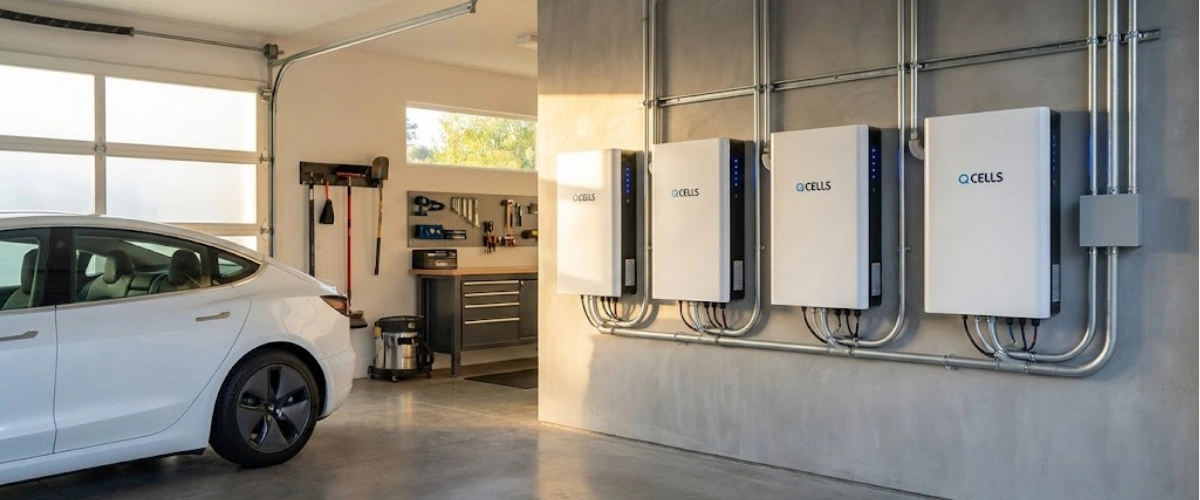
If you've been researching solar and battery storage for your Southern California home, you've probably noticed something frustrating: most online quotes only offer a single battery option. But what if your home uses electric heating, runs a pool pump year-round, or charges two electric vehicles? One battery might not cut it.
The good news? You absolutely can install multiple batteries with your solar system. In fact, with rising electricity bills in Southern California and NEM 3.0 policies pushing homeowners toward energy independence, multi-battery configurations are becoming the norm for high-demand California households.
Why Southern California Homeowners Are Adding Multiple Batteries
The solar landscape in California changed dramatically when NEM 3.0 took effect. Unlike the old net metering system where excess solar energy earned full retail credit, NEM 3.0 dramatically reduced export credits to pennies on the dollar during peak production hours.
This policy shift made battery storage essential rather than optional. Homeowners who produce solar energy during the day now need somewhere to store that power for evening use when rates spike and solar panels stop producing.
For many Southern California homes, especially those with electric heating, cooling systems, or EV charging needs, a single battery simply doesn't provide enough capacity. A standard 13.5 kWh battery might power essential loads for a few hours, but homes with electric radiators can drain that capacity in just one cold night.
That's where understanding how solar batteries can maximize your savings becomes critical. Multiple batteries allow you to store more daytime solar production and rely less on expensive grid power during evening peak hours.
Understanding Battery Capacity and Your Home's Energy Needs
Before deciding on one battery versus multiple batteries, you need to understand how battery capacity works and what your home actually consumes.
How Battery Capacity Is Measured
Solar batteries are rated in kilowatt-hours (kWh), which represents how much energy they can store. A typical residential battery like the QCells Q.HOME CORE stores 12.9 kWh of usable capacity.
But here's what most homeowners don't realize: you shouldn't regularly drain batteries from 100% to 0%. Battery longevity depends heavily on maintaining charge levels between 20% and 80% whenever possible. This optimal cycling range, often called the "sweet spot," can extend battery life from 8-10 years to 12-15 years.
If you're only using 60% of a 13 kWh battery's capacity to preserve longevity, you're really working with about 7.8 kWh of practical daily storage.
Calculating Your Home's Evening Energy Consumption
The average Southern California home uses 25-30 kWh per day. However, homes with electric heating, electric water heaters, pool equipment, or EV charging can easily consume 40-60 kWh daily.
Your evening consumption matters most for battery sizing. If your solar system stops producing at 5 PM and you don't return to solar production until 7 AM, that's 14 hours of potential grid reliance. During those hours, you're running refrigerators, HVAC systems, cooking dinner, charging devices, and possibly heating your home.
A single 13 kWh battery might cover basic evening loads, but add electric heating on a cold night and you'll be pulling from the grid at peak rates within a few hours.
For comprehensive guidance on battery basics, check out our guide on everything you need to know about solar and battery storage.
High-Demand Scenarios That Require Multiple Batteries
Certain household situations almost always benefit from multiple batteries:
Electric heating systems: Resistance heaters can consume 3-5 kW continuously on cold nights. That's 36-60 kWh over a 12-hour period—far exceeding what one battery can provide.
Multiple EVs: Charging two electric vehicles overnight can require 30-50 kWh, especially if you're coming home with low batteries.
Medical equipment: Homes with CPAP machines, oxygen concentrators, or refrigerated medications need reliable backup power that lasts through multi-day outages.
Home offices: Remote workers running computers, monitors, printers, and climate control all day need extended battery capacity.
Why NEM 3.0 Makes Battery Storage Essential
California's NEM 3.0 policy fundamentally changed the economics of solar. Under the old NEM 2.0 system, your excess solar production earned you credits at retail rates—essentially using the grid as a free battery.
NEM 3.0 slashed those export credits by 75-80%. Now when your solar panels produce excess power at noon, you might earn $0.05 per kWh in credits. But when you need to pull that same power from the grid at 7 PM, SCE charges you $0.45-0.60 per kWh during peak hours.
This rate structure makes battery storage incredibly valuable. Instead of exporting power for pennies and buying it back for dollars, you store your daytime solar production and use it during expensive evening hours.
Solar panels alone aren't enough in 2025 because battery storage is now the primary mechanism for maximizing your solar investment under current policies.
The Cost-Benefit Analysis: One Battery vs. Multiple Batteries
Price is naturally a major consideration when deciding between one large battery or multiple smaller units. Let's break down the real numbers.
Upfront Investment Comparison
A single 13 kWh battery typically costs $10,000-$13,000 installed, depending on the brand and installer. Adding a second identical battery might cost $8,000-$10,000 since much of the electrical infrastructure is already in place.
For comparison, one large 26 kWh battery system might cost $16,000-$20,000 installed. The per-kWh cost often decreases slightly with larger single units, but the difference is usually marginal. For more detailed pricing breakdowns, see our analysis of solar battery costs and whether they're worth the investment.
The federal solar tax credit applies to battery storage when installed with solar, covering 30% of the total system cost through the end of 2025. This credit drops to 26% in 2026 and 22% in 2027.
Long-Term Savings Under NEM 3.0
The real value of multiple batteries appears in your monthly utility bills. Under NEM 3.0, homes with adequate battery storage can:
- Avoid pulling grid power during expensive evening peak hours (4-9 PM)
- Store excess midday solar production instead of exporting it for minimal credit
- Maintain lower tier rates by reducing overall grid consumption
- Eliminate demand charges on TOU rate plans
A Southern California home using 35 kWh daily might save $150-200 monthly with optimized battery storage compared to solar-only systems. That's $1,800-2,400 annually in avoided grid costs.
With proper sizing, multiple batteries can pay for themselves in 7-10 years purely through utility bill savings, not counting the backup power value during outages.
For a detailed analysis of battery economics, see our breakdown of whether batteries are worth it for solar in California.
Battery Lifespan Considerations
Here's where multiple batteries offer a subtle but important advantage: battery longevity improves when you avoid deep discharge cycles.
Lithium batteries degrade faster when regularly cycled from 100% to 0%. Maintaining charge between 20-80% can extend useful life from 8-10 years to 12-15 years. With multiple batteries providing larger total capacity, each individual battery experiences shallower discharge cycles.
A home draining one 13 kWh battery to 20% nightly puts significant cycling stress on that unit. The same home with two 13 kWh batteries might only discharge each unit to 50-60%, substantially reducing wear.
Additionally, if one battery develops issues, you still have backup capacity while arranging service or replacement. With a single-battery system, any failure means complete loss of storage.
Sizing Your Battery System for High-Demand Homes
Proper battery sizing requires analyzing your specific energy consumption patterns, not just accepting a one-size-fits-all quote.
The Three-Day Rule for Backup Planning
For homes prioritizing backup power during outages, many experts recommend the "three-day rule"—storing enough energy to maintain critical loads for 72 hours without solar production.
Critical loads typically include refrigeration, some lighting, internet/communication, medical equipment, and minimal HVAC. For most homes, this represents 15-20 kWh daily. Three days of autonomy requires 45-60 kWh of battery capacity, pointing toward 3-4 residential batteries.
However, most grid outages in Southern California last less than 12 hours. For many homeowners, one or two batteries provide adequate emergency backup while focusing primarily on daily utility bill reduction.
Accounting for Seasonal Variations
Battery sizing also needs to account for seasonal consumption changes. Summer cooling loads and winter heating demands can double energy usage compared to mild spring months.
If your home uses electric heating and consumes 60 kWh on cold January nights, sizing your batteries for average 30 kWh consumption means you'll still rely heavily on grid power during your highest-cost months.
US Power's consultants analyze your 12-month usage history to identify these peaks and recommend battery capacity that addresses your worst-case scenarios, not just average days.
Want to understand backup duration with different battery configurations? Read our guide on how long a solar battery can power a house.
Scalability: Starting Small vs. Building Big
One advantage of modern battery systems is scalability. Most inverters support multiple batteries connected together, allowing you to start with one or two units and expand later.
This staged approach lets you:
- Reduce initial investment while getting solar panels installed quickly
- Monitor actual usage patterns with one battery before expanding
- Spread costs across multiple years for better cash flow
- Take advantage of improving battery technology and pricing
However, expansion isn't free. Adding batteries later requires another installation visit, permit updates, and potential electrical upgrades. If your usage patterns clearly indicate need for multiple batteries, installing them together upfront often costs less than staged installation.
What US Power's Battery Installation Process Includes
Installing multiple batteries requires expertise in electrical engineering, system integration, and local building codes. This isn't a DIY-friendly project, and choosing the wrong installer can create serious safety and performance issues.
Why Professional Installation Matters
Battery installations involve high-voltage DC connections, sophisticated inverter programming, and integration with your home's electrical panel. Improper installation can cause:
- Fire hazards from incorrect wiring or inadequate ventilation
- System failures that void manufacturer warranties
- Failed inspections that delay permission to operate
- Suboptimal performance that negates your investment
California requires CSLB licensing for solar and battery installations. US Power's installers hold proper licensing and insurance, and every installation includes engineer-stamped plans submitted for permit approval.
For guidance on selecting qualified installers, see our comprehensive guide to hiring solar battery installers in 2025.
The US Power Advantage: QCells Integration
As California's exclusive QCells partner, US Power offers seamless integration between QCells solar panels and Q.HOME battery systems. This integration provides several advantages:
Simplified monitoring: Single-app control for both solar production and battery storage, unlike mixed-brand systems requiring multiple monitoring platforms.
Optimized performance: QCells batteries are specifically programmed to work with QCells inverters, ensuring maximum efficiency and reliability.
Comprehensive warranty: US Power's 25-year warranty covers panels, batteries, inverters, and workmanship—no gaps between different manufacturers.
Factory-direct pricing: By partnering directly with QCells, US Power eliminates distributor markups, typically saving customers 15-20% compared to mixed-brand systems.
Installation Timeline for Multi-Battery Systems
Many homeowners worry that adding multiple batteries will significantly extend installation time. In practice, the difference is minimal.
A typical solar + battery installation through US Power follows this timeline:
- Week 1: Free consultation and system design
- Week 2-3: Engineering and permit submission
- Week 4-6: Permit approval (city/county dependent)
- Week 7: Installation (1-2 days for solar + batteries)
- Week 8: Utility inspection and permission to operate
Installing two batteries versus one typically adds only 2-4 hours to the installation day. The permitting and inspection timelines remain essentially identical.
Technical Considerations for Multiple Battery Installations
If you're the type of homeowner who wants to understand how the system actually works, here are the technical details worth knowing.
Parallel Configuration and Capacity Stacking
Multiple batteries connect in parallel configuration, meaning positive terminals connect together and negative terminals connect together. This arrangement adds the capacity (kWh) of each battery while maintaining the same voltage.
For example, two 13 kWh batteries in parallel create 26 kWh total capacity at the same voltage as a single unit. This differs from series configuration, which adds voltage but not capacity.
Most modern battery systems use a common DC bus bar—essentially a central connection point where multiple batteries, the solar panels, and the inverter all connect. This configuration allows batteries to charge and discharge simultaneously, balancing the load across all units.
Inverter Compatibility and Sizing
Your inverter must support the total battery capacity you're installing. Most residential hybrid inverters handle 2-4 batteries before requiring upgrades to larger commercial-grade equipment.
The inverter also needs sufficient power output (measured in kilowatts) to charge and discharge your batteries at appropriate rates. A 7 kW inverter can fully charge a 13 kWh battery in under 2 hours, but it might take 4-5 hours to charge two batteries if solar production is limited.
US Power's design process ensures your inverter appropriately matches your battery bank size and your home's power demands.
Communication and Monitoring Systems
Modern battery systems communicate via data cables that allow centralized monitoring and control. When installing multiple batteries, these communication cables daisy-chain from unit to unit back to the inverter.
This network enables:
- Real-time monitoring of each battery's state of charge
- Automated load balancing across all batteries
- Performance alerts if any unit develops issues
- Remote firmware updates and system optimization
The QCells monitoring app shows individual battery status, letting you quickly identify if one unit isn't performing as expected.
Making Your Decision: Next Steps with US Power
The decision between one battery and multiple batteries ultimately depends on your home's specific energy profile, your budget, and your priorities around backup power versus bill reduction.
Here's what separates US Power's approach from typical solar companies:
Honest assessment: We analyze your actual utility bills and recommend what you need, not what maximizes our profit. If one battery sufficiently serves your home, that's what we'll recommend.
Factory-direct pricing: Our exclusive QCells partnership eliminates middleman markups. You're paying manufacturing cost plus installation labor—not 40% distributor margins and sales commissions.
Comprehensive warranty: 25 years covering panels, batteries, inverters, and installation workmanship. One company, one warranty, zero finger-pointing between manufacturers.
Licensed expertise: CSLB-licensed consultants and installers who understand California's complex building codes, utility requirements, and NEM 3.0 policies.
Fast timeline: 3-6 weeks from consultation to permission to operate, compared to industry averages of 3-4 months.
Southern California electricity rates aren't decreasing. NEM 3.0 isn't getting more generous. The 30% federal tax credit expires at the end of 2025. The best time to optimize your energy independence was yesterday. The second-best time is today.
Frequently Asked Questions
Can you mix different battery brands or sizes?
How much space do multiple batteries require?
Do multiple batteries work during power outages?
What maintenance do battery systems require?
Will battery costs decrease if I wait a few years?


California Roof Compatibility Guide for Solar Panels
Most California roofs are solar-ready—learn how yours measures up if you go solar.

How to Size Solar Panels and Batteries for EV Owners
Your 2025 guide to solar panels, inverters, and batteries for a SoCal home.
Read This First Before Buying Solar Panels Yourself
Before you buy solar, get the facts and save more with expert installation.








Copyright © 2025 US Power - Axia by QCells. All Rights Reserved.

Get an instant solar estimate using satellite!