




Will a Cracked Solar Panel Still Work? CA Homeowner Guide 2026

Discovered a cracked solar panel on your roof? Here's what Southern California homeowners need to know about performance, water damage risks, warranty coverage, and when to call for replacement.
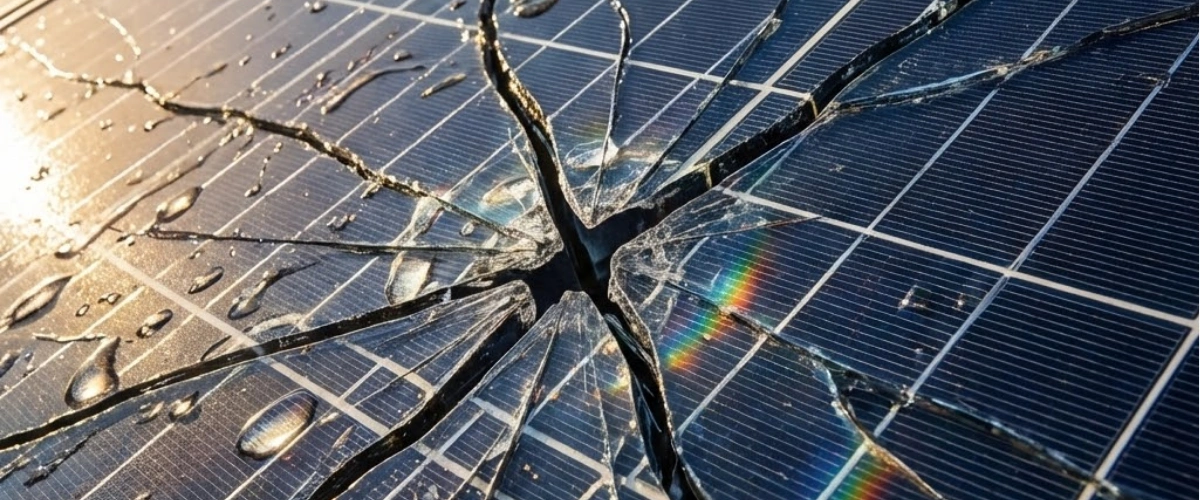
You're checking your solar monitoring app when you notice a dip in production. Or maybe you spotted the damage during a routine roof inspection—a spiderweb crack radiating across one of your panels. The question hits immediately: Will it still work? Do I need to replace it right away?
The short answer is yes, a cracked solar panel can still produce electricity. But there's a bigger problem brewing beneath that shattered glass, and waiting too long could cost you more than just lost production.
Let's break down exactly what happens when solar panel glass breaks, what your options are, and why Southern California homeowners need to act faster than you might think.
Why Your Cracked Solar Panel Might Still Be Working (For Now)
Here's the surprising part: a cracked panel often continues generating power immediately after the damage occurs. Some Southern California homeowners report no drop in output for weeks or even months.
The solar cells underneath the glass are usually still intact after impact damage. Light still reaches them, electrons still flow, and your system monitoring might not show any red flags. You might even see a temporary increase in output as the fractured glass refracts light differently across the cells.
But this is a false sense of security.
The real issue isn't what's happening today—it's what starts happening the moment moisture finds its way through those cracks. In Southern California's climate, that timeline accelerates during our occasional winter rains or morning coastal fog in areas like Torrance and Redondo Beach.
The Water Intrusion Timeline
Once the seal breaks, you're on borrowed time:
- Week 1-2: Panel continues normal operation
- Week 3-6: Moisture begins penetrating the laminate layers
- Month 2-3: Cell degradation starts, output drops 10-20%
- Month 3-6: Risk of complete failure or dangerous ground faults
One Pasadena homeowner ignored a cracked panel for four months. After the first significant rain, the panel failed completely—and because it was part of a string system, it took down 12 other panels with it until a technician could bypass the damaged unit.
What Actually Happens When Solar Panel Glass Breaks
Solar panels are built tough—tempered glass designed to withstand hail, debris, and decades of UV exposure. But they're not indestructible.
Common causes of panel damage in Southern California:
- Golf balls (especially in communities near courses in Valencia or Palm Desert)
- Tree branches during Santa Ana winds
- Hail in inland areas like San Bernardino and Riverside
- Rocks from landscaping equipment or neighborhood kids
- Debris from nearby construction
When the glass shatters, the immediate concern isn't electricity—it's the broken environmental seal. Solar panels are essentially sandwiches: tempered glass on top, solar cells in the middle, encapsulation layers protecting everything, and a backing material on the bottom.
That glass does more than protect the cells from physical impact. It creates an airtight, waterproof barrier that keeps moisture, dirt, and contaminants away from the sensitive electrical components.
What Happens After the Seal Breaks
The encapsulation material (usually EVA plastic) starts degrading when exposed to moisture and UV light. Water reaches the solar cells and busbars. Corrosion begins. Electrical resistance increases. Output drops.
In Southern California's dry climate, you might think you're safe from water damage. But even morning dew in coastal areas or a single winter storm is enough to start the degradation process. The damage is cumulative and irreversible.
Ground fault risk is the bigger safety concern. When water creates an electrical path between the solar cells and the grounded aluminum frame, you risk triggering safety disconnects or—in worst cases—creating fire hazards. This is why solar panel warranties typically exclude impact damage but cover performance degradation.
Does Homeowners Insurance Cover Solar Panel Damage in California?
This is where things get complicated—and expensive if you don't know the rules.
Most homeowners insurance policies in California will cover impact damage to solar panels from covered perils like hail, falling trees, or vandalism. But whether you should file a claim is a different question entirely.
The Math Almost Never Works
A single panel replacement typically costs $300-$800 depending on the panel model and labor. Most California homeowners carry deductibles of $1,000-$2,500. You're paying out of pocket either way.
Even if the damage exceeds your deductible, filing a claim for minor solar damage can:
- Increase your premiums for 3-5 years
- Create a claims history that affects future coverage
- Complicate home sales (buyers see claims history)
A Studio City homeowner filed a $1,200 claim for two damaged panels. Their premium increased $180/year for three years—a total cost of $540 on top of their $1,000 deductible. They would have saved money replacing the panels themselves.
When Insurance Makes Sense
File a claim if:
- Multiple panels are damaged (6+ panels)
- Your roof sustained hail damage requiring replacement
- Damage exceeds $3,000-$5,000 in repairs
- The incident also damaged your roof or home structure
For single-panel damage, pay out of pocket and save your insurance for catastrophic losses. And remember—warranty coverage won't help here. Manufacturer warranties cover defects, not impact damage from external sources.
String Systems vs. Microinverters: How Panel Damage Affects Your Array
Whether one damaged panel cripples your entire system depends entirely on how your solar array is configured. This is where understanding microinverters vs string systems becomes critical.
String Inverter Systems
If you have a traditional string inverter system (one large inverter for your entire array), panels are wired in series like old Christmas lights. When one fails, the entire string goes down.
The impact:
- 8-12 panels offline from a single failure
- 30-50% production loss until repair
- Urgent replacement needed to restore output
The good news? A technician can temporarily "bypass" the damaged panel by linking the string around it. Your system operates at reduced capacity, but at least it's producing power while you source a replacement.
Microinverter Systems
With microinverters (like Enphase) or power optimizers (like SolarEdge), each panel operates independently. A cracked panel only affects its own output—the other 19 or 29 panels keep producing normally.
The impact:
- Only 1 panel offline (3-5% total production loss)
- No urgency to replace immediately
- Can wait for pricing or panel availability
This is why many Southern California installers now recommend microinverters for residential systems. The panel-level independence provides resilience against partial failures, shading, or damage.
One Northridge homeowner with microinverters had two cracked panels from a hailstorm. They monitored performance for six weeks while sourcing matching panels at a better price. Their system continued producing 95% of expected output the entire time.
Should You Attempt a DIY Fix or Call a Professional?
Online forums are filled with temporary fixes: clear epoxy, windshield repair kits, UV-resistant films, even clear nail polish. Some Southern California homeowners swear by these methods.
Here's the reality: temporary fixes don't work long-term.
Cyanoacrylate glue (superglue) can seal small surface cracks temporarily, but it can't restore the airtight seal that prevents moisture intrusion. You might buy yourself a few extra months, but the panel will eventually fail.
Windshield repair kits are designed for much smaller impact points. Solar panel cracks typically radiate 6-12 inches from the impact site with dozens of hairline fractures—far beyond what these kits can address.
Why Professional Replacement Wins
The cost difference between a DIY attempt and professional solar installation is minimal—usually $100-200 for labor. But the risks of DIY are significant:
- Electrical hazards: Solar panels generate 30-40V DC even on cloudy days
- Roof safety: One misstep causes injury and roof damage
- Warranty voidance: Most installation warranties exclude owner modifications
- Code violations: California requires licensed contractors for electrical work
A Sherman Oaks homeowner tried sealing a cracked panel with marine epoxy. It worked for three months, then failed during the first rain. Water intrusion damaged the junction box, requiring replacement of both the panel and associated wiring—tripling the repair cost.
Why US Power's Panel Replacement Process Is Different
Most solar companies make panel replacement complicated. They require site visits, long quotes, scheduling delays, and unclear pricing. By the time you get a replacement, you've lost weeks of production.
US Power streamlines everything because we're the #1 QCells installer in California with direct factory access.
Our Replacement Advantage
Fast assessment: Photo-based damage review within 24 hours
Exact matching: Direct access to QCells inventory means we find your exact panel model
Factory pricing: 15-20% below market rates on replacement panels
Quick installation: Most replacements completed in 2-3 weeks
Warranty protection: 25-year comprehensive coverage on new panels
We recently helped a Calabasas homeowner replace two damaged panels from tree debris. Total timeline from initial contact to restored production: 18 days. Compare that to the 6-8 week average with national installers.
And because we specialize in QCells solar panel performance, we know these systems inside and out. Our technicians can assess whether related components (junction boxes, wiring, mounting hardware) sustained damage and need attention.
The CSLB Licensing Difference
California requires contractors to hold CSLB licenses for solar work—but not all installers comply. Unlicensed work can void your warranties, create insurance complications, and fail safety inspections.
Every US Power technician is CSLB-licensed and insured. We pull proper permits, pass inspections, and ensure your system maintains its warranty coverage. When you need help choosing a solar company in Los Angeles, licensing should be your first verification.
When to Replace vs. When to Monitor
Not every cracked panel needs immediate replacement. Your decision should factor in system type, damage severity, and production impact.
Replace Immediately If:
You have a string inverter system. Even minor cracks can lead to complete string failures. The production loss outweighs any delay.
The crack extends to panel edges. Edge cracks compromise the frame seal and accelerate water intrusion. These panels fail within weeks, not months.
You're seeing output drops. If monitoring shows the affected panel producing 10%+ below expected output, cells are already degrading.
Winter rains are approaching. Don't gamble with Southern California's December-February wet season. Moisture will find every crack.
You Can Monitor If:
You have microinverters. Panel-level monitoring lets you watch performance while exploring replacement options.
The crack is minor and central. Small surface cracks away from edges sometimes stabilize without spreading.
It's summer with no rain forecasted. Southern California's dry season (May-October) gives you time—but don't push it into November.
You're tracking daily production. Set alerts for output drops. The moment you see degradation, schedule replacement.
One thing is certain: every cracked panel will fail eventually. The question is whether you'll replace it on your timeline or your panel's timeline. Our recommendation? Take control and follow proper solar installation timeline in California practices to minimize downtime.
Don't Let a Crack Become a Crisis
A cracked solar panel won't destroy your system overnight, but every day you wait increases the risk of complete failure, additional water damage, and lost production.
Southern California homeowners face unique considerations—our weather might be drier than most regions, but our occasional winter storms and coastal fog create the perfect conditions for moisture intrusion. And with electricity rates continuing to climb, every day of reduced solar output costs you real money.
The smartest move? Assess the damage, understand your system type, and make a replacement decision before Mother Nature makes it for you. Whether you have a string system that needs urgent attention or microinverters that buy you time, knowing your timeline puts you back in control.
Frequently Asked Questions
How long will a cracked solar panel continue working?
Will my solar panel warranty cover the cracked glass?
Can I just seal the crack and keep using the panel?
How much does it cost to replace a single solar panel in California?
How can I prevent panel damage in the future?



How to Size Solar Panels for Your Home | California 2026 Guide
Proper solar panel sizing protects your investment and maximizes your savings.
Perovskite-Based Solar Will Lead the Next Decade of Clean Energy
Discover how Qcells’ perovskite solar tech could redefine energy in California.
Q.TRON AC Solar Panels vs. Traditional Systems: The Ultimate Guide
QCells Q.TRON AC vs traditional solar: which system delivers better ROI for CA homes?








Copyright © 2025 US Power - Axia by QCells. All Rights Reserved.

Get an instant solar estimate using satellite!