




Why Is My Electric Bill So High in California? (2026 Guide)

Your California electric bill isn't just high—it's historically expensive. Here's why SCE rates keep climbing and what you can do about it.
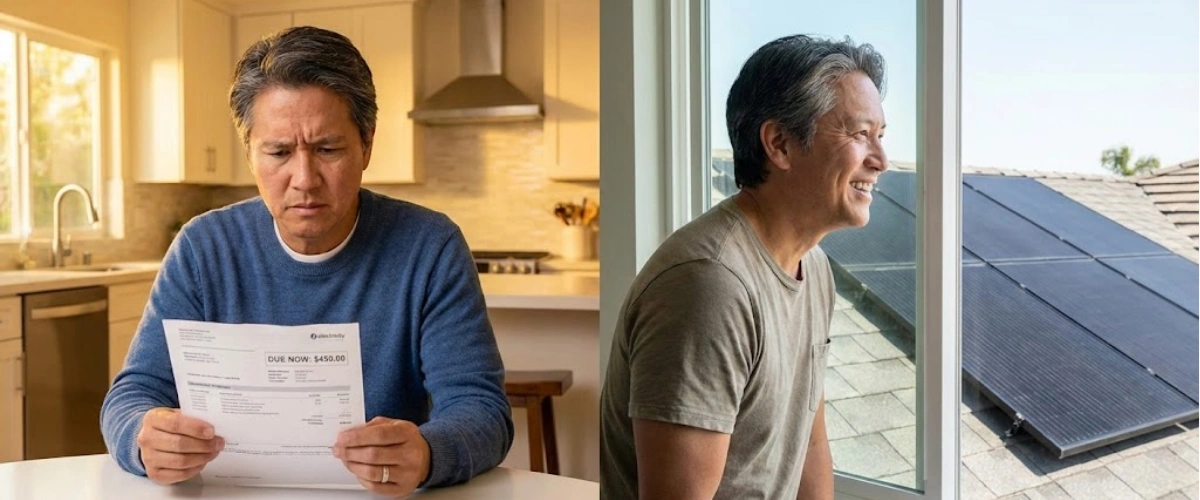
You're not imagining it. Your California electric bill really is sky-high—and you're not alone.
Across Southern California, homeowners are opening their SCE bills and feeling that same gut punch. Bills that used to hover around $150-$200 are now pushing $300, $400, even $600 during summer months. One Reddit user in Ohio recently shared their frustration: their locked-in rate jumped from $0.0699 per kWh to $0.0913—a 31% increase. And they pointed out something important: "In California, they're paying much more than that, for a long time."
They're right. California homeowners are facing some of the highest electricity rates in the nation, and 2026 isn't bringing relief. In this guide, we'll break down exactly why your bill keeps climbing, what's driving these increases, and—most importantly—how you can take control of your energy costs before they spiral further.
Why California Electric Bills Hit Record Highs in 2026
California's electricity rates aren't just expensive—they're among the highest in the United States. As of early 2026, SCE customers are paying an average of $0.34-$0.38 per kWh during peak hours, with some time-of-use rates pushing even higher.
Let's break down why electricity bills are so high in Southern California and what's actually happening when you open that monthly bill.
The Two Parts of Your Electric Bill You're Paying For
Most homeowners don't realize their electric bill has two major components, and both are rising:
Generation charges cover the actual cost of producing electricity. This is the rate you see advertised when comparing energy suppliers. But here's the catch: even if you lock in a competitive generation rate, you're still on the hook for the second part.
Distribution charges (also called delivery fees) cover the infrastructure—power lines, transformers, substations, and grid maintenance. These aren't negotiable. You pay whatever your utility charges, and as one frustrated commenter pointed out: "You don't get to choose the actual delivery charge. That's SCE's infrastructure and you don't have a choice."
Both are climbing steadily, and California utilities just received approval for another round of rate increases in 2026.
SCE Rate Increases: The Numbers Don't Lie
Since 2014, California electricity rates have increased by over 32%. But the pace has accelerated dramatically in recent years:
- 2023-2024: 13% average increase across SCE service areas
- 2025: Additional 6-8% approved increases
- 2026: Another 10% hike for infrastructure upgrades
For a typical Southern California household using 800 kWh per month, this translates to an extra $80-$120 per month compared to just three years ago. Over a year, that's $960-$1,440 in additional costs—money that's simply gone.
And unlike other states where you can shop around for cheaper electricity suppliers, California's deregulated market still leaves you stuck with SCE's distribution fees, which represent roughly half your total bill.
The Hidden Infrastructure Costs You're Subsidizing
Here's what most homeowners don't know: a significant chunk of your rising bill isn't just about energy costs. You're paying for:
Wildfire prevention and grid hardening: Billions in upgrades to prevent equipment from sparking fires. While necessary, these costs are passed directly to ratepayers.
Old infrastructure replacement: California's aging grid needs massive upgrades. Power lines installed 40-50 years ago are now being replaced, and utilities are billing customers for the multi-decade project.
Data center demand: Major tech companies are building AI data centers throughout California, creating unprecedented electricity demand. As one Reddit user noted: "They're going to drive your electric bill sky high." The infrastructure to support these facilities? You're paying for it.
Want to understand exactly what you're being charged? Learn how to read your SCE bill to understand so you can see where every dollar goes.
What's Actually Driving Your Rising Electricity Costs
Beyond the rate increases themselves, several factors are pushing California energy costs to historic levels in 2026.
Peak Demand and Time-of-Use Pricing
SCE has shifted most residential customers to time-of-use (TOU) rates. This means you pay drastically different prices depending on when you use electricity:
- Off-peak (9 PM - 4 PM): $0.28-$0.32/kWh
- Peak hours (4 PM - 9 PM): $0.45-$0.55/kWh
- Super off-peak (overnight): $0.22-$0.26/kWh
The problem? Peak hours are exactly when most families are home—cooking dinner, running AC, doing laundry, charging devices. That 5-hour window can account for 40-50% of your daily usage and 60-70% of your daily costs.
Clean Energy Mandates and Grid Upgrades
California's commitment to 100% clean energy by 2045 is admirable, but it comes with transition costs. Utilities are investing heavily in:
- Grid-scale battery storage facilities
- Renewable energy infrastructure
- Smart grid technology
- Electric vehicle charging infrastructure
Again, these investments are necessary for California's energy future. But the Public Utilities Commission (PUCO) has approved rate increases to fund them, meaning your monthly bill is financing this decades-long transition.
The "Whack-a-Mole" Game Homeowners Are Playing
One savvy Reddit commenter described the current situation perfectly: "You need to be proactive and play Whack-a-Mole with the utilities."
Some homeowners are constantly switching suppliers on comparison sites, trying to lock in better generation rates for 12-month contracts. Others are adjusting their usage patterns, running dishwashers and laundry only during off-peak hours. A few are considering energy management devices that utilities can control remotely to reduce peak demand.
But here's the reality: these are band-aids. Simple ways to reduce your electricity bills might save you $20-$40 monthly, but they don't solve the fundamental problem—you're still dependent on a grid with rising costs and volatile pricing.
How Solar Panels Protect You from Rate Increases
This is where solar fundamentally changes your relationship with your electric bill.
When you install solar panels, you're essentially locking in your electricity rate for the next 25+ years. While your neighbors continue paying whatever SCE decides to charge, you're generating your own power at a fixed cost.
The Economics of Energy Independence
Let's run the numbers for a typical Southern California home:
Current Situation:
- Average monthly bill: $320
- Annual electricity cost: $3,840
- Over 25 years (with 5% annual increases): $183,446
With Solar (US Power):
- System cost: $25,000
- Federal tax credit (30%): -$7,500
- Net investment: $17,500
- 25-year savings: $165,946
That's not a typo. A solar investment that costs less than five years of your current electricity bills can save you over $165,000 across the system's lifespan. Want to see the exact calculations for your home? Check out how much money solar panels save in 2025.
NEM 3.0 and Why Battery Storage Matters
California's Net Energy Metering 3.0 (NEM 3.0) changed the solar landscape in 2023. Under the new rules, excess solar energy sent back to the grid is compensated at a much lower rate—roughly 75% less than under NEM 2.0.
This means solar-only systems still save money, but they're less effective than before. The solution? Battery storage.
When you pair solar panels with a home battery system, you can:
- Store excess daytime solar production
- Use stored energy during expensive peak hours (4-9 PM)
- Maintain backup power during outages
- Maximize your solar investment under NEM 3.0
One homeowner recently shared their experience: after installing solar with battery storage, their average monthly SCE bill dropped from $380 to just $12-$18 (the minimum grid connection fee). Learn more about how solar batteries can maximize your savings under California's current regulations.
Why US Power Delivers More Value in Today's Market
With electricity rates at record highs, more California homeowners are considering solar than ever before. But as Reddit discussions constantly remind us, not all solar companies are created equal. Some homeowners report feeling trapped by predatory contracts, hidden fees, and poor installation quality.
Here's what makes US Power different—and why it matters more than ever in 2026.
Factory-Direct QCells Pricing: 15-20% Below Market
US Power is the exclusive QCells partner in Southern California, which means we bypass traditional distributor markups entirely.
Most solar companies buy panels through multiple middlemen, each adding their margin. By working directly with QCells' American manufacturing facility in Georgia, we eliminate those layers. The result? Factory-direct QCells pricing that typically saves homeowners $4,000-$7,000 compared to competitor quotes.
This isn't a promotional discount that disappears next month. It's our permanent business model—and in a market where every dollar counts, that structural advantage matters.
American-Made Quality, Not Imports
QCells manufactures their panels in Dalton, Georgia—the same panels used in commercial installations nationwide. You're getting:
- 25-year comprehensive warranty (panels, workmanship, performance)
- U.S. labor standards and quality control
- Direct manufacturer support if issues arise
- Panels designed specifically for California's climate
Installation Timeline: 3-6 Weeks After Approval
While many solar companies are quoting 4-6 month installation timelines, US Power completes most projects in 3-6 weeks after permit approval. We're a local Southern California company with our own installation teams—not a national brand that subcontracts to the lowest bidder.
This matters because with the 30% federal solar tax credit expiring at the end of 2025, time is critical. The faster your system is installed and operational, the sooner you start saving.
No Predatory Contracts or Hidden Fees
We've all read the horror stories: solar companies that make big promises, then lock homeowners into lease agreements with escalating payments, hidden dealer fees, or ownership structures that complicate home sales.
US Power operates differently. We offer:
- Transparent, fixed pricing with zero hidden fees
- Ownership options (cash purchase or financing—no leases)
- CSLB-licensed consultants (not commissioned salespeople)
- 175+ five-star Google reviews from real Southern California homeowners
When you're evaluating solar companies, experience matters. Learn how to choose the right solar company and avoid the common pitfalls that lead to buyer's regret.
Taking Control: Your Next Steps
California's rising electricity costs aren't going away. The factors driving rate increases—infrastructure upgrades, clean energy transitions, grid modernization—will continue pushing costs higher for years to come.
You have two options:
Option 1: Continue paying whatever SCE charges, watching your annual electricity costs climb 5-8% every year, and hoping for political intervention that probably won't come.
Option 2: Invest in solar now, lock in your energy costs, and start saving immediately—while the 30% federal solar tax credit is still available to reduce your upfront investment by 30%.
The 2025 Tax Credit Deadline
This is crucial: the federal solar tax credit drops from 30% to 26% in 2026, then to 22% in 2027. For a $25,000 system, that's a difference of $1,000-$2,000 in actual savings, depending on when you install.
But here's what many homeowners don't realize: you need to have your system installed and operational by December 31, 2025 to qualify for the full 30% credit. With permit approvals, utility interconnection, and installation timelines, that means you need to start the process soon—preferably within the next 30-60 days.
What a Free Consultation Actually Covers
US Power's consultations are genuinely no-pressure. A CSLB-licensed consultant will:
- Review your last 12 months of SCE bills
- Analyze your roof's solar potential (orientation, shading, size)
- Design a custom system sized to your actual usage
- Show you multiple financing options (cash, loan, etc.)
- Calculate your projected savings over 25 years
- Answer every question you have about solar, batteries, and incentives
The entire process takes 45-60 minutes, and you'll leave with concrete numbers—not sales pressure. If solar doesn't make financial sense for your situation, we'll tell you honestly.
It's Time to Save from Rising Electricity Bill
Your California electric bill is high—and it's going higher. The structural factors driving rate increases aren't temporary inconveniences; they're the new reality of grid-supplied electricity in California.
But you're not powerless. Solar technology has reached a point where it makes clear financial sense for most Southern California homeowners, especially with electricity rates at historic highs and a generous federal tax credit still available through 2025.
The question isn't whether solar makes sense—the numbers prove it does. The question is whether you'll take control of your energy costs now, or continue paying increasing amounts to utilities that answer to shareholders instead of ratepayers.
US Power has helped hundreds of Southern California families break free from volatile electricity costs. We'd be honored to show you what's possible for your home.
Ready to see your personalized savings projection? Get your free consultation here—no pressure, just honest answers and real numbers.
Frequently Asked Questions
Why did my SCE bill suddenly double this year?
Can I really save money with solar if rates are already so high?
What about net metering changes—don't they hurt solar savings?
How quickly can I start saving after installation?
What happens if electricity rates keep rising after I install solar?


Top 6 Appliances That Use the Most Electricity at Home
Identify home appliances that consume the most power and reduce usage smartly.

Why 2025 Is the Best Year for California Families to Go Solar
Take advantage of full solar tax credits and rising energy rates—go solar now.
Solar Installation Timeline Explained for California Homeowners
Understand the steps and timing for a smooth home solar installation process.








Copyright © 2025 US Power - Axia by QCells. All Rights Reserved.

Get an instant solar estimate using satellite!