




Why You Still Pay a Connection Fee with Solar Panels in California

Your solar panels are working perfectly, but you're still getting a bill from SCE. Here's why connection fees exist and what you'll actually save.
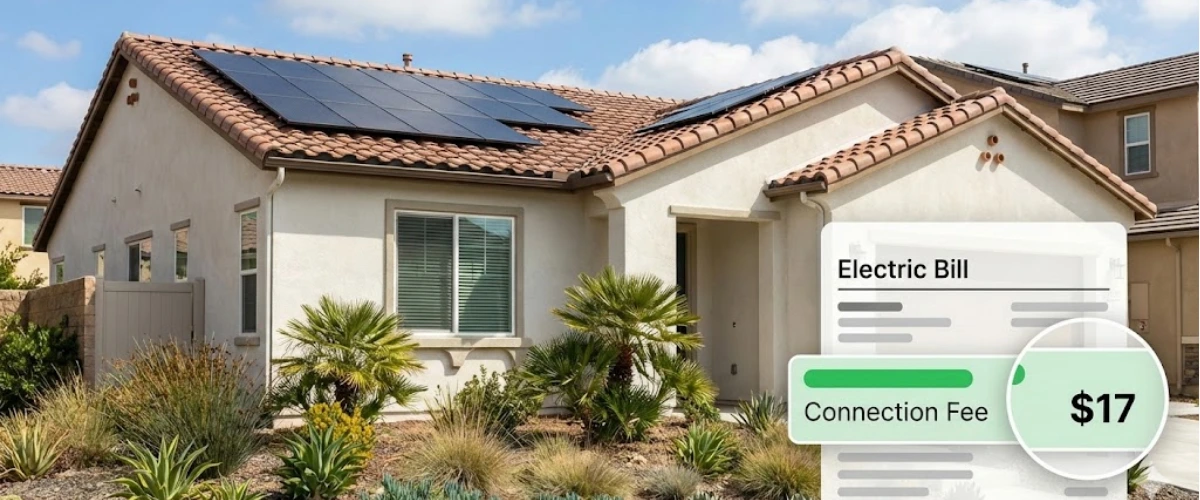
You installed solar panels. Your system is generating power. Your net metering credits are building up each month.
So why is SCE still sending you a bill?
If you're seeing a $15-$25 monthly charge despite producing more electricity than you use, you're not alone. Thousands of Southern California homeowners are confused by this "connection fee" that never seems to go away—even when their solar system covers 100% of their energy needs.
Here's the truth: connection fees are unavoidable, but they don't mean solar isn't working. In fact, that $17 monthly bill is proof your system is doing exactly what it should. Let's break down why these fees exist, what you're actually paying for, and how much you're still saving compared to life before solar.
Why Your Solar Bill Isn't Actually $0
Let's start with the Reddit post that inspired this article. A homeowner built an ultra-efficient 1,800 sq ft home, installed solar in April, and used net metering credits all winter to keep their house at 70°F. Their bill? Just $17.
But then they got a message from their utility company saying they could be "more efficient" and that similar homes were paying only $10 per month.
The problem? That $10 bill doesn't exist for regular homeowners. It's likely a low-income subsidy program, or it's simply bad data from an automated system that doesn't understand how net metering works.
Here's what's really happening. When you go solar in California, you're still connected to the grid. That connection costs money to maintain, and utilities charge a fixed monthly fee to cover:
- Grid infrastructure maintenance
- Wildfire prevention measures (insulated power lines, anti-sway brackets)
- Emergency tree trimming near power lines
- Billing and metering services
- Customer support systems
In Southern California, these connection fees typically range from $15-$25 per month depending on your utility provider. This is what you see on your bill even when you've used zero grid electricity.
The confusion happens because utility companies send automated "efficiency comparison" emails that don't account for solar customers. The algorithm sees your $17 bill and compares it to fictional averages—without realizing you're already producing more power than you're consuming.
Understanding why electricity bills are so high in Southern California makes the connection fee seem trivial by comparison. Before solar, the average SCE customer pays $180-$300+ per month.
How Connection Fees Work with Net Metering
California's net metering system (NEM 3.0) allows you to bank excess solar production during sunny months and draw from those credits during winter or cloudy periods.
Here's a simplified example:
April-September (high production months):
- Your solar system produces 1,200 kWh
- Your home uses 800 kWh
- Excess 400 kWh gets banked as credits
- You pay: $17 connection fee only
October-March (lower production months):
- Your solar system produces 600 kWh
- Your home uses 900 kWh
- You draw 300 kWh from banked credits
- You pay: $17 connection fee only
Your total annual cost with solar? About $204 in connection fees ($17 × 12 months).
Compare that to the $2,400-$3,600 you'd pay SCE without solar, and the connection fee suddenly feels insignificant.
Under NEM 3.0, the value of your solar credits has changed compared to older NEM 2.0 policies. Export rates are lower, which is why net metering credits now work differently than they did just a few years ago. But even with reduced export rates, solar still delivers massive savings—you're just not getting dollar-for-dollar credit like before.
The connection fee remains constant regardless of which NEM policy you're under. Whether you're on NEM 2.0 (grandfathered for 20 years) or NEM 3.0, you'll pay that fixed monthly charge.
Why Batteries Are Essential Under NEM 3.0
If you're considering solar in 2025, here's the uncomfortable truth: panels alone aren't enough anymore.
NEM 3.0 changed the game by dramatically reducing the value of electricity you export to the grid during peak production hours (10am-3pm). Instead of getting credited $0.30-$0.40 per kWh like under NEM 2.0, you now get $0.05-$0.08 per kWh during those hours.
Meanwhile, when you import electricity during expensive evening hours (4pm-9pm), you're paying $0.50-$0.70 per kWh from SCE.
That's a 10x difference.
Battery storage solves this problem by storing your excess daytime production and using it during expensive evening hours instead of exporting it for pennies. This is exactly why solar batteries can maximize your savings under the current rate structure.
Without battery:
- Export 30 kWh during midday → earn $2.40 in credits
- Import 30 kWh during evening → pay $18
- Net cost: -$15.60 (plus connection fee)
With battery:
- Store 30 kWh during midday → $0 export
- Use stored power during evening → $0 import
- Net cost: $0 (plus connection fee)
The connection fee doesn't change, but your ability to avoid expensive grid electricity does. For most Southern California homeowners, a battery system pays for itself in 7-10 years through avoided peak-rate charges alone.
How US Power Helps You Maximize Savings Despite Connection Fees
Connection fees are unavoidable, but overpaying for your solar system isn't.
US Power is the exclusive QCells partner in Southern California, which means we offer factory-direct QCells pricing that's typically 15-20% below market rates. Here's what that means for you:
Typical solar company pricing:
- 10 kW system: $28,000-$32,000
- After 30% tax credit: $19,600-$22,400
- Monthly savings vs. SCE: $180-$220
- Payback period: 8-10 years
US Power factory-direct pricing:
- 10 kW system: $23,000-$26,000
- After 30% tax credit: $16,100-$18,200
- Monthly savings vs. SCE: $180-$220
- Payback period: 6-7 years
That's $3,500-$4,200 in upfront savings for the same American-made QCells panels with the same 25-year comprehensive warranty.
Even accounting for the $204 annual connection fee, you're still saving $2,000-$2,400 per year compared to paying SCE's rates. Over 25 years, that's $50,000-$60,000 in total savings.
Our CSLB-licensed consultants provide transparent pricing with no hidden fees. We complete installations in 3-6 weeks after approval, significantly faster than the industry average of 8-12 weeks. And with 175+ five-star Google reviews, we've proven that quality installations and honest communication matter more than aggressive sales tactics.
The Real Math: What You'll Actually Save
Let's run the numbers for a typical 2,000 sq ft home in Los Angeles with a monthly SCE bill of $250.
Without solar (25 years):
- Monthly bill: $250 (increasing 5% annually)
- Total paid to SCE: $119,000
With solar (25 years):
- System cost: $25,000
- Federal tax credit: -$7,500
- Net investment: $17,500
- Connection fees: $5,100 ($17/month × 300 months)
- Total cost: $22,600
- Total savings: $96,400
Even with connection fees factored in, you're saving nearly $100,000 over the life of your system.
The 30% federal solar tax credit drops to 26% in 2026 and 22% in 2027 before potentially expiring entirely. That's an additional $1,000-$2,500 in lost savings if you wait.
For more detailed calculations specific to your home, check out how much solar panels save in 2025 with real examples from Southern California homeowners.
Understanding Your Real Costs
The connection fee isn't a hidden cost—it's a transparent, unavoidable charge that represents less than 4% of what you'd otherwise pay your utility company.
Here's what you should do next:
Step 1: Calculate your current annual electricity costs. Pull up your last 12 months of SCE bills and add them up. Most LA-area homeowners are paying $2,400-$3,600 per year.
Step 2: Get a solar quote that includes connection fees. US Power provides transparent estimates that show your true annual costs with solar, including connection fees, so you know exactly what to expect.
Step 3: Compare the 25-year cost difference. Even with connection fees, solar typically saves Southern California homeowners $80,000-$120,000 over the life of the system.
Step 4: Understand what to expect during solar installation. The process takes 3-6 weeks with US Power, and we handle all permitting, inspections, and utility coordination.
The bottom line? Connection fees are real, but they're insignificant compared to the savings solar delivers. That Reddit homeowner paying $17/month instead of $250/month? They're doing everything right.
Stop Worrying About Connection Fees—Start Saving on Everything Else
You'll never eliminate your connection fee. But you can eliminate 95% of your electric bill.
SCE rates have increased 32% since 2014 and show no signs of slowing down. The connection fee you're worried about? It's less than what SCE charges for a single day of electricity usage.
US Power specializes in helping Southern California homeowners maximize their solar savings through factory-direct QCells pricing, expert system design, and transparent communication. We don't hide costs or make unrealistic promises about $0 bills.
What we do promise: American-made panels, CSLB-licensed consultants, 25-year comprehensive warranties, and installations completed in 3-6 weeks.
Frequently Asked Questions
Can I eliminate the connection fee completely?
Why do connection fees vary between utilities?
Does the connection fee count toward my net metering credits?
Will my connection fee increase over time?
What if I move to a home that doesn't allow solar?


California’s Solar Mandate and Energy Savings for Homeowners
Learn everything about homeowners need to know about California’s solar mandate.
Solar Panel Warranties for Southern California Homes
Understand why homeowners should know about solar panel warranties in SoCal.
3 Things to Do Before Your Solar Consultation
Prepare effectively for your solar consultation with these essential steps.







Copyright © 2025 US Power - Axia by QCells. All Rights Reserved.

Get an instant solar estimate using satellite!