




Solar Generator vs Gas Generator: Is It Time to Make the Switch in 2026?

Gas generators are cheap but loud. Portable power stations cost $2000+ but offer limited runtime. Most homeowners don't realize there's a third option that eliminates both problems AND your electric bill.
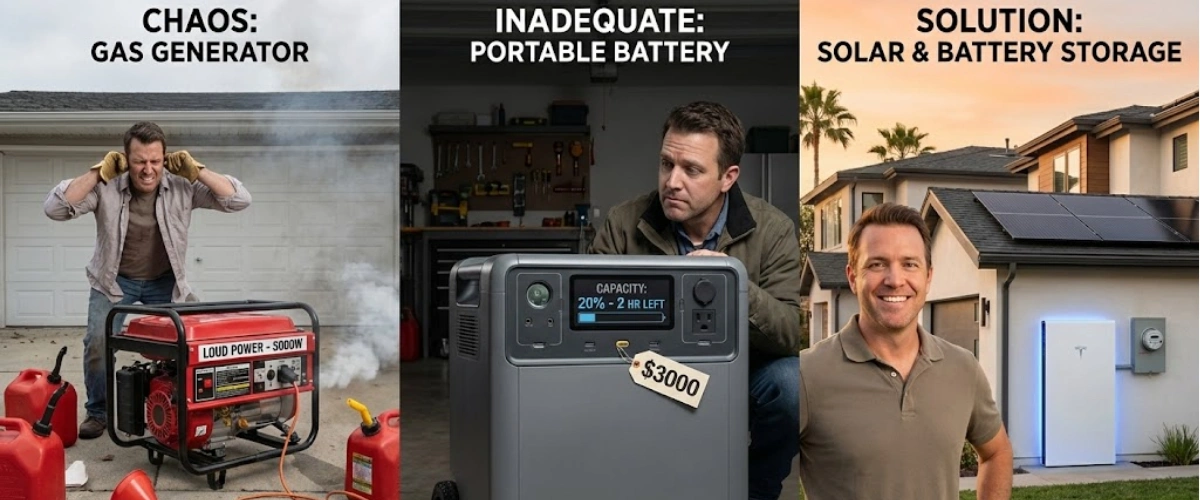
You've had enough. The generator noise wakes the neighbors. The gasoline sitting in your garage makes you nervous. And every time the power goes out, you're outside in the dark fumbling with extension cords while your fridge slowly warms up.
So you start researching portable power stations—those big battery boxes that promise silent, indoor-safe backup power. They look perfect. Until you see the price tag: $2,000 to $3,500 for a decent 4-5kWh unit.
That's 3-4 times what you paid for your gas generator. Is it really worth it?
Here's what most homeowners miss: You're comparing two emergency-only Band-Aid solutions when there's a permanent fix that solves backup power AND eliminates your electric bill at the same time.
At US Power, we don't sell gas generators or portable power stations. We install permanent rooftop solar panels with whole-home battery backup—and here's why that matters for your wallet and your peace of mind.
Why Gas Generators Seem Like a Good Deal (Until You Actually Use One)
A 5.5kW gas generator costs around $850. That's cheap enough that most homeowners don't think twice about it. You stick it in the garage, maybe use it once or twice a year during outages, and call it good.
But then reality sets in:
The noise is unbearable. Your generator sounds like a lawnmower running at 3 AM. During the 2020 California power shutoffs, entire neighborhoods sounded like racetracks as everyone fired up their generators simultaneously.
Fuel storage is a constant worry. Gasoline degrades in 3-6 months without stabilizer. Too much stored fuel is a fire hazard. Too little means you're scrambling during an emergency when gas stations might be closed.
You can't use it indoors. Carbon monoxide poisoning kills people every year. So you're stuck running extension cords from your driveway, through windows or doors, losing heating/cooling efficiency the entire time.
Maintenance adds up. Oil changes, spark plugs, carburetor cleaning. If you don't run it monthly, it probably won't start when you actually need it.
For occasional camping trips, a gas generator works fine. But for reliable home backup during rising electricity bills in Southern California and increasingly frequent outages? It's far from ideal.
And here's the key insight: While you're spending money on fuel every month and dealing with maintenance, you could be investing that same money into a system that eliminates your electric bill entirely.
Why Portable Power Stations Still Fall Short
Portable power stations solve the noise and fuel problems. No gasoline, no exhaust, no maintenance. Just plug in your devices and go.
But they create new problems:
They're expensive upfront. A 5kWh EcoFlow Delta Pro costs $3,600. That's before you add extra batteries (another $3,000 each) or solar panels ($800-1,200 for portable panels). You're looking at $5,000-7,000 for a complete setup.
Runtime is limited. That $3,600 battery powers your fridge, internet, and laptop for maybe 12-24 hours. Want to run your window AC for 6 hours like the Reddit user mentioned? That's 3.6-4.8kWh right there—nearly your entire battery capacity gone in one afternoon.
Recharging takes forever. Without solar panels, you're charging from the grid (defeating the purpose during outages) or from your gas generator (so you still need it). With portable solar panels, expect 6-10 hours of direct sunlight to fully recharge a 5kWh battery.
You still don't have whole-home backup. Portable stations power individual devices. You're not running your HVAC, electric stove, or EV charger. You're just keeping the essentials alive—barely.
One Reddit user in the thread mentioned spending $1,500 for a 3.6kWh unit with solar panels. That's roughly one day of backup power for basic loads. It's better than a gas generator for camping, but for serious home backup? It's still inadequate.
This is exactly why US Power focuses exclusively on permanent installations. Portable solutions can't compete with whole-home systems when it comes to daily savings and true energy independence.
Understanding how solar batteries maximize savings reveals why permanent solutions outperform portable units for California homeowners.
Comparing Your Backup Power Options: The Real Math
Let's break down what each option actually costs over 10 years—the typical lifespan of a battery system.
Important: We're showing these comparisons not to help you choose between generators and portable stations, but to demonstrate why neither makes financial sense compared to a permanent solar + battery system that also eliminates your utility bills.
Gas Generator (5.5kW)
- Initial cost: $850
- Fuel: $30/month average (stored gasoline + outage usage) = $3,600 over 10 years
- Maintenance: $150/year = $1,500 over 10 years
- Total 10-year cost: $5,950
- What you get: Loud, outdoor-only, constant maintenance, fuel storage hassles
Portable Power Station (5kWh)
- Initial cost: $2,500-3,600 (battery only)
- Solar panels: $800-1,200 (optional)
- Extra batteries: $3,000+ each (if needed)
- Total cost: $3,300-7,800+
- What you get: Silent, indoor-safe, limited runtime, no whole-home coverage
Whole-Home Solar + Battery
- Initial cost: $25,000-35,000 (typical Southern California home)
- Federal tax credit: -30% ($7,500-10,500 back)
- Net cost: $17,500-24,500
- Annual utility savings: $1,800-3,200/year
- Total 10-year value: Saves $18,000-32,000 in utility bills
- What you get: Silent, automatic, whole-home coverage, pays for itself, increases home value
When you look at which backup power option is right for your specific situation, the math changes dramatically once you factor in daily electricity savings—not just emergency backup.
The Real Solution: Whole-Home Solar + Battery Backup (What US Power Actually Installs)
Here's what most people miss when comparing gas generators to portable power stations: you're comparing two types of emergency-only equipment.
What if your backup power system also eliminated your electric bill?
That's exactly what whole-home solar + battery does—and it's the only thing US Power installs because it's the only solution that makes financial sense for Southern California homeowners. You're not just buying backup power—you're buying energy independence.
How it works:
- Solar panels on your roof generate electricity during the day
- Your battery stores excess power for nighttime use and outages
- During grid outages, your battery automatically kicks in within milliseconds
- You keep running your entire home—HVAC, appliances, EV charging, everything
- When the sun comes up, your panels recharge the battery and power your home simultaneously
What this means for you:
- No fuel costs ever. The sun is free.
- No noise. Silent operation 24/7.
- No maintenance. Solar panels and batteries are solid-state—no moving parts.
- Whole-home backup. Not just a fridge and router, but your entire electrical panel.
- Daily savings. Every single day, you're avoiding $5-15 in utility costs.
The reason solar panels alone aren't enough in 2025 is California's NEM 3.0 policy, which drastically reduced the value of sending excess solar power back to the grid. Now, storing that power in batteries is essential for maximizing your savings.
Real Runtime: What to Actually Expect
Let's address the elephant in the room: how long will a solar battery actually power your home during an outage?
The original Reddit poster wanted to run a window AC unit for 6 hours during outages. Here's what that requires with different systems:
Window AC Unit (800W) for 6 Hours
- Gas generator: Easy. Run it continuously with 1-2 gallons of fuel.
- 5kWh portable station: Uses 4.8kWh. That's 96% of your battery. Nothing left for your fridge, lights, or internet.
- Whole-home battery (13.5kWh): Uses 4.8kWh. You still have 8.7kWh left for everything else.
Fridge (150W), Internet (30W), Laptop (65W) for 24 Hours
- Gas generator: Requires constant refueling. Wastes 90% of generator capacity.
- 5kWh portable station: Uses 5.9kWh over 24 hours. You're dead by morning.
- Whole-home battery: Uses 5.9kWh. You still have 7.6kWh left.
Most Southern California homes need 20-30kWh per day. A single 13.5kWh battery paired with solar panels can handle typical daily loads indefinitely during multi-day outages, because your panels recharge the battery every morning.
Want specifics for your home? Learn more about how long can a solar battery power a house based on your actual usage patterns.
Why US Power Recommends Solar + Battery for Southern California Homes
US Power isn't in the portable power station business. We're not trying to sell you a $3,000 battery box that barely keeps your fridge running.
We install one thing: permanent rooftop solar panels with whole-home battery backup. Here's why that's the only solution we offer:
- Eliminate your electric bill (average savings: $1,800-3,200/year)
- Provide whole-home backup during outages—not just a few appliances
- Include 25-year warranties on panels, batteries, and workmanship
- Increase home value by an average of $15,000-20,000
- Qualify for 30% federal tax credit (through December 31, 2025)
- Generate free electricity daily instead of just sitting in your garage waiting for emergencies
Our QCells systems include:
- American-made solar panels (manufactured in Georgia)
- Factory-direct pricing (15-20% below market rates)
- CSLB-licensed consultants
- 3-6 week installation timeline after approval
- 175+ five-star Google reviews
We've seen too many homeowners waste money on stopgap solutions. You buy a gas generator for $850. Then you realize it's too loud and buy a portable station for $3,000. Then you realize that's not enough capacity and spend another $3,000 on extra batteries.
By the time you're done cobbling together a halfway-decent backup system, you've spent $7,000-10,000 and you still don't have whole-home coverage or daily savings.
For $17,500-24,500 (after tax credit), you get a permanent solution that pays for itself in 6-8 years through utility savings alone.
Here's the key insight: are batteries worth it for solar in California becomes a "yes" when you realize you're not just buying backup power—you're buying 25+ years of reduced electric bills.
Breaking Down the Cost vs. Value Equation
Let's be honest about the money. A whole-home solar + battery system is a bigger upfront investment than a gas generator or portable power station.
But here's the math that changes everything:
10-Year Comparison (Typical Southern California Home)
Option 1: Keep Using SCE/PG&E
- Annual electric bills: $2,400/year × 10 years = $24,000
- Rate increases (avg 6%/year): +$4,200 over 10 years
- Total paid to utility: $28,200
- Backup power capability: Zero
Option 2: Gas Generator + Electric Bills
- Generator + fuel + maintenance: $5,950
- Electric bills: $28,200
- Total 10-year cost: $34,150
- Backup power: Partial, loud, outdoor-only
Option 3: Portable Power Station + Electric Bills
- Battery system: $5,000
- Electric bills: $28,200
- Total 10-year cost: $33,200
- Backup power: Partial, limited runtime
Option 4: Solar + Battery (US Power)
- System cost after 30% tax credit: $21,000
- Electric bills: $3,600 (reduced 85%)
- Total 10-year cost: $24,600
- Net savings vs. Option 1: $3,600
- Backup power: Whole-home, unlimited (with solar recharge)
- Home value increase: +$18,000 average
The portable power station saves you nothing on daily electricity costs. The solar + battery system saves you $200-300 per month starting on day one.
After 7-8 years, you've broken even. After that, you're pocketing $2,000-3,000 per year in avoided utility costs for the next 15-20 years of your system's life.
Understanding are batteries worth it for solar in California requires looking beyond the sticker price to the total cost of ownership.
What About DIY Solar Generators?
Several Reddit commenters suggested building a DIY battery system to save money. It's possible—but risky.
DIY pros:
- Potentially 30-40% cheaper than commercial portable stations
- Customizable capacity
- Learning experience
DIY cons:
- No warranty or support
- Fire risk if improperly assembled
- Won't work with home solar panels without expensive additional equipment
- Not eligible for tax credits or rebates
- Liability issues if something goes wrong
- Time investment (40+ hours minimum)
If you're an electrical engineer who loves tinkering, DIY might make sense. For everyone else, the risk isn't worth the marginal savings—especially when a properly installed whole-home system comes with 25-year warranties and professional support.
Common Questions About Making the Switch
"Can't I just buy a portable station for emergencies and deal with high electric bills?"
You can, but you're paying twice: once for the portable station, then continuously for electricity. Most Southern California homeowners find that after 2-3 years of high utility bills, they wish they'd just gone solar from the start.
"What if I move before the system pays for itself?"
Solar + battery systems increase home value by more than their cost in Southern California. Zillow data shows homes with solar sell 13% faster and for $15,000-20,000 more on average. You'll recoup your investment at sale time.
"Isn't solar less reliable than having fuel on hand?"
Southern California gets 280+ sunny days per year. Your solar panels charge your battery even on cloudy days (though at reduced efficiency). For extended cloudy periods (rare here), most systems include grid connection as backup. You're not "off-grid"—you're "grid-optional."
"What about maintenance on solar panels and batteries?"
Modern solar panels have no moving parts and require minimal maintenance (occasional hosing off of dust). Batteries are solid-state and maintenance-free. Compare that to monthly generator maintenance, oil changes, and fuel stabilizer additments.
"How long does installation take?"
US Power's 3-6 week installation timeline is significantly faster than industry average. Most solar companies quote 2-4 months from contract signing to system activation. We streamline permitting and use factory-direct QCells inventory to cut that time in half.
Getting Started: Your Next Steps
If you're tired of generator noise, fuel hassles, and high electric bills, here's how to move forward:
Step 1: Get a free consultationWe'll review your electric bills, assess your roof, and calculate your potential savings. No pressure, no gimmicks—just honest numbers based on your actual usage.
Step 2: See your custom proposalWe'll design a system sized specifically for your home. You'll see exactly what it costs, how much you'll save, and how much backup power you'll have.
Step 3: Choose your timelineWant to install in 2025 to capture the 30% federal tax credit before it drops to 26% in 2026? We'll prioritize your installation. Want to wait until after the holidays? That works too.
Step 4: Enjoy energy independenceOnce your system is installed and activated, you're done. No more generator maintenance, no more fuel runs, no more shockingly high utility bills.
Most US Power customers tell us their only regret is not going solar sooner.
Stop Settling for Stopgap Solutions
Gas generators are cheap, loud, and require constant babysitting. Portable power stations are expensive, limited, and don't reduce your daily electric bills. Both are emergency-only solutions that leave you paying high utility rates 363 days a year.
US Power doesn't sell either of these products—and here's why:
Whole-home solar + battery is the only option that solves three problems simultaneously: backup power during outages, massive reductions in your monthly electric bills, and true energy independence. It's the only solution that actually pays for itself.
For Southern California homeowners facing rising SCE/PG&E rates, increasing wildfire-related outages, and the reality of NEM 3.0, the question isn't whether to go solar—it's how soon you can get started.
US Power makes it easy: factory-direct QCells pricing, 3-6 week installation, 25-year warranties, and transparent pricing with no hidden fees. We're not here to sell you a temporary fix. We're here to eliminate your electric bill and give you real peace of mind.
Ready to stop settling? Let's talk about what permanent energy independence actually looks like for your home.
Frequently Asked Questions
Can solar generators completely replace gas generators?
How much does a good solar battery backup system cost?
Will a 5kWh portable power station run my whole house?
What's better for California homeowners: portable power stations or permanent solar?
How long do solar batteries last compared to gas generators?


$23K Solar Battery Quote? Compare Franklin, Tesla & QCells
Is $23K a fair price for a home battery? compare quotes and incentives in SoCal.
Is Solar Worth It in 2025 for PG&E Customers?
Learn why Solar-only loses value under PG&E’s new rules—battery pairing is key.
SCE Time-of-Use Rates Explained: Cheapest Hours to Use Power
High SCE rates with solar + battery solutions. Avoid SCE peak charges with US Power.








Copyright © 2025 US Power - Axia by QCells. All Rights Reserved.

Get an instant solar estimate using satellite!