




PG&E Solar Buyback Rates 2026: What You're Actually Getting Paid

Selling solar to PG&E for 4¢ while paying 45¢ to buy it back? You're not alone—and batteries change everything.
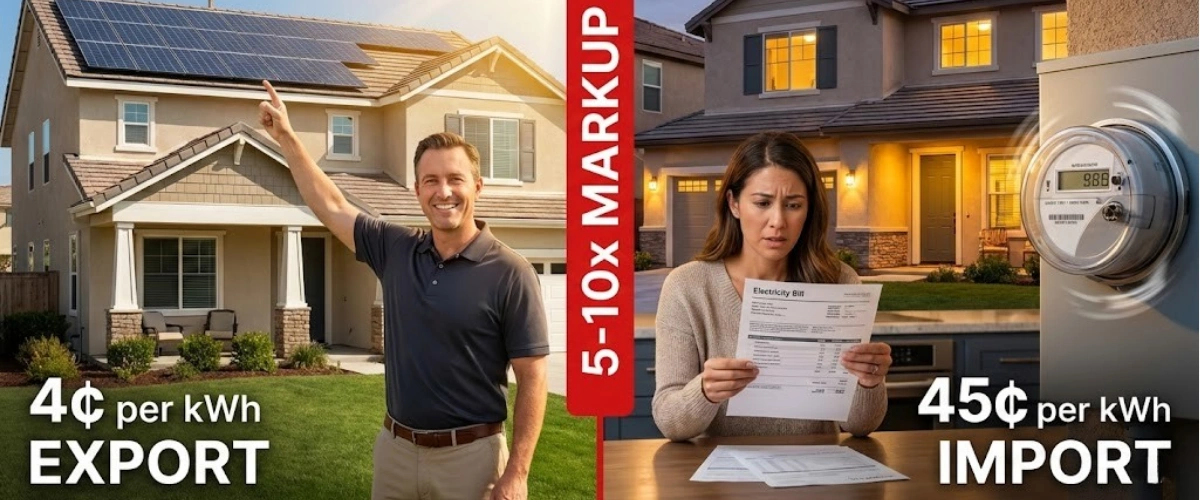
If you're researching solar in California, you've discovered the frustrating truth: PG&E pays roughly 4 to 9 cents per kilowatt-hour (kWh) for excess solar energy you send to the grid—while charging you 40 to 50 cents per kWh to buy that same power back during peak hours.
That's not a mistake. That's NEM 3.0, California's current solar billing policy since April 2023. Thousands of Southern California homeowners are discovering that traditional solar-only systems no longer deliver the savings they expected.
But solar isn't dead in California—it just requires a smarter approach. One that involves battery storage, strategic self-consumption, and factory-direct pricing. Let's break down exactly what's happening with PG&E solar buyback rates in 2026 and what you can do about it.
Why NEM 3.0 Changed Everything for Solar Buyback Rates
Before April 2023, California solar homeowners enjoyed NEM 2.0 (Net Energy Metering 2.0). Under that system, you received credits roughly equal to retail rates for exported electricity—essentially a one-to-one exchange.
NEM 3.0 changed everything.
What PG&E Actually Pays in 2026
Under NEM 3.0, compensation for solar exports is based on "avoided cost rates"—what it costs PG&E to not generate that electricity. These rates vary by hour but average:
- Midday solar production (10 AM - 3 PM): 4 to 8 cents per kWh
- Evening peak hours (4 PM - 9 PM): You pay 40 to 50 cents per kWh to import
- Net Surplus Compensation (annual excess): 2 to 9 cents per kWh
Meanwhile, PG&E's retail rates in 2026:
- Off-peak: 25 to 35 cents per kWh
- Peak hours (4-9 PM): 40 to 50 cents per kWh
- Base Services Charge (starting March 2026): $24/month fixed
You're giving away power for pennies and buying it back at a 5x to 10x markup. This is why how solar batteries can maximize your savings becomes essential—batteries let you store daytime solar for use during expensive evening hours, eliminating low-value exports and high-cost imports.
What Changed with NEM 3.0
The California Public Utilities Commission approved NEM 3.0 in December 2022 to reduce "cost shifts" and incentivize battery adoption. The result? A 75% reduction in export compensation.
Here's the impact:
8 kW solar system producing 12,000 kWh/year (40% exported):
- NEM 2.0 annual export value: ~$1,920
- NEM 3.0 annual export value: ~$480
- Payback period (solar only): Jumped from 6-7 years to 15-20 years
Without batteries, traditional solar systems under NEM 3.0 rarely make financial sense. For the full policy breakdown, see NEM 3.0 California solar changes.
The Real Math: What You're Losing Without Battery Storage
Let's get specific with a typical Southern California scenario:
Household Profile:
- Monthly electricity usage: 900 kWh
- Solar system: 8 kW producing 1,000 kWh/month
- Daytime consumption: 300 kWh (30%)
- Exported to grid: 700 kWh (70%)
Solar Only (No Battery):
- Exports to PG&E: 700 kWh × $0.06 = $42 credits
- Evening imports: 600 kWh × $0.45 = $270 cost
- Base charge: $24
- Net monthly bill: $252
Solar + Battery:
- Exports: 100 kWh × $0.06 = $6 credits
- Evening battery discharge: 600 kWh = $0 cost
- Base charge: $24
- Net monthly bill: $18-30
The difference? $220+ saved monthly with batteries. That's $2,600+ per year.
This is why everything you need to know about solar and battery storage is essential reading. Batteries aren't optional anymore under NEM 3.0—they're the key to actual savings.
Why PG&E Rates Keep Rising (And Why It Matters)
Your PG&E bills have climbed dramatically:
- 2014 average: ~20 cents per kWh
- 2024 average: ~40 cents per kWh
- Increase: 100% in 10 years
Drivers include wildfire mitigation ($billions), grid upgrades, regulatory mandates, and guaranteed shareholder returns. While PG&E announced a 5% rate decrease in January 2026, that's minimal compared to the decade-long trend.
As a monopoly utility, PG&E has no incentive for long-term rate reductions. The more infrastructure they build, the more they can charge. This is why electricity bills are so high in Southern California—and why solar + battery is critical for cost control.
How US Power Makes Solar + Battery Affordable Under NEM 3.0
Sticker shock from $40,000 quotes has killed solar for many homeowners. US Power solves this through three key differentiators:
Factory-Direct QCells Pricing
As California's #1 QCells installer and exclusive factory-direct partner, we offer:
- 15-20% lower pricing than traditional retailers
- No middleman markup—direct from manufacturer
- American-made panels from QCells' Georgia facility
- 25-year comprehensive warranty (panels, workmanship, performance)
Most companies buy wholesale, mark up 30-50%, and pass costs to you. We eliminate that. Factory-direct QCells pricing explains the exact savings.
Right-Sized Battery Systems
You don't need massive 20 kWh batteries. We design based on actual usage:
- Typical 8-10 kWh battery: Covers evening peak (4-9 PM)
- Capacity to avoid exports: Stores excess daytime solar
- Scalable: Add capacity as needs change
Right-sizing keeps costs reasonable while maximizing ROI.
3-6 Week Installation Timeline
While competitors quote 3-6 months, US Power delivers in 3-6 weeks:
- Free consultation (virtual or on-site)
- Custom design based on roof and usage
- Permitting (we handle paperwork)
- Installation by CSLB-licensed crews
- Inspection and PTO with PG&E
Faster installation means earlier savings and locking in current pricing.
Is Battery Storage Worth the Investment in 2026?
Batteries add $10,000-$15,000 upfront (before incentives). Here's the real ROI:
10 kWh Battery System:
- Upfront cost: ~$12,000
- Federal tax credit (30%): -$3,600
- SGIP rebate (if eligible): -$2,500 to -$7,500
- Net cost: $1,500 to $6,000
Annual savings (vs. solar-only):
- Avoided evening imports: ~$2,400/year
- Payback: 1 to 3 years
Without batteries, NEM 3.0 solar-only systems have 15-20 year paybacks. With batteries, total system payback drops to 5-7 years. Are batteries worth it for solar in California confirms batteries are financially essential, not optional.
Real Homeowner Comparison
Before Solar: $280/month = $3,360/year
Solar Only (NEM 3.0): $180-220/month = $2,160-2,640/year
Savings: $720-1,200/year
Solar + Battery (NEM 3.0): $24-50/month = $288-600/year
Savings: $2,760-3,072/year
The battery difference: $2,000+ annually. Over 25 years, that's $50,000+ in your pocket.
How to Offset Battery Costs: Incentives Still Available
Federal Solar Tax Credit (30%)
Applies to both panels and batteries (if solar-charged). For a $30,000 system:
- Tax credit: $9,000
- Net cost: $21,000
This drops to 26% in 2033—2026 is your last full year at 30%.
California SGIP Rebates
The Self-Generation Incentive Program offers battery storage rebates:
- General market: $150-200/kWh (10 kWh = $1,500-2,000)
- Equity budget (low-income): $850-1,000/kWh (10 kWh = $8,500-10,000)
- Equity Resiliency (high fire threat): Up to $1,000/kWh
California SGIP rebates for home batteries details eligibility and application process.
Note: SGIP is first-come, first-served with 6-12 month processing times. Factor this into financing.
Combined Example (15 kW solar + 10 kWh battery):
- Total: $35,000
- Federal credit (30%): -$10,500
- SGIP (general): -$1,800
- Net cost: $22,700
- Annual savings: ~$3,200
- Payback: ~7 years
Why Your Solar Company Choice Matters More Than Ever
The California solar industry has horror stories: vanishing companies, predatory contracts, systems that never break even. Under NEM 3.0, choosing wrong means the difference between 7-year payback and never recovering costs.
Red Flags:
- Oversized systems (15 kW for 1,200 sq ft home)
- "Free solar" claims (predatory leases/PPAs)
- Pressure tactics ("price good today only")
- Vague warranties
- No CSLB license
What to Verify:
- CSLB licensing (required in California)
- Factory-direct partnerships
- Transparent, itemized pricing
- Local installation crews (not subcontractors)
- Clear 25-year warranties
- Post-installation support
US Power delivers all of this—CSLB-licensed consultants designing systems for your needs, not sales quotas. How to choose a solar company in Los Angeles provides a complete vetting guide.
Conclusion
PG&E solar buyback rates in 2026 range from just 4 to 9 cents per kWh while retail rates sit at 40 to 50 cents per kWh. That 5x to 10x gap makes solar-only systems financially unviable for most Southern California homeowners.
But solar + battery systems still deliver massive savings when designed correctly. The winning strategy: maximize self-consumption by storing daytime solar for evening use, avoiding both low export rates and high import costs.
US Power makes this affordable through factory-direct QCells pricing, right-sized battery systems, and 3-6 week installation. With 175+ five-star Google reviews, CSLB licensing, and comprehensive 25-year warranties, you're working with California's most trusted solar partner.
Every month on PG&E's grid costs $200-300 you'll never recover. Take control of your energy costs today.
Frequently Asked Questions
What is PG&E paying for solar power in 2026?
Can I still save money with solar under NEM 3.0?
How much does solar + battery cost in Southern California?
Will PG&E rates keep increasing?
How long does installation take?


Choosing the Right Backup for Southern California Homes
Find the best backup solution to keep your Southern California home powered.

Pros & Cons of Today’s Solar Batteries: A Guide for Homeowners
Weigh the benefits and drawbacks of each solar battery to maximize energy savings.
Why Every California Homeowner Needs a Solar Battery in 2025
California’s new solar rules, it’s no longer enough to just go solar— storage is key.








Copyright © 2025 US Power - Axia by QCells. All Rights Reserved.

Get an instant solar estimate using satellite!