




Why PG&E Won't Let You Charge AND Export Your Solar Battery

PG&E's NEM 3.0 rules force a choice: grid charging OR export. Here's why. the battery rule costing homeowners thousands in winter heating bills.
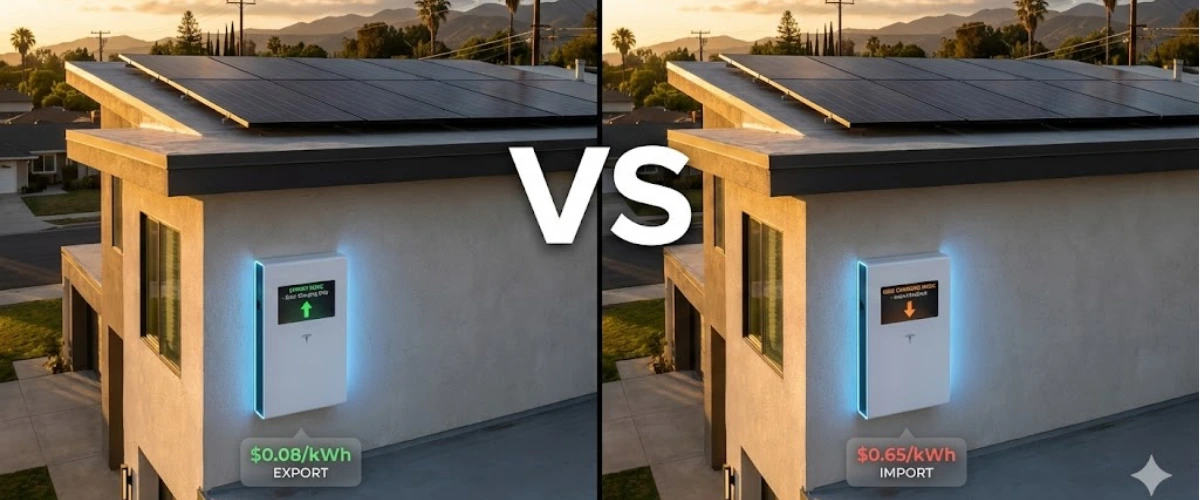
You installed solar panels and batteries to take control of your energy costs. But now it's a cold, cloudy January day in Northern California. Your solar production is barely keeping up, and your heaters are running nonstop. Your batteries sit at 40% capacity, and you're watching your evening peak rates tick up to $0.65 per kWh.
You know your batteries could charge from the grid during cheap off-peak hours and then power your home during expensive peak times. That's exactly what batteries are supposed to do, right? But when you installed your system, your contractor told you something frustrating: PG&E makes you choose. You can either charge your batteries from the grid OR export excess solar to the grid—not both.
If you're on NEM 3.0 and scratching your head about this restriction, you're not alone. Thousands of California homeowners are discovering this limitation the hard way, especially during winter months when solar production drops and heating costs spike. Let's break down exactly why this rule exists, what your options are, and how to make the smartest choice for your situation.
The Battery Charging Dilemma California Homeowners Face
The Reddit thread that sparked this discussion tells a familiar story. A Northern California homeowner with Enphase panels and 10C batteries asked a simple question: "Why can't my batteries charge from the grid AND export to the grid?"
The answer reveals a crucial detail most solar shoppers don't learn until after installation: PG&E's interconnection agreement forces you to pick one of two operating modes:
Option 1: No Grid Charging (Export-only)
- Batteries charge only from your solar panels
- Excess solar exports to the grid for NEM 3.0 credits
- During cloudy days, batteries may not fully charge
- You're stuck importing expensive grid power during peak hours
Option 2: No Storage Export (Grid-charging allowed)
- Batteries can charge from either solar or the grid
- You can use cheap off-peak power to fill your batteries
- But you cannot export any battery power back to the grid
- Solar panel output can still export, but not battery discharge
Here's where the frustration builds. With NEM 3.0's terrible export rates (often just $0.05–$0.08 per kWh compared to import costs of $0.50–$0.70), most homeowners would gladly give up export credits to reduce their peak consumption. Understanding how solar batteries can maximize your savings becomes critical under these new rules.
But PG&E's current rules don't allow the kind of load-shifting that would benefit both the grid and the homeowner.
What PG&E's Interconnection Agreement Actually Says
So where does this restriction actually come from? It's not just PG&E being difficult (though that's debatable). The rule is established by the California Public Utilities Commission (CPUC) and implemented through PG&E's interconnection agreement.
According to PG&E's official documentation, the two permitted battery configurations are:
No Grid Charging Configuration
Your batteries can only charge from renewable sources (your solar panels). This means all stored energy in your batteries came from the sun, which is verifiable for renewable energy tracking purposes. You're allowed to export this solar-derived energy back to the grid and receive NEM 3.0 export credits.
No Storage Export Configuration
Your batteries can charge from any source—solar panels or the grid. However, because PG&E cannot distinguish whether the energy in your battery came from renewables or the grid, you're prohibited from exporting battery power back to the utility. Your solar panels can still export directly, but not your battery discharge.
The technical reasoning centers on renewable energy tracking. California has stringent renewable energy portfolio standards, and utilities need to verify that energy credited as "renewable" actually came from renewable sources. If your battery could charge from the grid and then export, PG&E wouldn't be able to prove whether that exported energy was solar or fossil-fuel-derived grid power. For a deeper understanding of how these systems work together, see our guide on everything you need to know about solar and battery storage.
This matters for tax implications, renewable energy credits, and compliance with state mandates. But it creates a frustrating limitation for homeowners trying to optimize their energy costs.
Why the "Choose One or the Other" Rule Exists
The restriction boils down to three main concerns from the utility's perspective:
1. Energy Arbitrage Prevention
If you could both charge from cheap off-peak grid power and then sell it back during expensive peak hours, you'd essentially be reselling PG&E's own electricity back to them at a higher rate. Under NEM 2.0's retail-rate compensation, this would have cost utilities significant money.
Here's the catch though: Under NEM 3.0, this argument barely holds water anymore. Export credits are now wholesale rates (sometimes 90% lower than import costs), meaning homeowners would still lose money on arbitrage. One Reddit commenter calculated that even with perfect arbitrage, it would be a net negative for the customer except for maybe a week or two in late summer when peak export rates spike to $2–$3 per kWh.
2. Renewable Energy Source Verification
California utilities must meet renewable portfolio standards. If grid power (which includes fossil fuels) could flow through home batteries and get exported as "solar," it would corrupt the renewable energy tracking system. This is a legitimate technical concern.
3. Grid Infrastructure and Cost-Shifting Concerns
Utilities argue that frequent charging and discharging increases wear on grid infrastructure. However, other states and utilities (like some in Massachusetts and Colorado) have found ways to incentivize residential battery participation in grid services through Virtual Power Plant (VPP) programs.
The irony? NEM 3.0 was specifically designed to encourage battery adoption and reduce peak demand. Yet the interconnection rules prevent the exact load-shifting behavior that would benefit everyone.
How NEM 3.0 Changed Everything for Battery Owners
The shift from NEM 2.0 to NEM 3.0 fundamentally altered the battery storage equation in California.
Under NEM 2.0 (Pre-April 2023)
- Export credits matched retail rates (1:1 compensation)
- Batteries were optional for most homeowners
- Some NEM 2.0 customers report being able to both grid-charge and export
- Time-of-use rates existed but weren't as critical
Under NEM 3.0 (April 2023 Onward)
- Export credits are wholesale rates (typically $0.05–$0.15/kWh)
- Import costs remain retail rates ($0.40–$0.70/kWh)
- Batteries became essential to maximize savings
- Peak vs. off-peak timing is everything
- The "choose one or the other" restriction became more painful
Here's a real example from the Reddit thread: A homeowner on NEM 3.0 pays retail prices for grid imports but receives wholesale prices for exports. During most of the year, export credits are a tiny fraction of import costs. The only exception? August and September evenings (6–8 PM), when export rates spike to $2–$3 per kWh due to extreme grid demand.
Learn more about how NEM 3.0 changed everything for California solar homeowners and what it means for your battery strategy.
This creates a bizarre situation where the policy ostensibly designed to reduce peak demand actually prevents homeowners from using their batteries to shift load away from peaks. One commenter put it perfectly: "It would allow homes to fully recharge their batteries during the day on cold, cloudy winter days and consume battery power during evening peaks. Essentially just load-shifting, which seems like it would be better for the grid and save the utility money."
Your Two Options Under PG&E's Current Rules
So what can you actually do? Let's break down both configurations and when each makes sense.
Option A: Export-Only Mode (No Grid Charging)
Best for: Homeowners with consistent solar production year-round
How it works:
- Batteries charge exclusively from your solar panels
- Excess solar exports to grid for NEM 3.0 credits
- During peak evening hours, your batteries discharge to power your home
- On cloudy days or in winter, batteries may not fully charge
Pros:
- Maximize export credits during high-rate periods (Aug–Sept)
- Batteries always contain "clean" solar energy
- Works well in sunny Southern California climates
Cons:
- Winter production gaps leave you importing expensive peak power
- Cloudy days mean partially charged batteries
- Can't take advantage of super-cheap off-peak rates
Before committing to this configuration, consider reading our analysis on whether batteries are worth it for solar in California to understand the full financial picture.
Option B: Grid-Charging Mode (No Storage Export)
Best for: Homeowners with high winter heating costs or inconsistent solar production
How it works:
- Batteries charge from both solar and grid power
- You can schedule charging during cheapest off-peak hours (typically 9 PM–4 PM)
- Batteries discharge to power your home during expensive peaks
- Zero battery export to the grid (but solar panels can still export directly)
Pros:
- Guaranteed full battery charge every day
- Massive savings on winter heating costs
- Peak demand reduction even on cloudy days
- Takes advantage of off-peak rate arbitrage
Cons:
- Miss out on summer export credits ($2–$3/kWh during Aug–Sept peaks)
- Can't use batteries to export excess solar
- Slightly higher complexity in managing charge schedules
The Hidden Third Option: Storm Watch
Interestingly, systems like Tesla Powerwall and Enphase batteries have a "Storm Watch" feature that automatically grid-charges when severe weather is forecast. This is technically allowed as an emergency exception, even if you're in export-only mode. It's a small workaround, but it shows the rules aren't entirely inflexible.
Smart Workarounds and Strategies for NEM 3.0 Homeowners
While you can't change PG&E's rules, you can optimize within them. Here are proven strategies from homeowners who've figured out the system:
Strategy 1: Right-Size Your Battery Capacity
If you're in export-only mode, size your battery to store enough solar energy to cover your entire evening and overnight usage. This minimizes grid imports during expensive hours. US Power's energy consultants run detailed consumption analysis to determine your optimal battery capacity. With NEM 3.0's economics, understanding why solar panels alone aren't enough in 2025 is essential for maximizing your investment.
Strategy 2: Smart Load Management
Program your battery management system to prioritize charging during peak solar production (10 AM–2 PM), then switch to battery + solar to offset grid consumption during peak hours (4 PM–9 PM). Many modern systems like Enphase allow this kind of scheduled operation.
Strategy 3: Seasonal Mode Switching
Some homeowners switch between modes seasonally:
- Summer (May–October): Export-only mode to capture high export credits
- Winter (November–April): Grid-charging mode to handle heating loads
Check with your installer whether this is permitted under your interconnection agreement. Some jurisdictions allow it, others require sticking with your initial choice.
Strategy 4: Participate in VPP Programs
PG&E offers Virtual Power Plant programs where you can get paid for allowing the utility to discharge your battery during critical grid events. The Emergency Load Reduction Program (ELRP) pays $2 per kWh of battery discharge during emergencies. This doesn't violate the export restriction because it's an opt-in emergency program. If you're curious about capacity, learn how long a solar battery can power a house to plan for both emergencies and daily usage.
Strategy 5: Oversize Your Solar Array
If you're stuck in export-only mode and worried about winter production, install a slightly larger solar array (10–15% oversized). This ensures adequate battery charging even on partly cloudy days. With NEM 3.0's low export rates, the extra panels won't significantly increase costs versus the benefit of guaranteed battery charging.
Should You Switch from Export-Only to Grid Charging?
This is the million-dollar question for existing NEM 3.0 homeowners who chose export-only mode initially.
When Grid-Charging Makes Sense
Consider switching if you experience:
- High winter heating costs that exceed summer export credit earnings
- Frequent cloudy days preventing full battery charging
- Large evening/overnight loads (EVs, pools, heating) during expensive peak hours
- Minimal summer export potential due to shading or smaller array size
When to Stay Export-Only
Stick with your current setup if you have:
- Excellent year-round solar production (no shading, optimal orientation)
- Low heating loads in winter (mild climate or gas heating)
- Large solar array that easily fills batteries even on cloudy days
- Significant August–September export earnings during $2–$3/kWh peak periods
The Math That Matters
Run this simple calculation:
- Summer export earnings: (kWh exported during peak months) × (avg export rate) = $____
- Winter heating costs: (kWh imported during peak hours) × (peak rate) = $____
If your winter heating costs exceed summer export earnings, grid-charging mode will likely save you more money.
One Reddit user shared that with NEM 3.0's structure, grid-charging would reduce their bill by using cheaper off-peak power to fill batteries, then avoiding expensive peak imports. Even though they'd lose some export credits, the net savings would be higher because the export credits were so minimal anyway.
Working Within PG&E's Rules to Maximize Your Savings
PG&E's battery charging restrictions reflect outdated thinking in an era when distributed energy storage could benefit both utilities and homeowners. The inability to both grid-charge and export forces NEM 3.0 homeowners into suboptimal configurations that either sacrifice winter savings or summer export earnings.
While we can't change the rules, we can work within them intelligently. The key is choosing the right configuration for your specific usage patterns, climate, and financial goals. For most Northern California homeowners dealing with winter heating loads and cloudy days, grid-charging mode increasingly makes sense despite losing minimal export credits.
The larger opportunity? Installing a properly sized system from the start. Working with experienced solar consultants who understand PG&E's interconnection requirements and can model both scenarios ensures you make the right choice the first time.
And remember: the 30% federal solar tax credit expires December 31, 2025. That's a $10,000+ credit on a typical solar + battery system. Whether you choose export-only or grid-charging mode, installing before the deadline is the single biggest financial decision you can make this year.
Frequently Asked Questions
Can I just enable both modes and hope PG&E doesn't notice?
Do SCE and SDG&E have the same restrictions?
Will these rules ever change?
Can I change my mode after installation?
Does this apply to backup-only battery systems?



Does the New PG&E and SCE Base Service Charge Hurt Solar Customers?
How it affects your solar investment, and smart solutions that protect your savings.

Why Large Solar Providers Can Charge Unexpected Fees
Get smart and go solar safely—avoid hidden costs with US Power’s expert guidance.

How Much Are California Homeowners Paying for Electricity
See current electricity costs and what California homeowners has to pay monthly.








Copyright © 2025 US Power - Axia by QCells. All Rights Reserved.

Get an instant solar estimate using satellite!