




Is Solar Still Worth It in 2026 Now That the Tax Credit Is Gone?

Solar works in 2026 despite no tax credit. Here's why the math still adds up.
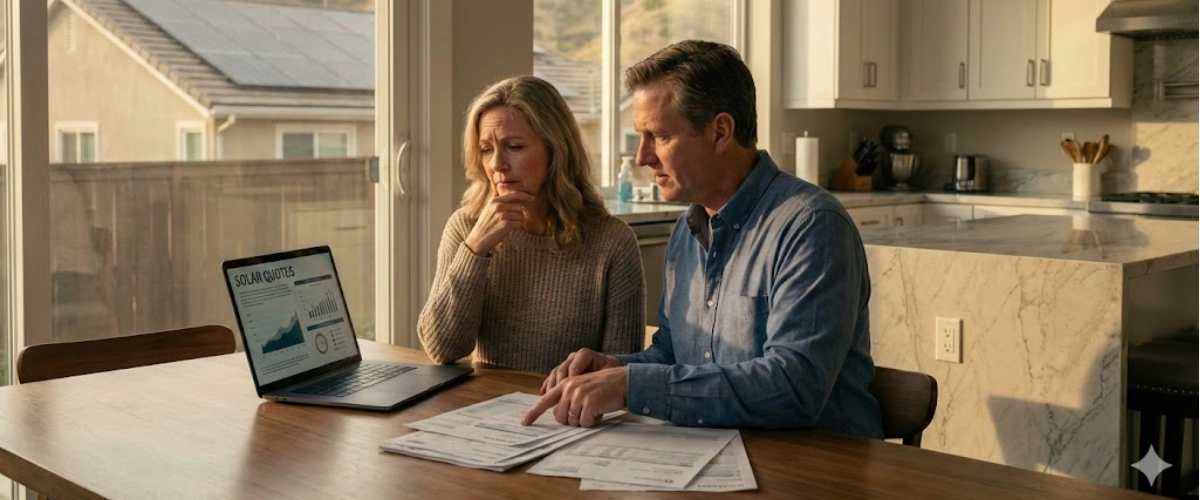
You Missed the December 31 Deadline—Now What?
If you're reading this in early 2026, you probably know the feeling. That nagging regret about not pulling the trigger before December 31, 2025. You watched neighbors scramble to get their panels installed before the deadline. You saw Reddit threads full of homeowners racing to beat the clock. And now? The 30% federal solar tax credit is gone.
For a typical Southern California solar system, that credit was worth $6,000 to $9,000. Real money that would've made the investment easier to swallow. But here's the thing nobody's talking about: the disappearance of the tax credit doesn't mean solar stopped making financial sense. In fact, for many Southern California homeowners, the math is more compelling than ever—you just have to understand the new equation.
The Tax Credit Anxiety That Gripped Southern California
The end of 2025 was chaotic for the solar industry. Installers worked weekends and holidays. Homeowners paid rush fees. Some systems were thrown together just to make the deadline. The Reddit solar forums were full of people asking: "Do the panels need to be turned on by December 31?" "What if interconnection is delayed?" "Will I lose the credit?"
That anxiety was real. For many families, $8,000 was the difference between "yes" and "not yet." But now that the deadline has passed, a different reality is settling in. The people who installed in December 2025 got the credit. The people who waited are wondering if they missed their chance.
Why Thousands of Homeowners Are Asking This Question Right Now
Southern California Edison (SCE) doesn't care about tax policy. Neither does PG&E. Your electric bill in January 2026 is going to be just as high as it was in December 2025—probably higher. SCE rates have increased 83% over the past 10 years. That's not slowing down. In fact, residential rates are projected to rise by another 5% annually through 2028.
So while you're mourning the lost tax credit, you're also paying 34.5 cents per kilowatt-hour for electricity. And when peak hours hit (4-9 PM), you're paying up to 58 cents per kWh. Without solar, a typical Southern California household is spending $210 to $240 per month on electricity. Over 25 years, that's $63,000 to $72,000—and that's assuming rates don't climb faster than projected.
The Brutal Truth About Solar Costs in 2026
Let's be honest about what you "lost" when the tax credit expired. The average 7 kW solar system in Southern California costs about $22,600 before incentives. The 30% tax credit would've reduced that to $15,820. That's a $6,780 difference. It hurts, but it's not the end of the story.
What That 30% Tax Credit Actually Meant (In Dollars)
Here's the breakdown for typical system sizes:
- 5 kW system: $17,150 → $12,005 with credit (saved $5,145)
- 7 kW system: $22,600 → $15,820 with credit (saved $6,780)
- 10 kW system: $31,400 → $21,980 with credit (saved $9,420)
Those are real numbers, and yes, they sting. But consider this: even without the credit, the 7 kW system costs less than three years of your current electric bills. And unlike your utility bills, which keep rising forever, your solar system has a fixed cost. You pay once, and then you're done (aside from minimal maintenance).
How SCE Rate Increases Change the Equation
This is where the math gets interesting. SCE's average residential rate is now 34.5 cents per kWh as of January 2026. Five years ago, it was 19 cents. That's an 82% increase. And according to the California Public Utilities Commission (CPUC), rates are expected to continue climbing at 5-7% annually due to wildfire mitigation costs, grid upgrades, and infrastructure modernization.
What does that mean for you? Every year you wait, your baseline cost goes up. If you spend $240/month on electricity today, you'll spend approximately $252/month next year, $265/month the year after, and so on. Over 25 years, that compounds into $80,000+ in utility payments—money you'll never get back.
Meanwhile, solar locks in your electricity cost. Once you install, your "rate" is whatever you paid divided by 25 years of production. For most systems, that works out to 8-12 cents per kWh—less than half of SCE's current rates, and a fraction of what rates will be in 2030 or 2035.
For a deeper analysis of how SCE's rate structure impacts your monthly bill, check out our guide on understanding Southern California electricity rates.
Why Solar Math Still Works—Even Without Federal Incentives
The disappearance of the tax credit didn't change the fundamental economics of solar. It just changed the payback timeline. Under the old system with the 30% credit, most Southern California homeowners broke even in 5-7 years. Without the credit, you're looking at 7-10 years. But after that? The next 15-20 years are pure savings.
Factory-Direct Pricing Can Offset the Lost Credit
This is where US Power's model makes a real difference. As an exclusive QCells partner with factory-direct pricing, we're able to offer systems 15-20% below typical market rates. On a 7 kW system, that's a savings of $3,400 to $4,500—which recovers about two-thirds of the lost tax credit.
Think about it: the average solar installer in California charges $3.14 per watt. At US Power, our factory-direct QCells pricing brings that down closer to $2.50-$2.75 per watt. For a 7 kW system, you're looking at $17,500 to $19,250 instead of $22,000. That's a $4,750 difference right out of the gate.
Combine that with the fact that QCells panels are American-made with a 25-year comprehensive warranty (covering panels, workmanship, and performance), and you're getting premium quality at a discount. In 2026, that matters more than ever.
Your Electric Bill Doesn't Care About Tax Policy
Here's the uncomfortable truth: while you're deciding whether solar is "worth it" without the credit, SCE is raising rates again. January 2026 rates are up. Summer 2026 rates will be higher. By 2027, you'll be paying even more. Every month you delay is another month of paying full retail rates for electricity.
Let's do the math. A typical Southern California household uses about 600 kWh per month. At 34.5 cents per kWh, that's $207 per month, or $2,484 per year. Over 10 years, that's $24,840. Over 25 years, it's $62,100—and that assumes rates stay flat, which they won't.
A 7 kW solar system that costs $19,000 (with factory-direct pricing) will produce approximately 10,500 kWh per year in Southern California. That offsets $3,622 in annual electricity costs at current rates. Payback period: 5.2 years. After that, you're saving $3,622 every year for the next 20 years. Total savings: $72,440.
Even without the tax credit, that's a 281% return on investment over 25 years. Show me a savings account or index fund that can match that.
Want to see your specific numbers? Use our solar savings calculator to calculate your personalized ROI based on your actual electricity usage and roof specifications.
What Changed (and What Didn't) After the Tax Credit Ended
The federal solar investment tax credit (ITC) expired on December 31, 2025 as part of the One Big Beautiful Bill (OBBB). Systems installed on or after January 1, 2026 are no longer eligible for the 30% credit. That's the bad news. The good news? Almost everything else stayed the same.
Rising Utility Rates Are Your New "Incentive"
The real incentive for going solar in 2026 isn't a government rebate—it's the fact that utility rates keep climbing. SCE's residential rates increased 13% in October 2025 alone. Over the past three years, rates have risen 25%. And with ongoing wildfire mitigation costs, grid hardening projects, and infrastructure upgrades, the CPUC has approved rate increases through 2028.
Think of it this way: every time SCE raises rates, the value of your solar system increases. If you install today at 34.5 cents per kWh and rates climb to 40 cents in three years, your savings accelerate. Your payback period actually shortens because the electricity you're not buying from SCE is worth more.
This is the hidden benefit of solar that nobody talks about. You're not just saving money at today's rates—you're insulating yourself from decades of future rate hikes. And in California, where rates have doubled in the past decade, that protection is worth more than any tax credit.
Battery Storage Under NEM 3.0: More Critical Than Ever
California's Net Energy Metering 3.0 (NEM 3.0) policy went into effect in April 2023, and it fundamentally changed the solar equation. Under the old NEM 2.0 rules, you got full retail credit for every kilowatt-hour you sent back to the grid. Under NEM 3.0, export credits are worth about 75% less.
What does that mean for you? Solar-only systems are less attractive than they used to be. But solar-plus-battery systems are more valuable than ever. With a battery, you can store excess solar production during the day and use it during expensive peak hours (4-9 PM) when SCE charges 58 cents per kWh. You're not sending cheap power to the grid—you're using it to avoid buying expensive power.
Battery attachment rates in California have surged from 11% in 2022 to over 50% in 2024. That's not a coincidence. Under NEM 3.0, batteries turn solar from a "nice to have" into a "this actually makes sense." And in 2026, without the tax credit cushion, batteries are essential for maximizing your return on investment.
Typical battery costs range from $10,000 to $15,000 for a system that stores 10-15 kWh. Yes, that's an additional expense. But the payback on solar-plus-storage under NEM 3.0 is actually shorter than solar-only systems in many cases—typically 7-8 years instead of 8-10 years. The battery lets you arbitrage SCE's time-of-use rates, which means bigger savings.
If you're confused about how NEM 3.0 works and why batteries matter, our comprehensive NEM 3.0 guide for California homeowners breaks down the policy changes and battery strategies in plain English.
How US Power Keeps Solar Affordable in 2026
Without the tax credit, every dollar matters. That's why US Power's factory-direct model isn't just a nice perk—it's the difference between "this works" and "this doesn't work" for a lot of families.
QCells Factory-Direct Pricing: 15-20% Below Market
Most solar companies mark up equipment by 30-50% to cover overhead, sales commissions, and profit margins. US Power's exclusive partnership with QCells eliminates the middleman. You're buying American-made panels at factory-direct prices, which means 15-20% savings compared to typical installers.
On a 7 kW system, that's the difference between paying $22,600 and paying $18,000-$19,000. That $3,600 to $4,600 savings doesn't just make solar more affordable—it directly shortens your payback period. Instead of waiting 9 years to break even, you're looking at 6.5-7 years. That's huge.
And it's not like you're sacrificing quality to save money. QCells panels are consistently rated among the top performers in independent testing. They're built in the United States with higher quality control standards than most imported panels. The 25-year warranty covers everything—panels, workmanship, and performance guarantees. You're getting premium equipment at a discount, which is exactly what you need in a post-tax-credit world.
Financing Options That Make Sense Without the Credit
In 2025, a lot of homeowners financed their solar systems expecting to use the tax credit as a lump-sum payment to reduce the loan balance. That strategy is gone. But financing still makes sense—you just need smarter loan terms.
US Power works with lenders who understand the 2026 landscape. Instead of high-interest solar loans with hidden fees, we connect you with options like:
- Home equity loans: Often 6-8% APR with no origination fees. Your interest is tax-deductible, and you own the system outright.
- PACE financing: Property Assessed Clean Energy (PACE) loans are available in many California counties and attach to your property tax bill. Rates are competitive, and if you sell your house, the loan transfers to the new owner.
- Credit unions: Many local credit unions offer "green energy loans" at better rates than private solar lenders.
The key is avoiding loans with 2-3% dealer fees or teaser rates that balloon after two years. With the tax credit gone, you can't afford to throw away $1,500 in fees. We're transparent about costs because in 2026, you need to see every dollar.
Even with financing, the math works. Let's say you borrow $19,000 at 7% for 15 years. Your monthly payment is $171. If you're currently paying $210/month to SCE, you're saving $39/month from day one. And in year 16, when the loan is paid off, you're saving the full $210/month (adjusted for rate increases) for the next 10-15 years.
Learn more about solar financing options and payment plans that work in the post-tax-credit landscape, including our partnerships with low-rate lenders.
Should You Wait for New Incentives or Act Now?
One of the most common questions we're hearing in 2026 is: "Will the tax credit come back?" The short answer is: nobody knows. The longer answer is: waiting probably costs you more than acting now.
California State Programs Still Available
While the federal tax credit is gone, California still offers some incentives:
- SGIP (Self-Generation Incentive Program): Battery storage rebates of $150-$250 per kWh for SCE, PG&E, and SDG&E customers. For a 13 kWh battery, that's $1,950-$3,250 back. SGIP funding is limited and gets depleted every year, so if you're adding a battery, apply early.
- Property tax exclusion: California law excludes the added value of your solar system from property taxes, which saves you money every year.
- Local utility rebates: Some municipal utilities and community choice aggregators offer small rebates for solar or battery installations. Check with your local utility.
These aren't as generous as the 30% federal credit, but they help. And unlike the federal credit, which required tax liability, these programs are often direct rebates or ongoing savings.
The Cost of Waiting (Rising Rates + Rising Equipment Costs)
Here's what happens if you wait another year hoping for a new incentive:
- You pay $2,500-$3,000 more to SCE in 2026 electricity bills.
- SCE raises rates again in 2027, increasing your annual cost.
- Solar equipment prices may increase due to tariffs or supply chain issues.
- You miss a full year of solar production, which is worth $3,500-$4,000 in offset electricity.
Even if Congress reinstates a 20% tax credit in 2027 (which is far from guaranteed), you've already lost $6,000-$7,000 in cumulative costs. You'd need a 35% credit just to break even on the delay. That's not happening.
The reality is that every month you wait, you're betting that a future incentive will outweigh the money you're spending on electricity today. That's a bad bet. The guaranteed savings from installing now are worth more than the hypothetical savings from waiting for a program that might never come.
The Best Time Was Yesterday. The Second-Best Time Is Now.
Yes, you missed the tax credit. That stings, and there's no way to sugarcoat it. But here's what you didn't miss: the 25+ years of rising SCE rates that are coming whether you have solar or not. You didn't miss the opportunity to lock in predictable energy costs. You didn't miss the chance to stop writing $200-$300 checks to your utility every month.
The homeowners who installed solar in December 2025 got a great deal. But the homeowners who install in 2026 with factory-direct pricing, smart financing, and a clear understanding of NEM 3.0 battery strategies? They're still getting a great deal. It's just a different calculation.
Solar in 2026 isn't about chasing incentives. It's about math. And the math says that spending $18,000-$20,000 today to save $60,000-$75,000 over 25 years is a good investment—tax credit or not. Especially when you consider that utility rates aren't getting cheaper, equipment costs might rise, and every month you wait is another month of paying full price for electricity.
The tax credit deadline created urgency. Now that it's gone, the urgency comes from a simpler truth: every month without solar is another month of unnecessarily high electric bills. The question isn't whether you should have installed in 2025. The question is whether you're willing to keep overpaying for electricity in 2026, 2027, 2028, and beyond.
Frequently Asked Questions
How much more expensive is solar without the tax credit?
What's the payback period now?
Are there any California state incentives left?
Should I wait to see if the credit comes back?
Is financing still a good option?


Is DIY Solar Worth It in 2025? Legal Rules & Costs Explained
California’s 2025 guide to safe, legal, and cost-effective solar installation.

The Overlooked Costs of Solar Ownership in California
Understand how to manage and minimize your ongoing solar costs in California.
Debunking the Solar “Cost Shift” Myth in California
Clarifying the truth about solar cost shifts and who really pays in California.








Copyright © 2025 US Power - Axia by QCells. All Rights Reserved.

Get an instant solar estimate using satellite!