




Can You Charge a 12V Battery with a Solar Panel?

Wondering if you can charge a 12V battery with any solar panel? The answer involves understanding voltage compatibility, charge controllers, and why professional installation matters for California homeowners.
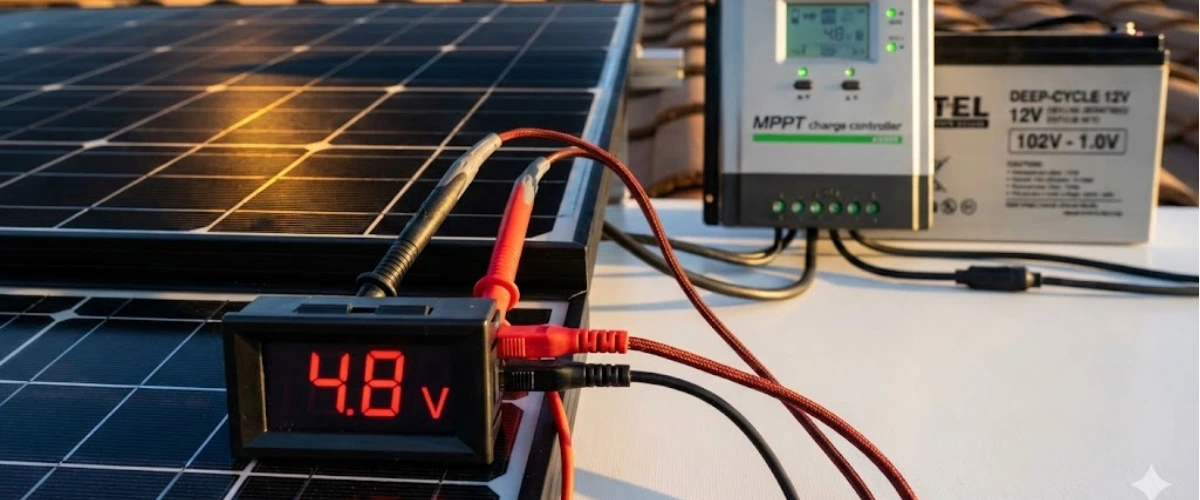
You've just bought a solar panel and a battery. The panel says 48 volts, the battery says 12 volts. Can you connect them? Technically yes, but you'll waste most of your power and potentially destroy your battery in the process.
This might seem like a small-scale DIY problem, but it reveals something critical about residential solar systems in California. The relationship between solar panel voltage and battery voltage affects every homeowner considering solar, especially under NEM 3.0 where battery storage is essential under NEM 3.0.
If you're researching solar for your Southern California home, understanding how voltage compatibility works can save you thousands of dollars and prevent costly mistakes during installation.
Understanding Solar Panel Voltage vs Battery Voltage
Here's what happens when you connect a 48V solar panel directly to a 12V battery: the panel's voltage drops to match the battery, but the power output plummets. You'll only capture about 25% of the panel's rated capacity.
Think of it like trying to fill a bathtub with a fire hose. The pressure is too high, the flow is uncontrolled, and most of the water ends up on the floor instead of where you need it.
The Voltage Mismatch Problem
Solar panels generate DC power at specific voltages. Residential panels typically operate at 30-40 volts, while commercial or specialized panels can reach 48 volts or higher. Meanwhile, battery banks come in standard configurations: 12V, 24V, or 48V.
When voltage doesn't match, you need equipment to bridge the gap. Without it, you're essentially throwing away the majority of your solar investment.
Why This Matters for California Homeowners
Your residential solar system faces the same voltage matching challenges, just at a larger scale. The panels on your roof generate DC power at one voltage, but your home runs on 120/240V AC power. Your battery storage system operates at yet another voltage.
Professional installation ensures every component works together efficiently. Understanding your home's energy needs helps determine the right combination of panels, inverters, and batteries.
How Charge Controllers Protect Your Investment
The solution to voltage mismatch is a charge controller. This device sits between your solar panels and battery, regulating the charging process and protecting against overcharging.
Two types of charge controllers exist, and the difference between them determines how much of your solar power you actually use.
PWM Controllers: The Budget Option with Hidden Costs
Pulse Width Modulation (PWM) controllers are the cheaper option, sometimes costing as little as $10-30 for small systems. They work by rapidly switching the connection between panel and battery on and off, maintaining safe voltage levels.
The problem? PWM controllers can't transform voltage efficiently. If your panel voltage is four times your battery voltage, you're still only using about 25% of available power. The rest is wasted as heat.
MPPT Controllers: Maximum Power, Maximum Efficiency
Maximum Power Point Tracking (MPPT) controllers cost more upfront but deliver dramatically better results. These sophisticated devices continuously adjust to extract maximum power from your panels, then convert that high-voltage power to the lower voltage your battery needs.
With an MPPT controller, you can capture close to 100% of your panel's rated output. The efficiency gain often means charging four times faster than with a PWM controller.
For residential solar systems, this same principle applies to how solar batteries maximize your savings. Professional-grade inverters and charge management systems ensure you get every watt of power you're paying for.
Why Residential Solar Systems Need Proper Equipment
The voltage compatibility issue isn't just about hobbyist solar projects. Every residential installation requires careful attention to voltage specifications across all components.
The NEM 3.0 Reality in California
Under California's NEM 3.0 billing structure, homeowners receive significantly less credit for excess solar power sent to the grid. This makes battery storage almost mandatory for meaningful savings.
But adding batteries introduces new complexity. Your solar panels, inverter, charge controller, and battery bank must all work together seamlessly. A mismatched system can result in:
- Reduced charging efficiency (losing 25-75% of production)
- Premature battery failure from improper charging
- Inability to power your home during outages
- Voided equipment warranties
Learning about solar batteries and how they work helps you understand why professional system design matters.
The Hidden Cost of DIY Solar
Many homeowners are tempted by the apparent savings of DIY solar installation. The equipment seems straightforward: panels, batteries, some wiring. How hard could it be?
The answer: very hard when you factor in voltage matching, electrical code compliance, permit requirements, and utility interconnection standards.
A professional installer handles all of these details, ensuring your system delivers the promised performance. US Power's CSLB-licensed installers have completed thousands of installations across Southern California, avoiding the common pitfalls that plague DIY projects.
What US Power Does Differently: Professional System Design
When you work with US Power, every component is selected and sized for optimal compatibility. There's no guessing about voltage requirements or charge controller specifications.
American-Made QCells Technology
US Power is the exclusive QCells partner in Southern California, offering American-made QCells solar panels manufactured in Dalton, Georgia. These panels are engineered to work seamlessly with QCells battery systems and industry-standard inverters.
Every system includes:
- High-efficiency panels optimized for Southern California sun exposure
- Smart inverters that handle voltage conversion and grid connection
- Integrated battery management for safe, efficient charging
- 25-year comprehensive warranty covering panels, workmanship, and performance
The Installation Timeline Advantage
While other companies take 3-6 months to complete installations, US Power's streamlined process gets you from consultation to power production in just 3-6 weeks after approval. This efficiency comes from experience and choosing the right solar company that handles every detail correctly the first time.
Common Mistakes Homeowners Make When Choosing Solar
Understanding voltage compatibility is just one piece of the solar puzzle. Here are other critical mistakes to avoid common solar installation mistakes:
Undersizing the System
Many homeowners try to save money by installing a smaller system than they actually need. This backfires when:
- Rising electricity rates increase consumption costs
- Electric vehicle charging demands more power
- Home additions or new appliances exceed system capacity
Proper system sizing accounts for current needs and reasonable future growth.
Choosing Price Over Quality
The cheapest solar quote often comes with budget equipment, subpar installation practices, and limited warranty coverage. Equipment failures can cost thousands to repair, erasing any initial savings.
US Power's factory-direct pricing delivers professional quality at competitive rates. You don't have to choose between affordability and reliability.
Ignoring Battery Storage
Under NEM 3.0, solar-only systems leave significant savings on the table. Without batteries, you're forced to sell excess midday production for pennies and buy evening power at premium rates.
A properly sized battery captures your solar production and delivers it when electricity rates are highest, maximizing your return on investment.
Sizing Your Solar System Correctly
Just as you need the right charge controller for voltage compatibility, you need the right system size for your home's energy needs.
Calculating Your Power Requirements
Start by reviewing your SCE or other utility bills from the past 12 months. Look for:
- Total kilowatt-hours (kWh) consumed per month
- Peak usage times (when rates are highest)
- Seasonal variations (summer AC vs winter heating)
Most Southern California homes use 800-1,200 kWh per month. A properly sized solar system should offset 90-100% of this usage.
The Battery Sizing Question
Battery capacity depends on several factors:
- How much backup power you want during outages
- Your evening electricity consumption
- Whether you plan to charge an electric vehicle overnight
Most homeowners benefit from 10-20 kWh of battery storage, though larger homes or EV owners may need more.
Working with experienced installers ensures your system has room to grow without requiring expensive upgrades later.
Your Next Steps: Getting Started with Professional Solar
The voltage compatibility question that started this article illustrates a larger truth: solar installation requires expertise at every level, from component selection to system design to electrical integration.
Why December 2025 Matters
The Federal tax credit expires December 31, 2025, dropping from 30% to 0% overnight. This represents thousands of dollars in savings that won't be available in 2026.
With US Power's 3-6 week installation timeline, you still have time to complete your project and claim the full credit—but you need to start now.
The US Power Advantage
When you choose US Power, you get:
- Free consultation (virtual or on-site)
- Transparent pricing with no hidden fees
- Factory-direct QCells equipment
- CSLB-licensed professional installation
- 25-year comprehensive warranty
- 3-6 week installation timeline
Every system is custom-designed for your home's specific needs, with proper voltage matching, electrical code compliance, and utility interconnection handled by experienced professionals.
Make Your Wise Decision for 2026!
The question "Can you charge a 12V battery with a 48V solar panel?" reveals fundamental principles that apply to every solar installation. Voltage compatibility, proper equipment selection, and professional system design determine whether your solar investment delivers promised savings or becomes a costly disappointment.
For Southern California homeowners considering solar, the stakes are even higher under NEM 3.0. Without proper battery integration and system optimization, you'll miss out on the financial benefits that make solar worthwhile.
US Power's factory-direct QCells partnership, experienced installation teams, and comprehensive warranties ensure your system delivers maximum value for decades to come. With the federal tax credit expiring in just weeks, now is the time to take control of your energy costs.
Get your free consultation today and discover what a professionally designed solar system can do for your home and your budget.
Frequently Asked Questions
Can I use any solar panel with any battery?
How do I know if my solar system is properly sized?
What happens if I don't use a charge controller?
Is professional installation worth the cost?
How long does a properly installed solar system last?


California SGIP Rebates for Home Batteries
Up to $1,100 per kWh in rebates for eligible SoCal homeowners installing batteries.
Should You Expand Your Solar Panels or Add a Battery
Solar panels or battery? Learn which saves you the most money with the right setup.
Power Your Home & EV with Solar Before Incentives Slip Away
Charge your EV and cut bills with solar + battery with Qcells and US Power.








Copyright © 2025 US Power - Axia by QCells. All Rights Reserved.

Get an instant solar estimate using satellite!